the key keeps finding her
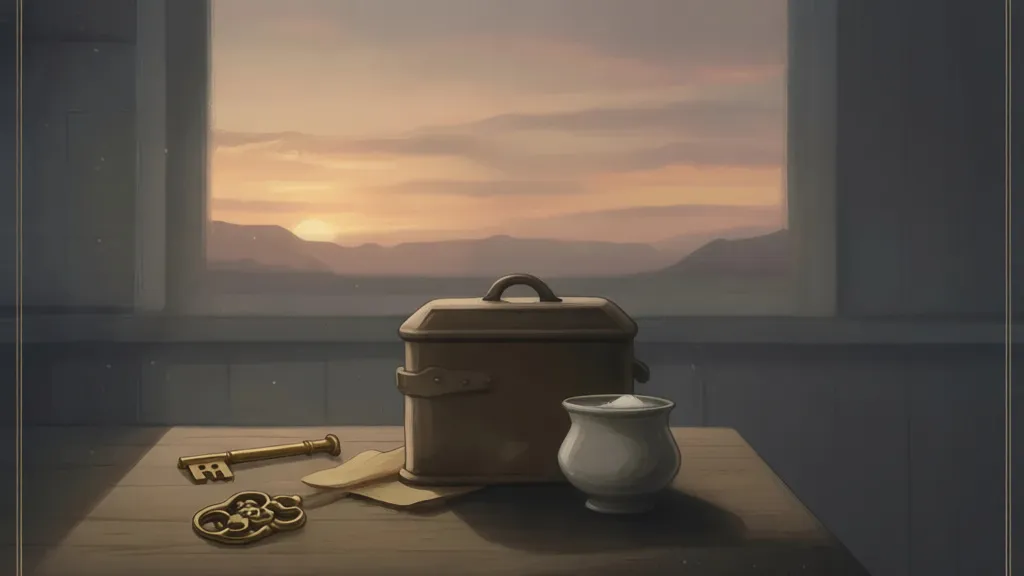
The bread box first.
She is reaching for the heel of the sourdough — the last of the loaf she bought the morning before the funeral, still wrapped in its paper sleeve — and the key is there. Brass. The teeth facing up. She holds it in her palm for eleven seconds before she puts it in her coat pocket, and she does not think about it again until she is thinking about it again, which is immediately, which is the rest of the day.
His name was Eli. She keeps almost saying is.
Tuesday. Under the sugar bowl.
She lifts the bowl to refill it — the bag of sugar is on the counter, already open, already tipped on its side because she set it down wrong when she came back from the store, and there is sugar on everything now, a fine grit under her bare feet — and the key is there.
Same key. Brass. She checks her coat pocket. The pocket is empty.
She puts the key back in her pocket.
She does not refill the sugar bowl. She stands in the kitchen with the grit under her feet and the bag still on its side, and she waits. For what. She doesn't know. Something to explain itself.
Things she has already let go:
- His phone. Wiped and donated, the man at the counter pulling it from the box without looking up.
- Three bags of clothes. The donation center was closed so she left them by the door. She drove past the next day and they were gone, which was good, which was what she wanted, except one of the bags had the flannel he wore every Sunday and she hadn't meant to include it.
- His voicemail greeting. She called his number nine days after. The number had already been reassigned. A woman answered and said hello? twice and then hung up.
- The smell of his apartment. Gone by the third day she was cleaning it. She had left the windows open.
Wednesday. The key is in the cuff of his raincoat.
The raincoat is still hanging by her front door. She brought it home from his apartment because it was raining the day she cleaned out his closet, and she needed a coat, and his was there. She has not moved it since. It hangs on the hook like it is waiting for someone to come back for it.
She finds the key when she reaches into the pocket for a tissue. Not the pocket — the cuff. Folded into the turned-up cuff of the left sleeve, the way you might hide something small and important if you wanted to keep it close.
She checks her coat pocket again. Empty again.
She does not believe in ghosts. She wants to be clear about this.
She believes in forgetting. In the way grief makes the hands unreliable, makes you set things down in places you would never set them. She believes in the ordinary failure of attention. She believes she is putting the key somewhere and not remembering.
This is the rational explanation, and it is probably true, and it does not help at all.
Thursday. A knock.
The courier is young — maybe twenty, maybe less — and he holds the envelope out like it is nothing, like it is not addressed in Eli's handwriting, the sharp downward slant of the M in Mara, the way he always wrote her name like it was falling off a ledge.
She signs for it. The courier leaves. She stands in the doorway.
The envelope is sealed. No return address. Postmarked five days ago — two days before the funeral. He must have mailed it. He must have walked to the post office, or handed it to someone, or — she doesn't know. She doesn't know what his last week looked like. She has been trying not to reconstruct it.
Inside: a receipt. A storage unit. Facility name she doesn't recognize. Unit 14. Monthly rental. Paid through the end of October.
No note. No explanation.
Just the receipt, folded once.
She calls the facility. A man answers. She gives the unit number.
"And you are?"
"His sister."
A pause. She can hear him typing.
"We'll need proof of—"
"I have the key," she says.
She doesn't know why she says it. She doesn't know that the key fits. But she says it, and the man on the phone says, "Okay. We close at nine but the gate code is on the receipt."
She looks at the receipt. There is a four-digit code written in pencil at the bottom. Not Eli's handwriting. Someone else's.
She waits until dark. She doesn't know why this either.
The facility is on the east side of the city — the city she has lived in for eleven years without ever feeling like she lives in it. She parks under a light that flickers. The gate code works. The hallway is long and fluorescent, the kind of light that makes everything look like evidence.
Unit 14 is at the end. A metal door. A padlock.
She takes the key from her coat pocket.
It fits.
She has brought a flashlight and a paper grocery bag. The flashlight because she doesn't trust the overhead light in a storage unit. The bag because — she doesn't know. Because she might want to take something. Because she might want to carry something out.
The overhead light works. She uses the flashlight anyway. It makes the space smaller, controllable. A circle of attention she can move.
The unit is ten by ten. Maybe smaller.
Boxes. Twelve, maybe fourteen. Cardboard, taped shut, unmarked. A rolled-up rug she doesn't recognize. A floor lamp with no shade. A filing cabinet, two drawers, both closed.
She stands in the doorway for a long time.
The problem is not what is in the boxes.
The problem is that he had a life she did not ask about. That he packed parts of it into cardboard and brought them here and paid monthly to keep them in the dark and never mentioned it. That she never asked what he was keeping. That she never asked what he was afraid of losing. That the distance between them was not dramatic — was not a fight, was not a silence, was not a falling-out — was simply the ordinary drift of two people who loved each other and forgot to pay attention.
She saw him every few weeks. They ate together. They talked about the news, about the city, about their mother's hip and whether she should move to a smaller place. They did not talk about the inside of his life. She did not ask, and he did not offer, and neither of them was wrong, and both of them were.
She opens the first box.
Books. Paperbacks mostly. Science fiction — she didn't know he read science fiction. The spines are cracked. He read these more than once. She picks one up. The Left Hand of Darkness. She has heard of it. She has never read it. She puts it in the grocery bag.
Second box. Photographs.
Not in albums. Loose, in a shoebox inside the cardboard box, like he meant to organize them and never did. She recognizes some: the two of them on the porch of the house they grew up in, her maybe eight, him maybe twelve, both squinting. Their mother at a table she doesn't remember. A dog she doesn't remember. A birthday cake — whose?
Others she doesn't recognize. People she has never seen. A man in a blue jacket, laughing. A woman asleep on a couch with a book open on her chest. A group at a restaurant, candles on the table, everyone mid-sentence.
His friends. His life. The rooms she was not in.
She puts the shoebox in the bag.
Third box. She stops.
She is kneeling on the concrete floor of a storage unit at nine-thirty on a Thursday night with a flashlight in one hand and a photograph of a stranger in the other, and she realizes she is afraid.
Not of what she will find. Of what she has already missed.
Every box she opens is a measure of the distance. Every object she doesn't recognize is proof that she was not paying attention. And the worst part — the part that makes her set the photograph down and sit back on her heels and press her palms flat against her thighs — is that he was right here. He was in the same city. He was twenty minutes away. She could have asked him anything.
She opens the third box.
Letters. Dozens. Handwritten, in envelopes, addressed to people she doesn't know. All sealed. All stamped. Never mailed.
She picks one up. The name on the front means nothing to her. The return address is his.
She does not open it.
She puts it back in the box and closes the flaps.
Here is what grief actually is: it is not the loss. It is the inventory of everything you did not know you were losing while you still had it.
She opens five more boxes that night. She does not open them all.
She finds: a chess set with two pawns missing. A winter coat she remembers — dark green, the zipper broken, she was with him when he bought it, she was sixteen and impatient and waiting outside the store. A stack of notebooks. A compass. A mug with no handle. A pair of shoes still in their box, never worn.
She puts the green coat in the bag. She holds the mug for a while. She puts it back.
The notebooks she does not open.
She picks one up. She holds it. She can feel the weight of the pages, the slight warp of paper that has been written on. She imagines his handwriting inside — the same sharp slant, the M falling off its ledge, all the words she will never hear him say aloud.
She puts it back.
Not yet.
There are four boxes she does not open at all. They are at the back, stacked against the wall, and she looks at them and understands that she can come back. The rent is paid through the end of the month. She has time. She does not have to know everything tonight.
This feels like the truest thing she has understood in weeks.
She locks the unit. The key turns easily, like it has always known her hand.
She carries the grocery bag to the car. Inside: six paperbacks, a shoebox of photographs, a green coat with a broken zipper. The weight of it is ordinary. She sets it on the passenger seat.
She sits in the car with the engine off.
The parking lot is empty. The light above her flickers and steadies. She can see her breath.
She will come back Saturday. She decides this in the car, in the dark, with the grocery bag beside her like a passenger. She will come back and she will open the notebooks and she will read his handwriting and she will learn things about her brother that she should have learned while he was alive.
And then she will come back again. And again. Until the rent runs out or until she has opened everything or until she understands that opening everything will not bring him closer, will only make the shape of his absence more precise.
She reaches into her coat pocket. The key is there.
She takes it out. Holds it in her palm. Brass. The teeth pressing into her skin.
She puts it back.
It stays.
On the drive home she passes his street. She does not turn. The windows of his apartment are dark — someone else's apartment now, someone else's dark. She drives past at the speed of traffic, and she does not slow down, and she does not look away, and both of these things are true at the same time, the looking and the not-looking, the way you can hold two things in one hand if you are willing to let them press against each other.
The bread box is empty when she gets home. She sets the grocery bag on the kitchen table. She hangs his raincoat back on the hook by the door.
She leaves the key in her pocket.
She goes to bed with the light on and the sugar still on the floor and the envelope still open on the counter, and she sleeps without dreaming, which is its own kind of mercy, which is not the same as peace but is, for now, enough.