the loaf she kept behind the ice
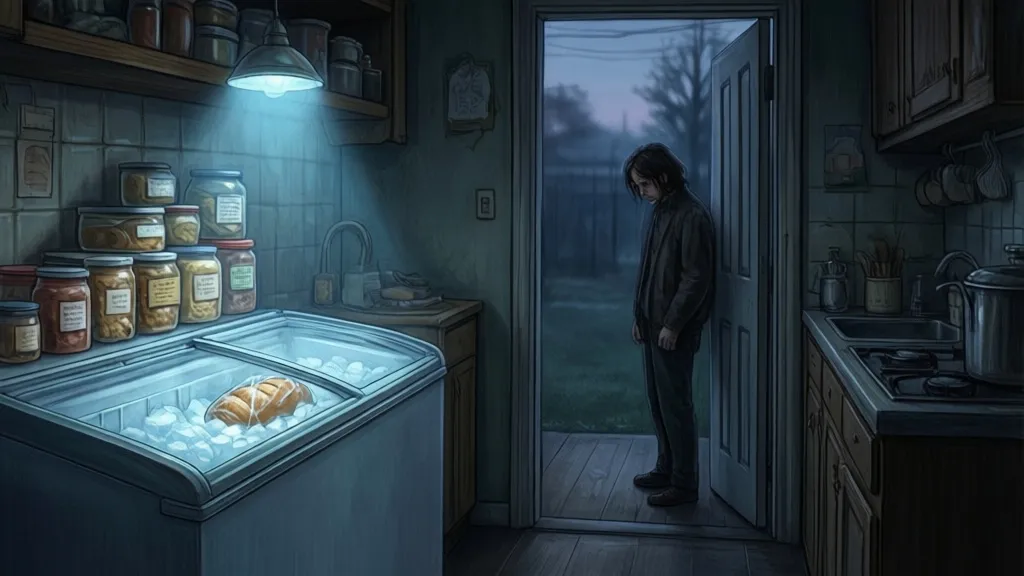
The freezer hums like it has always hummed. Like it will hum after her. Like humming is its entire theology.
She stands in the kitchen doorway with a roll of trash bags and a pair of rubber gloves her mother would have called excessive.
The peas first.
Labeled in her mother's handwriting—garden, July—though there is no garden, has never been a garden, only a balcony with a ceramic pot that held, at various times: mint, cigarette butts, a finch's nest made from dryer lint.
Garden, July. As if naming it could make it so.
She drops the bag into the trash. Then retrieves it. Then drops it again.
Broth. Three containers, each dated. The oldest is from fourteen months ago. The newest is from six weeks before. Six weeks before what. She does not finish the thought because finishing it would require a verb, and the verb would require a tense, and the tense would be wrong no matter which one she chose.
The broth goes.
The loaf.
Blackened, dense, wrapped in wax paper with a single strip of masking tape across the fold. No label. No date. It weighs more than bread should weigh. Frozen things always do—something about the water crystallizing, expanding, a physics she doesn't remember. She sets it on the counter. It begins to sweat immediately.
Behind the ice trays: a cassette tape.
Not hidden. Not placed. Stored. The way her mother stored everything—as if the apartment were an archive and she were both curator and sole visitor.
The tape is a Maxell UR-90. The label, in her mother's hand: for after.
No name. No date.
She holds it the way you hold something that might be empty.
The super knocks at 8:47.
"Just reminding," he says through the door. "Midnight. The whole unit goes dark."
"I know."
"You want I should prop the service elevator?"
"I don't have much."
He lingers. She can feel him lingering. People linger around the recently bereaved the way they linger around unlocked doors—drawn forward, then ashamed.
"Midnight," he says again, and goes.
Her mother's tape deck is still on the bedroom shelf, between a clock radio and a photograph of someone she has never asked about. A man in a pale shirt, standing beside a car that is mostly out of frame. Smiling at something to the left of the camera.
She plugs in the tape deck. Presses play.
Static. A long breath. Then:
—is it going? Okay. Okay.
So. Wednesday. The twelfth, I think. Or the eleventh. It doesn't matter.
I'm sitting in the park on Montrose, the one near the fountain that doesn't work. You were maybe three. Maybe four. You had the red shoes with the buckle you kept undoing. R was there.
She stops the tape.
R.
She does not press play again for six minutes. During those six minutes, the freezer hums, the loaf sweats, and outside, a siren passes with the long Doppler slide that means it is going somewhere else.
She presses play.
R brought those little sandwiches, the ones with the crusts cut off, and you wouldn't eat them because you said they were naked. You said that. Naked sandwiches. And R laughed so hard—you know that laugh, the one that sounds like it surprised them—and you crawled into R's lap and fell asleep.
I sat there watching. The fountain was off. It was always off. And R looked at me over your head, your hair all sweaty and flat against their neck, and said—
A pause. Long enough that she checks if the tape has ended.
Said: "This is what I would have wanted."
And I didn't ask what that meant. I should have asked what that meant.
She does not remember the park on Montrose.
She does not remember red shoes with a buckle.
She does not remember anyone called R.
Except.
Except that downstairs, in the lobby, the super mentioned someone waiting. "Friend of your mother's," he said when she arrived. "Been coming by all week. Sits in the lobby, reads. Doesn't bother anyone."
She hadn't asked. Hadn't wanted to know.
Now she wants to know.
I'm recording this because I won't say it to you alive. That's not—it's not courage, it's something else. It's that the saying would require your face to be doing something in response, and I can't control what your face does, and I don't want to have to see it and then decide what it means.
R was in my life for four years. R was—
No. I won't define it. Defining it is what ended it.
A sound. Not crying. Something drier. A swallow, maybe.
You knew R. You loved R. And then R was gone, and I told you nothing because you were four, and then you were five, and then you were thirty-seven, and the window for telling had become a wall.
The freezer's hum changes pitch. She notices it the way you notice a headache only once it stops—except this is the reverse. It is louder. The compressor working harder against the apartment's warmth, against the open drawers, against the absence of cold things to keep cold.
She looks at the counter. The loaf is softening. A dark watermark spreads across the wax paper like a bruise learning its edges.
She goes to the hallway. Opens the front door. Looks down the corridor toward the elevator.
Does not go to the lobby.
Closes the door.
The afternoon in the park. You had grass stains on both knees and R carried you home because you fell asleep, and I walked behind them watching your sandals hang off your feet, and I thought: I will remember this as the best afternoon. And I was right. I have remembered it as the best afternoon. For thirty-three years I have remembered it as the best afternoon, and you don't remember it at all, and R—
R remembers.
That's why I gave R the address.
The tape runs silent. Not dead—she can hear the ambient hiss, the room tone of her mother's bedroom recorded months or years ago. The sound of someone sitting with a microphone and deciding what not to say next.
9:14 PM.
She unwraps the loaf.
Inside the wax paper, inside the blackened crust that she now realizes is not rot but molasses—a dark bread, Eastern European, the kind sold at the place on Dearborn that closed in 2016—there is a small square of paper, folded twice.
The ink has bled. She can make out:
R's recipe. Do not
The rest is water.
The super knocks again at 9:30.
"Everything okay in there?"
"Yes."
"The person in the lobby is asking—"
"I know."
"Should I—"
"Not yet."
She hears him shift his weight from one foot to the other. She can picture the gesture—hands at his sides, the way men stand when they have been told to wait by a woman and don't know where to put their willingness.
"Not yet," she says again, softer.
I don't know if you'll find this. I don't know if the freezer will outlast me. I don't know if you'll play it. I don't know—
Here's what I know:
That afternoon happened. Your shoes were red. The sandwiches were naked. R's laugh surprised everyone, including R. And you slept with your mouth open against R's collarbone, and a pigeon walked through the fountain basin like it owned the place, and I was happy.
I was happy and I didn't tell you about it because happy is hard to explain to someone who needs you to have been something else.
The tape ends. Not with a click—the deck is old—but with a slow whir as the reel runs out, the hiss widening into silence the way a road widens into a field.
10:02 PM. The freezer is louder now. Something in the mechanism sounds effortful, strained, the way breathing sounds in the weeks before it doesn't.
The peas are in the trash. The broth is in the trash. The loaf sits open on the counter, thawing into something that smells like caraway and cold.
She puts the tape back in its case. Holds it.
She does not remember the park.
She does not remember the shoes.
But she remembers—she is almost certain she remembers—a laugh. A laugh that sounded surprised by itself. And a feeling of being carried, of height without effort, of someone's neck warm against her cheek.
She has never known where to put this memory. It has no scene around it. No face. Only the sensation of being lifted, and the smell of bread.
11:16 PM.
The freezer's hum stutters. Catches. Resumes, but quieter.
Water pools on the linoleum beneath it—slow, clear, almost formal, like a thing being returned.
11:41 PM.
She takes the elevator to the lobby.
The lobby is beige tile and a plastic fern and a bench near the mailboxes. On the bench: a person, reading, with a jacket folded beside them like a companion.
They look up.
She does not recognize them. She is certain of this. She does not recognize them at all. And still there is something—not the face, not the hands, not anything she can see—a quality of attention, the particular way they close the book without marking the page, as if they'd been waiting for exactly this interruption and no other.
They do not stand.
She does not sit.
The lobby light buzzes. The elevator doors close behind her with a sound like something agreeing to be finished.
"You're R," she says.
They nod.
"She told you to come."
"She asked me to wait."
The distinction lands. It lands and stays and she does not know what to do with it, so she stands there, in the lobby, holding a cassette tape and smelling of thawed bread, and R sits there, holding a closed book, and neither of them moves because moving would be a decision, and a decision would require knowing what this is, and neither of them knows what this is.
Upstairs, the freezer hums its last.
Midnight.
The lights do not go out all at once. First the hallway. Then the stairwell. Then the elevator panel blinks and dims.
The lobby stays lit a moment longer—some secondary circuit, a grace period, a thing the building does without being asked.
In that extra light, she sits down on the bench.
Not next to R. Near R.
The distinction, again.
R opens the book to no particular page. She sets the tape between them on the bench. The plastic casing ticks softly as it adjusts to the warmth.
Then the lobby light goes too, and they sit in the dark, and the dark is not symbolic, it is only dark, and in it she can hear R breathing the way a person breathes when they are trying not to breathe too loudly, and she thinks: so this is what she wanted me to find.
Not the tape. Not the loaf. Not the memory she can't recover.
This. The sitting. The almost-touching. The sound of someone else's breathing in a room where nothing needs to be said because the person who needed to say it already said it, on tape, from inside a freezer, in a voice that sounded like hers but wasn't.