the shape still cold from keeping
1
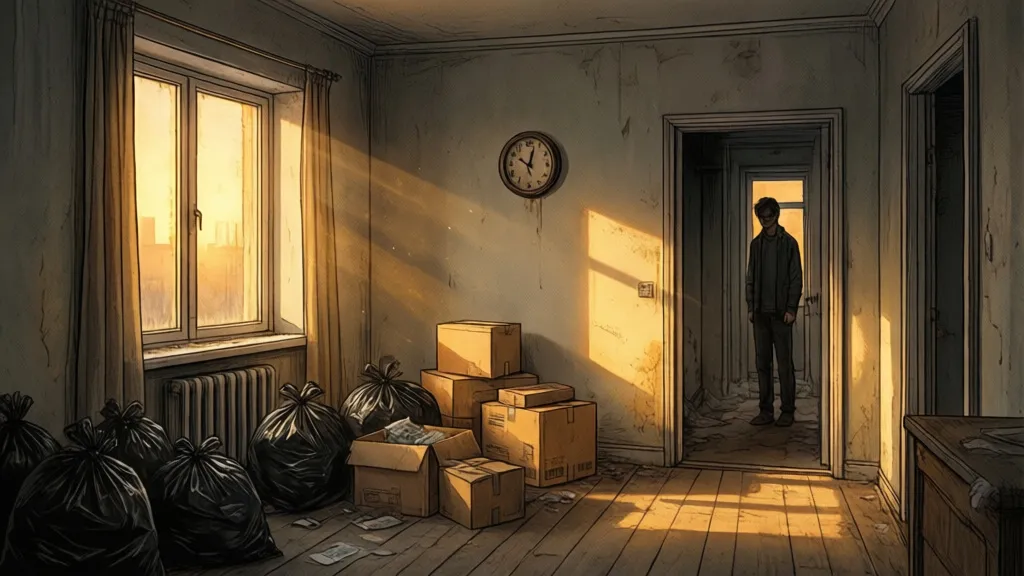
The clock on the wall has not been right since February. She knows this. It reads 2:47 but the light through the window says later — the particular amber of four o'clock in August, the sun already dropping behind the parking structure, already giving up.
She has been here since morning. She has filled eleven garbage bags and carried seven boxes down to the car and come back each time expecting the apartment to feel emptier, but it does not feel emptier. It feels the same. The same kitchen. The same hallway. The same particular way the floorboard near the bathroom door gives under the left foot.
The buyer is downstairs. She can feel him there like a low hum — sitting in his car, probably, running the air conditioning, scrolling through his phone. He has been patient. He was patient when she asked for an extra hour. He was patient when she called at noon and said just a little longer. He is a patient man, and she hates him for it, because it would be easier if he were pushing. If he were angry. If he knocked on the door and said I have a contract and she could be angry back, could slam something, could feel justified in how slowly she is moving through these rooms.
But he doesn't knock. He waits. And the clock says 2:47 and the light says later.
2
The kitchen is the last room.
She has been saving it, or avoiding it. The distinction does not matter. The kitchen is where her brother was most himself — not the bedroom with its careful stacks of paperbacks, not the living room with its one good chair and its silence. The kitchen. He cooked the way some people pray: frequently, attentively, with an earnestness that could embarrass you if you weren't careful.
She starts with the cabinets. They are mostly bare. She cleared the food weeks ago — the opened boxes of pasta, the expired cans, the spice jars with their handwritten labels in his small, precise print. Sumac. Aleppo. Urfa. She had stood in this kitchen holding a jar that said Urfa and had not known what it was and had not been able to throw it away and had taken it home and put it on her own shelf, where it still sits, unopened.
The cabinets hold only shelf paper now. Pale blue. She peels it up and finds, beneath it, a ring of dried something — coffee, maybe — in the shape of a mug's bottom. She stares at it. She leaves it.
3
The light above the sink buzzes.
Not steadily. It buzzes and pauses and buzzes again, as if it is trying to remember a word. She has been hearing it all day. She has tried ignoring it. She has tried turning it off, but the switch does nothing — the fixture is wired wrong, has been wired wrong for years. Her brother mentioned it once on the phone. The light above the sink has a mind of its own, he said, and she had said just call the landlord and he had said I don't mind it. It keeps me company.
She minds it. She minds it very much.
4
The freezer.
She has been looking at the freezer all day. Not directly. In the way you look at something you are not ready for — catching it in peripheral vision, noting its presence, turning back to something easier.
It is a small unit, under-counter, tucked beneath the row of cabinets like an afterthought. The door is frosted shut. Not frozen in the ordinary way — sealed, a thick lip of ice along the rubber gasket, white and deliberate, as if the freezer has made a decision about staying closed.
She pulls the handle. Nothing. She pulls harder. Her palm slips on the frost.
She finds a butter knife in the last drawer — the only thing left in it — and works the blade along the seal, chipping at the ice in small, careful strokes. The ice comes away in thin curls that fall to the floor and melt immediately in the heat. The apartment has no air conditioning. Her brother never installed it. I like knowing what season it is, he said once, and she had laughed, and now the air is thick and still and tasting of August.
The seal gives. The door opens with a soft exhale — the sound of something held too long finally released.
5
Inside, the freezer is nearly empty.
Nearly.
On the middle shelf, centered as if placed with intention, there is a shape wrapped in white butcher paper. The paper is stiff with frost, opaque, the edges folded and tucked the way he always folded and tucked — precise, unhurried. On the front, in his handwriting, in black marker:
Rosemary lamb — Mom's — for when A. visits
A. is her.
She has not visited in fourteen months.
6
The smell comes first.
Rosemary. Old plastic from the wrap beneath the paper. And something else — a small, alarming sweetness, the scent of meat that has been frozen a long time and has begun to remember that it was once alive. Not rot. Not yet. A threshold.
She holds the package in both hands. It is the size of a brick, roughly. Heavy for its size. Still cold, though the frost is already softening against her palms, the paper going damp and translucent at the edges.
Mom's. Their mother's recipe. The one she made for holidays and for no reason and for the nights when everything was wrong and cooking was the only answer she had. Their mother, who died six years before their brother, who left behind no written recipes, only the muscle memory in her children's hands. Her brother had it. That memory. He could make the lamb and it tasted right — not like their mother's, exactly, but like the feeling of their mother's, which is closer to the truth.
She cannot make it. She has tried. It never tastes like anything but effort.
7
The clock says 2:47.
The light says later.
She stands in the kitchen holding the lamb and the light above the sink buzzes and pauses and buzzes and the buyer is downstairs and the key is on the counter by the door — the key, singular, the only copy, the one she must hand over by evening because she signed a paper that said she would hand it over by evening and she is a person who does what papers say.
She could throw it away. The lamb. She could put it in the last garbage bag with the shelf paper and the crumbs and the dust and carry it downstairs and leave it by the dumpster and hand over the key and drive home and that would be the end of the apartment and the kitchen and the freezer that hums and the light that buzzes and the floorboard that gives.
She could call the buyer. She could say I'm ready, come up. She could hand him the key and walk out and the lamb could go in the garbage or stay in the freezer for him to discover, a stranger's confusion, a small mystery he'd tell someone about at dinner — there was frozen meat in the freezer, can you believe it, people just leave things — and the story would belong to him then, not to her.
She could keep it. Take it home. Put it in her own freezer. Never cook it. Never throw it away. Let it sit there behind the ice cream and the frozen peas, a cold fact, a thing she carries forward into whatever comes next.
8
The thing about grief that no one tells you — no. Everyone tells you. Everyone tells you everything about grief. There are books. There are stages. There are gentle voices on podcasts saying there is no right way to grieve which is itself a way of telling you how to grieve.
What no one tells you is that it comes down to objects. Not feelings. Objects. A jar of Urfa. A butter knife in an empty drawer. A package wrapped in butcher paper with your initial on it, prepared by someone who believed you were coming, who kept believing you were coming, who maintained that belief in the precise language of freezer and paper and ink.
For when A. visits.
Not if. When.
9
Her phone buzzes. The buyer.
Hi — no rush at all, just checking in. I'm downstairs whenever you're ready.
She reads it twice. She puts the phone down. She picks up the lamb. She puts the lamb down. She picks up the phone.
She does not reply.
10
The paper is wet now. Her hands have done that. The cold is gone from the surface, though she can feel it still at the center — a core of cold, holding.
She peels back one corner of the paper. Beneath it, the plastic wrap, clouded. Beneath that, the dark shape of the meat, marbled with white fat, flecked with the green-black of dried rosemary pressed into the surface. He seasoned it before freezing. Of course he did. He would have stood here — right here, in this kitchen, with this light buzzing above him — and pressed rosemary into the lamb with his thumbs the way their mother did, the way she showed them both, standing between them at the counter when they were small enough to need a step stool.
She remembers the step stool. Yellow. Plastic. One leg slightly shorter than the others so it rocked when you stood on it.
She remembers standing on it, rocking.
11
She wraps the paper back. Folds the corner down. Presses it flat with her palm.
She looks at the clock. 2:47. It will say 2:47 forever. It will say 2:47 when the buyer comes up and when the key is handed over and when the new person stands in this kitchen and changes the light and fixes the floorboard and paints over whatever is left of her brother in these walls.
She puts the lamb in her bag.
Not the garbage bag. Her bag. The canvas tote she brought this morning, the one that held her water bottle and her phone charger and the folder of paperwork. She sets the lamb inside it, on top of the papers, where it will leave a damp mark she will notice later and not wipe away.
12
She texts the buyer.
Coming down in five.
She ties the last garbage bag. She does a final walk through the apartment — hallway, bedroom, bathroom, living room. Each room bare. Each room holding nothing but the particular quality of its light at this hour.
She comes back to the kitchen.
The freezer door is still open. She closes it. The gasket seals with a small click, definitive, like a sentence ending.
The light above the sink buzzes once more, then stops.
She picks up the key. She picks up her bag, heavy now on one side.
She does not look back at the kitchen. Not because she is strong. Because looking back would be a kind of ending, and she is not ready to end. She is only ready to leave, which is different.
The hallway. The door. The stairs.
The lamb against her hip, still cold at the center, wrapped in paper that bears her name in the handwriting of someone who expected her.
13
The buyer is kind. He shakes her hand. He says something about the neighborhood, something about the light in the apartment, something about how he can tell it was a loved space. She nods. She hands him the key. It is warm from her holding it.
She walks to her car.
She puts the bag on the passenger seat.
She drives home with the windows down because the air conditioning in her car is broken and has been broken since June and she has not fixed it because she has been busy, she has been clearing an apartment, she has been carrying things out of rooms and deciding what to keep and what to leave and the distinction has never once been clear, not once, not for any object, not for any room, not for any version of her brother she holds in her mind — the one who cooked, the one who called, the one who wrapped a piece of lamb in paper and wrote her name on it and put it in the freezer and waited.
The lamb sits beside her, thawing.
She will put it in her freezer when she gets home. She will not cook it tonight. She will not cook it tomorrow. She may never cook it.
But she will know it is there — behind the ice, in the cold, waiting the way it was always waiting.
For when A. visits.
She is visiting now. She is always visiting now.