The Key Fits One Lock
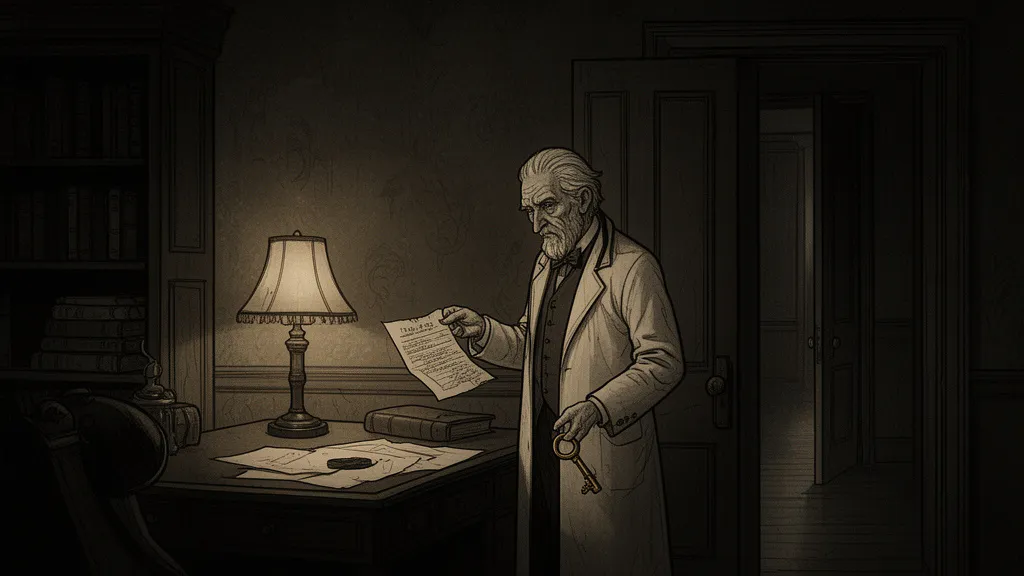
The telegram reached Dr. Percival Oates on a Thursday evening, which was inconvenient, and from Dunmore-on-Severn, which was worse. He had retired from the practice of medicine fourteen months prior — retired, he wished to emphasise to anyone who would listen, with considerable intention — and had expected the profession to extend him the reciprocal courtesy of leaving him alone.
It had not.
To Dr. P. Oates, formerly of Whitmore Street — STOP — Mrs. Cecily Vane deceased this afternoon — STOP — Family requests certification before dawn — STOP — Matter of some urgency — STOP — Carriage will attend — STOP — Hargrove, Solicitor.
He studied the telegram for some time. He had treated Cecily Vane twice, three years prior, for a nervous complaint that had never been satisfactorily named. She had been a woman of forty, pale in the particular way that suggested not ill health but an excess of indoors, and she had watched him throughout both consultations with an expression he had categorised, in his notes, as watchful. He had not, he reflected, expected her to die. Nor had he expected to feel, upon learning of it, the faint and irrational conviction that she had done so deliberately, as a means of drawing him back.
The carriage arrived before he had finished his second objection.
Dunmore-on-Severn was a town that appeared to have been designed by someone who had once heard a town described but had never visited one. The streets bent at angles that served no navigational purpose. The river, glimpsed between buildings as the carriage descended toward the lower quarter, sat too high in its banks for the season. The Vane house stood at the terminus of a lane that ended, as far as Oates could determine, for no reason other than the house's own insistence.
It was Georgian, broadly speaking. Three storeys. The windows of the upper floor were dark. The windows of the ground floor were lit with a gaslight that shifted and dimmed as he watched from the carriage step — not flickering, precisely, but breathing. Expanding and contracting at a rhythm that put him in mind, though he could not have explained why, of something submerged.
The door was opened before he knocked.
"Dr. Oates." The man was narrow, grey-suited, carrying a leather satchel and the expression of someone who had long ago made peace with not sleeping. "Hargrove. We spoke — that is, I telegraphed. Thank you for coming with such admirable promptness. If you will follow me."
Oates followed him through a hallway that smelled of river damp and something beneath river damp — something older, less classifiable — and into the front parlour, where Cecily Vane lay on a trestle table beneath a white sheet.
The room was not cold, which was the first thing he noticed. The second thing he noticed was the wallpaper.
It had been, at some prior point, a handsome pattern — dark green, a repeat of climbing roses. Now it was peeling from the upper corners in long, moist curls, the paper hanging like shed skin, revealing beneath it a plaster the colour of old bone. The peeling had not been patched. It had not been remarked upon. The family — two adult sons and an elderly aunt who sat in the corner without speaking or, apparently, blinking — behaved as though the walls were perfectly sound.
"The paperwork," Hargrove said, and placed his satchel on a side table, "is quite straightforward. Cardiac failure, the family believes. You need only confirm—"
"I need," Oates said, with the measured authority of a man who had spent thirty years deploying it, "to examine the deceased."
Hargrove smiled the smile of a man who had anticipated this and was not, precisely, pleased by it.
The sheet was turned back.
Cecily Vane looked, if anything, more watchful in death than she had in life. Her face was composed. Her hands had been arranged upon her chest in the traditional posture of repose — but not quite. The fingers of both hands were curled, not folded. Curled around something. When Oates leaned closer, he saw what it was: a brass key, perhaps three inches in length, old-fashioned in design, its bow cast in the shape of an eye.
"What is this?" he said.
The two sons exchanged a glance that Oates had not, in thirty years of practice, ever been taught to interpret.
"A family piece," the elder one said. "Sentimental."
"She was holding it?"
"She was found holding it."
This distinction, Oates felt, was doing a great deal of work for a very small collection of words. He straightened. He looked at the key. He looked at the gaslight, which had dimmed again — breathed in — and then recovered.
"What does it open?"
A pause of extraordinary length.
"Nothing in the house," Hargrove said. "The family has checked quite thoroughly. Now, Doctor, if you might direct your attention to the matter of certification — the hour is advancing, and there are certain — the family has certain requirements regarding the timing of—"
From somewhere above, in the upper regions of the house, there came a knock.
Then another. Then another.
Three knocks, evenly spaced, at an interval that was neither hurried nor casual but measured, as a person measures something they intend to get precisely right.
"The nursery," the elderly aunt said, from her corner, without raising her eyes. It was the first time she had spoken. "Don't mind the nursery."
Oates had been a house physician for eleven of his thirty years, which meant he had stood in more rooms than most men and understood the grammar of houses — the way a room communicated its history through temperature, through smell, through the particular quality of silence it maintained when no one was speaking. He had certified deaths in drawing rooms and attic chambers and, on one occasion he did not enjoy recounting, a conservatory during a hailstorm. He had never, in any of these rooms, experienced the sensation he experienced now, which was the sensation of being assessed.
The key was three inches long. The bow was shaped like an eye. He had, against his better judgement, picked it up — the elder son had objected; he had ignored the objection — and turned it over in his hands. The brass was warm. Warmer than it ought to have been, given that a dead woman had been holding it.
He thought of the room he had been told about upon arrival. Hargrove had mentioned it almost in passing, in the manner of a man who has rehearsed the casual mention of something for several hours: there is a room at the end of the second-floor corridor, Doctor, which is kept locked — a private matter, family affairs, we would ask that you confine your movements to the ground floor and the upper landing if the, ah, if the necessity arises.
The necessity, it occurred to Oates now, had been anticipated.
Three knocks from above. Then silence.
"Where," he said, with deliberate calm, "is your housekeeper? I should like to speak with someone who has been in service here longer than—"
"Mrs. Fell is indisposed," Hargrove said.
"Indisposed how?"
"She has retired for the evening."
"It is eleven o'clock at night and you are certifying a death in the front parlour. Your housekeeper has retired?"
Hargrove's mouth performed a sequence of small movements that did not, in the end, constitute speech.
Oates looked at the key in his hand. He looked at the wallpaper, hanging in its long damp curls. He looked at the gaslight, which had dimmed again and this time did not immediately recover, so that the room sat for a full four seconds in a darkness that was not quite dark — that occupied, rather, the peculiar register between shadow and the anticipation of shadow.
Then he walked to the door.
"Doctor." Hargrove's voice had shed, in that single word, its entire professional veneer. "Doctor, the paperwork—"
"Will wait," said Oates, "as the deceased has already demonstrated a capacity for patience."
The second-floor corridor was exactly as unpleasant as he had expected and in ways he had not.
The wallpaper here had not merely peeled. It had been removed entirely, or had removed itself — he could not determine which, and discovered he did not wish to stand still long enough to determine it — leaving the plaster walls bare and faintly glistening, as though the house were perspiring. The gaslight fixtures on this level had no mantles. They were dark. He carried a candle the elder son had thrust at him, whether in helpfulness or malice he could not say.
The door at the end of the corridor was not remarkable. This disappointed him, obscurely. It was a door. Panelled oak, painted over in the same cream that covered every other door in the house. The lock was a standard plate lock, the escutcheon worn smooth.
He held the key up. It was still warm.
From the room behind the door — from whatever lay behind the door — there came no sound at all. No knocking. No movement. Only a silence so complete and so particular that it had a quality he could only describe as attentiveness. As though something on the other side had heard his footsteps and had stopped, carefully and with great deliberateness, everything it had been doing, and was now simply waiting to learn what he would choose.
He thought of Cecily Vane, watchful on the trestle table below. He thought of fourteen months of retirement and the telegram that had arrived on a Thursday and the carriage that had come before he had finished objecting.
He thought: she was found holding it.
The key entered the lock the way a word enters a silence — inevitably, and with the quality of something that cannot afterward be unsaid.
It turned.
The latch disengaged.
The door, swinging inward on hinges that made no sound whatsoever, revealed a room in which a single candle burned on a table beside a chair, and in the chair — upright, hands folded, in a posture of complete and terrible composure — sat Mrs. Fell, the housekeeper, her eyes open and fixed on the doorway, her expression one of profound, undisguised relief.
She was, beyond any question requiring medical certification, dead.
She had been dead, by Oates's estimate, for some considerable time before his arrival.
On the table beside the candle, in her handwriting, on a single sheet of paper folded once, was a note addressed — in the particular and unarguable manner of a woman who had planned for this moment — to the doctor, when he comes.
Oates stood in the doorway.
Below him, in the front parlour, the gaslight went out entirely.
He did not open the note. He understood, with the clarity that arrives only when understanding can no longer be avoided, that he was not yet ready to know what it said — that the reading of it would constitute a threshold of an altogether different kind than the one he had just crossed, and that once crossed, like the first, it could not be recrossed.
The candle on the table burned without flickering.
Somewhere in the house — not above him, not below, but within, as though the walls themselves had learned to be precise — the knocking began again.
One knock. Two. Three.
He picked up the note.
He began, with great care, to unfold it.