The Letter That Knew Her Name
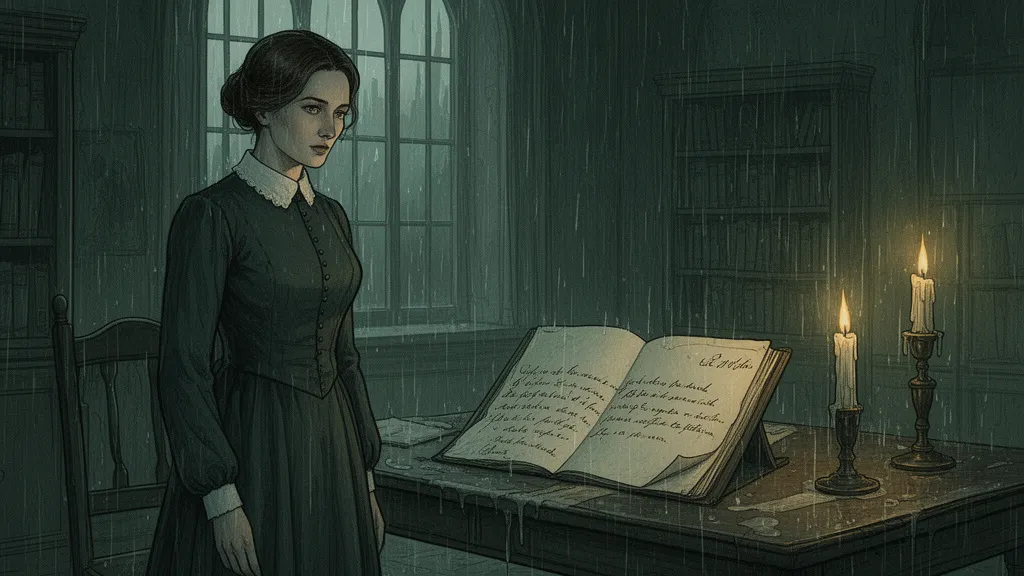
The rain had been falling since Thursday, which Miss Clara Voss considered a personal slight.
She arrived at the vicarage at half past six in the evening, her satchel heavy with inventory ledgers, her coat so thoroughly saturated that it had ceased to function as a coat and had become instead a second, wetter self. The church committee had telephoned that morning — Saturday, her one concession to rest — to inform her that the Reverend Aldous Crane had died intestate, that his belongings required cataloguing before the diocese could take possession, and that she, as the county archive's most junior member of staff, was the appropriate person to attend to the matter. Miss Voss had written this down in her diary beside the word unacceptable, and then had gone.
The vicarage stood at the far end of a lane that the local maps still named Crane's Walk, though no member of the Crane family had occupied the living for longer than anyone could easily remember. The building was Jacobean in its bones and Victorian in its renovations, which is to say that it possessed all the gloom of one period and all the bad taste of the other. A churchwarden named Mr. Pollit met her at the gate, handed her a key ring containing seven keys, pointed at the front door, and left at a pace that struck Miss Voss as slightly too brisk for a man who had claimed, on the telephone, to be entirely untroubled by the whole affair.
She let herself in.
The study was on the ground floor, at the end of a passage that smelled of damp hymnals and something else — something lower and sweeter that she could not, and later would not try to, name. It was a small room, adequate for a man of moderate scholarly ambition, furnished with a reading chair, a fireplace already laid with coal, a writing desk of dark walnut positioned before the window, and four bookcases arranged with the kind of obsessive symmetry that one either admires or finds faintly alarming. Miss Voss, who had spent six years cataloguing other people's obsessions, found it merely professional.
She lit the fire, arranged her ledgers on the reading chair's arm, and began.
The bookcases presented no difficulty — theological texts, county histories, a complete run of the Church Times from 1889 to 1931, an inexplicable collection of railway timetables. Miss Voss catalogued them with the brisk efficiency of someone who knows that seven hundred books are simply seven hundred entries, no more frightening than any other form of repetition. She was halfway through the writing desk's upper drawers before she noticed.
Each drawer had been lined.
Not with the usual paper, not with the floral wallpaper offcuts or plain newsprint that one commonly found serving this domestic purpose. These were thin strips of newspaper, cut with great precision from pages she could not immediately identify, layered in overlapping rows, smoothed flat and then — this was the part that gave her pause — left to absorb whatever moisture the room contained, so that their edges had gone soft. Not merely damp. Furred. The texture, when she ran a careful finger along one strip, was closer to skin than paper.
She withdrew her hand. She made a note in her ledger: Drawer linings: newspaper strips, unusual condition. She considered this an admirably restrained entry.
The date on every strip was the same.
She checked six drawers to confirm this. She checked a seventh, which she had not intended to open, and found it also the same. The date was the fourteenth of March, 1887, repeated across every surface of every drawer, as though the Reverend Crane had spent considerable time ensuring that the interiors of his furniture were in agreement about when they had occurred.
Miss Voss sat down in the reading chair.
The fire had settled to a low, even burn. Outside, the rain continued its disagreement with the roof. From somewhere above — the floor above, she corrected herself, there was a second floor, it was simply a house — she heard what she initially took to be the house settling. Old buildings made sounds. This was well understood. She had catalogued the library of a fourteenth-century priory in a February gale and had not found it alarming, and she saw no reason to revise her general position on the sounds of old buildings now.
The sound came again. Slower than her own footsteps had been. Heavier.
She returned to the desk.
The writing desk's central drawer was locked. Of the seven keys on Mr. Pollit's ring, six had already been accounted for — the front door, the study door, the passage door, and three whose purposes remained obscure. The seventh key was small and flat and silver and slid into the central drawer's lock with a precision that suggested it had been made for exactly this purpose and no other.
Inside the drawer: one envelope.
It was cream-coloured, the paper heavy and old, the kind of stationery that had once cost money and now cost considerably more. The handwriting on the front was precise and unhurried, the script of a man accustomed to writing things that were meant to last.
The name on the envelope was Miss Clara Voss.
She stared at it for a period of time that she later estimated, conservatively, at four minutes, though she acknowledged that her sense of time had become somewhat unreliable by that point in the evening. Then she turned the envelope over. The seal — red wax, bearing the impression of a fish, the old Christian symbol — had already been broken, carefully, as though by someone who had opened it, read it, resealed it imperfectly, and then reconsidered.
Or as though it had opened itself.
Miss Voss was twenty-six years old. The Reverend Aldous Crane had died, Mr. Pollit had informed her, at the age of ninety-three, in February of the current year. A man born in 1887 — she noted, with a calm she did not entirely feel, the recurrence of that date — would have been quite old enough, in 1887, to write a letter. He would have been, she calculated, precisely zero years old.
She took the letter from the envelope.
The paper was not furred. This, she thought, was something.
The letter was dated the fourteenth of March, 1887, and began:
My dear Miss Voss, You will have found the drawers first. You always do. I was particular about the date so that you would understand what I am telling you is not a coincidence, which is a word that people use when they have decided not to look directly at something.
Her throat tightened. She read on.
The house has known you were coming for some time. Not because it is an intelligent thing — I would be sorry if it were, for reasons I cannot explain in a single letter and which would distress you further in any case — but because certain places acquire a kind of gravity. A waiting. You are what it has been waiting for. I am sorry. I did not choose this arrangement, and I do not think you would have, either.
She became aware, as she read, that the fire had changed colour. It was burning now with a low blue light — not the blue of gas, not the blue of chemical interference, but the blue of something that had simply decided to be a different temperature. She looked at it. It looked, insofar as a fire could look at anything, back.
From upstairs, the footsteps moved. Slow. Crossing from one side of the room above to the other, and then stopping at a point she calculated was directly overhead.
She read the next line aloud. She did not intend to. The words came out of her as though they had been waiting there since Thursday.
Do not read it aloud.
She stopped.
Something in the wall to her left produced a sound that was not a groan and not a creak and not any word she had available to her, but which seemed, nevertheless, to be a response. A settling-closer. She had the distinct and horrible impression that the room had heard her voice and was now adjusting itself around it, the way one adjusts a chair to better accommodate a guest one has been expecting.
The letter continued. She could see the words from where she sat, could read the next two paragraphs without raising the paper any higher, without speaking. She was a professional. She was in possession of two university degrees and six years of archival experience and a thorough theoretical understanding of the difference between what was known and what was merely feared. She pressed her lips together very firmly and read with her eyes only.
The house will ask something of you before morning. I could not determine what. I tried, over many years and with considerable dedication, to determine what. I was not able to. This may be because the answer changes depending on who arrives, or it may be because the question was always meant for you and not for me, and I was only the custodian. There is a third possibility that I have not written down, because writing a thing down is a way of letting it know that you know, and I have found it better, in this house, to understand things quietly.
Miss Voss set the letter down on her knee. Her hands, she observed, were steady. She considered this an achievement of some magnitude.
The blue fire guttered. From above, a single footstep. Directly overhead. Not moving — simply present, as though something had leaned its weight forward, toward the floor, toward the ceiling of the room she sat in, listening to her breathe.
She looked at the remaining paragraph.
It was short. She could see that much. Three sentences, perhaps four. The handwriting had changed in the final lines — still precise, still controlled, but written, she thought, quickly. Written by a man who was aware of something just outside the room.
She understood, then, why the seal had been broken.
The Reverend Crane had read it. At some point in his ninety-three years, perhaps only at the very end, he had opened the letter he had written as a young man, or as no age at all, and read what it said, and then he had sat in this same chair, before this same fire, with the letter on his knee and those same final lines waiting.
And he had left the letter in the drawer.
Miss Voss looked at the fire. She looked at the ceiling. She looked at the last paragraph of the letter she had been carrying in her name since before she existed.
She read it.
The walls drew in one slow breath.
And then she understood exactly what the house had been waiting to ask her, and the understanding arrived in her like cold water through old stone — complete, and total, and absolutely without comfort — and outside, the rain went on falling, as it had been falling since Thursday, and would fall, she thought, for quite some time yet.