What the Cabinet Kept Warm
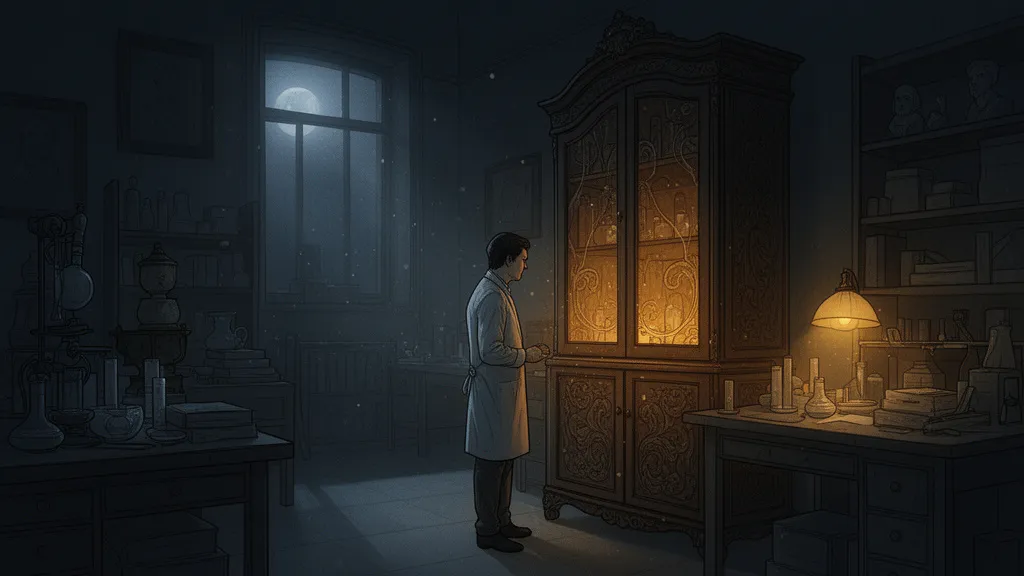
The call came at twelve minutes past midnight, which Mrs. Vera Calloway considered an imposition of the first order.
She had been a conservator of decorative arts for twenty-three years, and in those years she had grown accustomed to the particular indignities of the profession: the humidity readings taken at three in the morning, the panicked curatorial telephone calls about cracked lacquer, the storage disasters that seemed constitutionally unable to occur at reasonable hours. She had not, however, grown accustomed to them. She had simply continued.
Her husband had died four years prior, leaving behind a cat, a mortgage of manageable proportions, and the habit of silence that his absence had never quite filled. She was, as a result, alert in the small hours with the particular alertness of those who have no one left to wake.
The call was from Mr. Aldous Fenwick, deputy director of the Morrow Collection, a man whose relationship with structural crises was one of theatrical distress barely containing genuine incompetence. He described, in a voice elevated well beyond the requirements of the situation, that one of the archive cabinets on Sub-Level B had begun — and here he employed a word Vera found herself forced to request he repeat — weeping.
"Weeping," she said.
"A dark substance. Through the seams. Mr. Hargreaves noticed it on his rounds. The trustees arrive at nine."
She was in the archive within the hour.
Sub-Level B was a long room below the waterline of the original Victorian building, accessed by a stairwell that smelled of old stone and the particular institutional bleakness that institutions had, apparently, always smelled of. The boiler ran through the walls here, a rhythmic ticking that one felt rather than heard — not a sound so much as a periodic reminder that the building was alive in the way that old buildings are alive, which is to say: in ways one would rather not examine closely.
Mr. Hargreaves, the night-security attendant, stood at the far end of the room with the expression of a man who had decided to retire as soon as humanly possible. He pointed without speaking. This, Vera felt, was the most sensible contribution he could have made.
The cabinet stood against the east wall, as it had stood for sixty years, according to the archive inventory she'd had cause to review some months prior. It was Dutch, late seventeenth century, a kabinettschrank of the type used to house collections of curiosities: black-lacquered oak, its surface carved into a dense procession of foliage and masked faces whose expressions suggested an acquaintance with unpleasant knowledge. It was approximately five feet in height, four in width, and remarkable, in the ordinary way of such objects, for nothing beyond its craftsmanship and the faint odour of cedar and old wax that Vera had always associated with it.
It was not, she observed, weeping. Weeping implied a degree of effort, of distress, that was too sympathetic by half.
What it was doing was this: from the carved seams — the joins between panels, the gaps beneath the mask-faces — a dark resin was emerging, slowly, with the deliberateness of something that had been waiting for the right conditions to appear. It was not red. It was not any colour she had an immediate clinical term for. It had the quality of old varnish exposed to prolonged heat, except that the archive was kept, by statute and considerable expense, at precisely sixty degrees Fahrenheit.
She put on her gloves. She took a sample with the scraper she kept in her case with the automatic competence of long practice. She examined the substance under her loupe.
It was, to the best of her immediate assessment, organic.
She did not say this aloud. There was no purpose in saying it aloud to Mr. Hargreaves, who would not find the information useful, and who was, she noticed, now standing noticeably closer to the stairs.
The back panel was the obvious place to begin.
Conservators understand instinctively that the history of an object is most honestly recorded where no one has thought to look: the underside of a drawer, the backing of a painting, the interior walls of a sealed cabinet. The front of a thing is what it wishes to be. The back of a thing is what it is.
Vera drew the cabinet away from the wall with more effort than a single person ought reasonably to manage, and did not consider, as she did so, that the resistance she felt was in any way unusual. Old cabinets were heavy. This was a fact of the physical world.
She removed the four retaining screws from the back panel — they turned with a fluency that surprised her, as though they had been recently oiled, though the archive log showed no access in six years — and lifted the panel free and set it against the wall and looked inside.
The dust was, as one would expect, considerable. Sixty years of archive-quiet had laid it evenly across the interior base, undisturbed, as far as all documentary evidence was concerned, since the cabinet's donation in 1963.
All documentary evidence, she amended silently, except this.
In the centre of the dust, clear as a signature, was a handprint.
Small. Child-sized. The fingers pressed together, the palm full and distinct, the kind of print left not by a hand falling carelessly but by a hand pressing deliberately, from inside, against the base of the thing. The dust around it was undisturbed. The resin had not reached this far, but at the edges of the cabinet's interior walls it gleamed faintly, like the margins of a text.
Vera looked at the handprint for a long time.
Then she looked at her own gloved hand, and at the dimensions of the cabinet's interior, and she performed — with the professional rigour for which she was, among colleagues, somewhat formidably regarded — the mental geometry necessary to understand that no adult hand could have made that print, and that the cabinet, once sealed, could not be entered from the outside.
She replaced the back panel. She did not replace the screws.
The donor ledger was kept in the adjacent reading room, in the third drawer of the cataloguing desk, which was also, she noted as she opened it, faintly damp.
The rain had been heavy since eleven; she could hear it now, displaced from the previous quiet of her concentration, hammering against the lower windows with an enthusiasm that seemed, in the context of the evening's events, to be somewhat overdetermined. Water was pressing at the lower windows. The boiler ticked. The archive sat beneath the waterline.
She found the entry for the cabinet in four minutes.
Kabinettschrank (Dutch, att. c.1680). Donated February 1963 by the estate of Mrs. Constance Iver, of Iver Hall, Cambridgeshire. The piece was acquired by Mrs. Iver's late husband, Mr. Frederick Iver, at some point prior to 1919, provenance uncertain. Note appended by donor's solicitor: the family requests that the piece not be publicly displayed without prior written consultation. No reason given.
This was not unusual. Families made such requests regularly, for reasons ranging from the sentimental to the superstitious, and in Vera's experience the requests were honoured until they were inconvenient and thereafter quietly set aside. She turned the page.
Beneath the formal entry, written in a different hand — smaller, less practiced, added some time after the original notation — were six lines that she read twice before the room adjusted itself around her meaning.
Supplementary note — March 1963. Further information received from Mr. D. Iver (son of the above). During the flood winter of 1916, and for reasons he declined to specify more precisely, his father had concealed within the cabinet the body of a child — a girl, aged approximately eight years — for a period of several days, until the flood waters permitted movement and arrangements could be made. Mr. Iver junior wished this recorded but not widely circulated. He expressed uncertainty as to whether the cabinet had subsequently been properly — his word — cleaned. The matter was considered adequately closed.
The matter was considered adequately closed.
Vera sat with this sentence for a moment that she was unable, afterward, to accurately estimate.
She was a woman of scientific training and considerable professional composure, and she was also a widow who had spent four years alone in a house that still contained her husband's reading chair, his half-finished crosswords, the particular quality of his absence in every room. She understood, with a completeness that required no argument, that the dead leave impressions. That grief was, at its most fundamental, the experience of a space that would not stop being shaped by what had once filled it.
She understood also that this was not what she was thinking about. She was thinking about the handprint.
There were, as she assessed them, two positions available to her.
The first: she could burn the ledger — the addendum, at least, this single damning page — in the reading room's small metal wastepaper bin, which would accommodate it, and she could complete her examination of the cabinet's resin emissions with the clinical thoroughness the trustees would require, and she could recommend a stabilising treatment and a light clean, and by nine o'clock tomorrow morning the kabinettschrank would stand in the main gallery under the appropriate lighting and the trustees would admire it and the evening would be, in every documentable sense, unremarkable.
The second: she could file the note. She could report what she had found. She could set in motion the institutional processes that would remove the cabinet from display, involve the appropriate authorities in a discussion that would, by any reasonable expectation, damage the Collection's relationship with the Iver estate, complicate the morning's meeting, and result — given the absence of any living witness and the distance of a century — in no resolution that could be described as satisfying.
The rain hit the lower windows. The boiler ticked.
She was still holding the ledger.
The thing about old objects — the thing she had understood since her first year of training, the thing she had tried and failed to explain to people who did not work with them — was that they were not passive. They were records. They held what had been done near them, or with them, or inside them, the way wood holds water: invisibly, under pressure, until the conditions were right for it to come through.
A child. A flood winter. Several days.
Until arrangements could be made.
She set the ledger on the desk. She did not burn it.
When she returned to the archive, she did not approach the cabinet immediately.
She stood at the entrance to the room and looked at it from the distance the doorway afforded, and she noted — with the care of a person who has trained herself to record what she observes and reserve judgment until the observation is complete — that the resin had continued to emerge in her absence. It was not dramatic. It did not cascade or flow. It pressed, slowly, through the carved seams, through the open mouths of the mask-faces, and it had reached, she estimated, a further quarter-inch beyond where it had been when she had first arrived.
It was making progress. At what rate and toward what conclusion, she declined to calculate.
She crossed the room. She stood before the cabinet. The boiler ticked in the wall behind it, a sound she now felt in her sternum rather than heard with her ears.
She placed her gloved hand flat against the lacquered surface.
The wood was warm.
Not the warmth of the boiler — she knew that warmth, had catalogued it across twenty-three years of institutional buildings, knew exactly the quality of heat conducted through plaster and stone. This was a different temperature. It was, and she stood with this observation for a considerable moment, the warmth of something recently inhabited.
She removed her hand.
Mr. Hargreaves, she noticed, was no longer in the room.
At half past two in the morning, Mrs. Vera Calloway, FAIC, senior conservator, widow, woman of scientific training and adequate professional composure, took the following actions, in the following order.
She photographed the exterior resin emissions, in full, with the documentation camera she had brought from her case. She photographed the interior of the cabinet, including the base and the handprint, from three angles, with a flash that seemed, in the silence of the archive, inordinately bright. She photographed the ledger entry in its entirety, including the addendum in the smaller hand.
She wrote a report. It was four pages, single-spaced, and it contained every measurement and observation she had made that evening, including the temperature of the cabinet's surface, which she recorded as anomalously elevated above ambient, a phrase she recognised as a very small hedge against a very large thing.
She placed the report, the photographs, and the ledger itself — not burned; intact; properly documented — in the overnight envelope addressed to Mr. Fenwick, and she wrote across the outside of it, in handwriting more controlled than her current state perhaps warranted:
The trustees' presentation should be postponed. See enclosed.
She did not recommend treatment. She did not recommend a light clean.
She put on her coat. She picked up her case. She walked to the foot of the stairwell and she looked back across the room at the cabinet, standing under the archive lights against the east wall, warm, slowly pressing its dark record through every carved seam.
The masks looked back at her with their expressions of unpleasant knowledge.
She thought of the handprint. She thought of the particular quality of pressed dust — not brushed, not stirred, but pressed, deliberately, by something that had understood it was leaving a mark for someone who would eventually come to look.
The boiler ticked.
She went up the stairs and out into the rain, and behind her the archive settled into its sixty-year quiet, except that it was not, and had not been for some time, as quiet as it had appeared.