The Bell That Held a Name
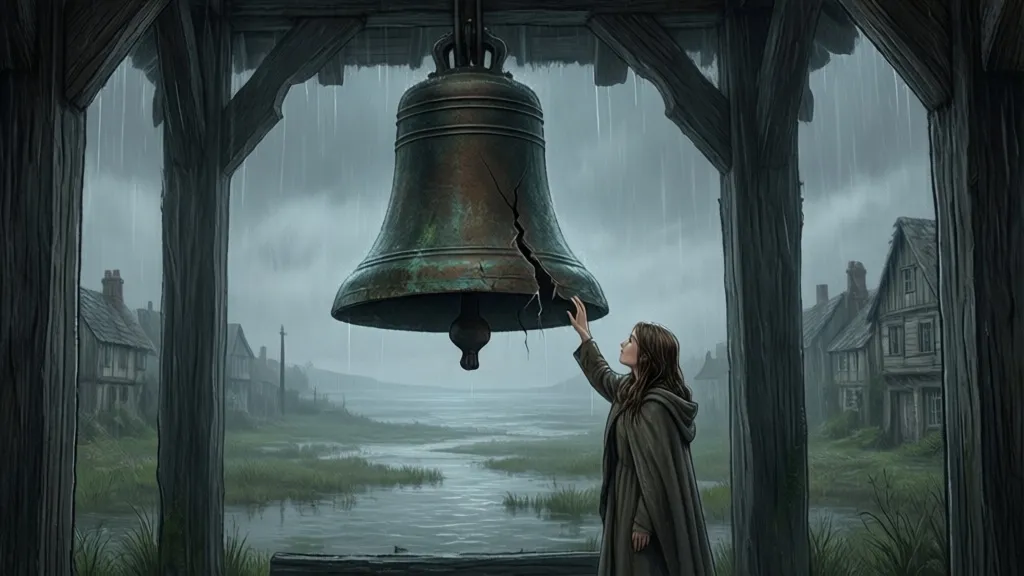
The crack appeared on the seventh day of rain, a hairline fracture that ran from the bell's shoulder to its waist like a seam the foundry had forgotten to close. Mara found it at dawn, her fingers tracing the split iron while water pooled in the tower's corners and the marsh below the village swelled against the stilts that held the houses above the tide.
The bell had rung the hours for two hundred years. It had called the boats home through fog, marked births and funerals, warned of storms that came inland from the grey sea. Now it hung silent in its frame, and the elders had gathered in the square to decide what should be done with the ash.
The ash had been sitting in its cedar box for eleven days. No one spoke of whose ash it was. The marsh took children sometimes—everyone knew this—and the village had learned long ago that naming the taken only made the marsh remember them too clearly. Better to scatter the remains at twilight, ring the cracked bell one last time to mark the passing, and let the reeds forget what they had witnessed.
"You'll ring it," Goram said. He was the eldest of the council, and his voice carried the weight of decisions made before Mara was born. "Just once. Clean and final. Then we scatter before the king tide reaches the stilts."
Mara looked at the bell. The crack gleamed wetly in the rain. "It might not sound," she said.
"It will sound," Goram replied. "Everything sounds once before it breaks."
She climbed the tower stairs alone. The wood was slick beneath her boots, and the air smelled of rust and standing water. The bell waited in its iron cradle, patient as a held breath, and Mara wondered—not for the first time—what the foundry workers had known when they cast it, what instructions they had followed that were older than instruction, inherited like the colour of eyes or the cadence of prayer.
She reached for the rope. The hemp was rough against her palms, familiar from years of ringing the hours, and she pulled.
The bell swung. The clapper struck iron.
The sound that emerged was low and broken, a note that split at its centre and fell away into silence. But beneath it—so faint she almost missed it—came a second voice. Smaller. Higher. A bell within a bell, ringing from some hollow place inside the iron throat.
Mara froze. The rope slipped through her fingers.
The second voice faded, but not before she heard what it carried: the shape of a name, caught in metal, trying to escape.
Lior.
She knew, then. Everyone knew. The child who had vanished eleven days ago, walking out across the marsh flats at low tide and not returning. The child whose name the village had agreed, collectively and without discussion, to forget.
But someone had spoken it. Someone had said it aloud within range of the bell, and the iron had remembered.
Mara descended the stairs slowly, her heart a drum against her ribs. The elders were waiting in the square, the cedar box held carefully between them, and the marsh tide was already lapping at the lowest stilts. She could hear it—the wet whisper of water finding wood, the ancient patient hunger of the reeds.
"Well?" Goram asked.
"It rang," Mara said.
"Then we scatter."
"Wait." The word came before she could stop it, and the elders turned to look at her with expressions that were not quite warning and not quite plea. "The bell—there's something inside it. A second voice. I think—"
"The bell is cracked," Goram said, not unkindly. "Cracked things make strange sounds. You heard iron failing. Nothing more."
But Mara had heard bells fail before. She had heard metal fatigue and stress fractures and the slow groan of rivets pulling free. This was not that. This was a voice.
"The foundry tower," she said. "When did they seal it?"
The elders looked at one another. The rain fell steadily into the marsh.
"After the last casting," Goram said finally. "Fifty years ago. Maybe more. The foundry workers knew things we don't. Better to let their knowledge rest."
"And if something didn't rest? If it's still there, waiting?"
Goram's face was very old and very tired. "The marsh takes children, Mara. It has always taken children. We endure this because the alternative is worse. Do you understand? The bargain keeps the village safe. If we break it now—if we name what was taken—the marsh will remember we are here."
"And if the child isn't taken?" Mara asked. "If they're alive?"
The silence that followed was the silence of a question no one wanted answered.
The tide was rising. Mara could feel it through the soles of her boots—the marsh pressing upward, testing the stilts, patient as a held breath. She thought of Lior, who had been seven years old and small for their age, who had liked to collect snail shells and arrange them in spirals on the doorstep. She thought of the cedar box, waiting to be opened, and the ash inside that might not be ash at all but something the marsh had left behind to satisfy the agreement.
She thought of the bell, cracked and faithful, holding a name in its iron throat.
"I'm going to the foundry," she said.
"Mara—"
"If I'm wrong, you can scatter the ash before the king tide peaks. If I'm right—" She stopped. "If I'm right, the bargain was already broken. Someone spoke the name. The marsh already knows."
Goram closed his eyes. When he opened them again, they held something that might have been relief or might have been surrender. "Then go," he said quietly. "But go quickly. And if you find nothing, come back before the water takes the stairs."
The foundry tower stood at the village's edge, its base sunk deeper than the houses, its walls thick enough to hold a century of heat. The door had been barred and sealed with pitch, but the pitch was old and brittle, and Mara's knife found the gaps easily.
Inside, the air was dense and metallic. Moulds lined the walls—bells in various stages of completion, frozen in their moment of becoming. Rain dripped through cracks in the roof, pooling on the stone floor, and in the centre of the room stood the great furnace, cold for fifty years but still radiating memory.
And in the corner, curled beneath a workbench with a waterskin and a heel of bread, was Lior.
They looked up when Mara entered, their eyes wide and dark and terribly aware. "I couldn't go home," they whispered. "If I went home, the marsh would know I was there. I heard someone say my name by the bell, and I knew—I knew it would hear."
Mara knelt beside them. "How long have you been here?"
"Since the first night. I hid. I waited. I thought—I thought if everyone forgot, the marsh would forget too."
Outside, the tide was climbing. Mara could hear it lapping at the foundry's base, testing the door. The marsh remembered now. The name had been spoken, caught in iron, and carried across the reeds.
She thought of the bargain—whatever it was, whatever the village had agreed to in some distant generation. She thought of Goram's tired face and the cedar box and the children the marsh had taken before. She thought of the bell, cracked and faithful, holding a voice it should not have held.
And she thought: Perhaps the marsh does not want children. Perhaps it only wants us to remember that we are not safe. That safety is negotiated, not given. That the world is older than our agreements, and it will outlast them.
"Come on," she said, and held out her hand.
Lior took it.
They climbed the stairs together while the water rose behind them. When they reached the square, the elders were still waiting, the cedar box still closed, and the rain was beginning to ease. Goram looked at Lior for a long moment, then at Mara, and then—very carefully—he opened the box.
Inside was ash, yes. But it was not human ash. It was river clay and burned reed and the crushed shells of marsh snails.
The marsh had sent them a substitute. It had always sent substitutes.
"What do we do now?" someone asked.
Goram closed the box. "We scatter it," he said. "And we ring the bell. And we remember that bargains end when both parties agree, not when one decides in secret."
Mara climbed the tower one last time. The crack in the bell gleamed like a new scar, and when she pulled the rope, the sound that emerged was broken but clear—a note and its echo, a voice and its answer.
The marsh tide paused at the stilts, then slowly began to recede.
In the foundry tower, the moulds of unfinished bells stood silent and patient, waiting for the day someone would return to complete what had been started—not with iron and fire, but with names spoken aloud and bargains renegotiated under open sky.
The rain stopped. The reeds whispered. The village remained.