The Bell That Rang Before Noon
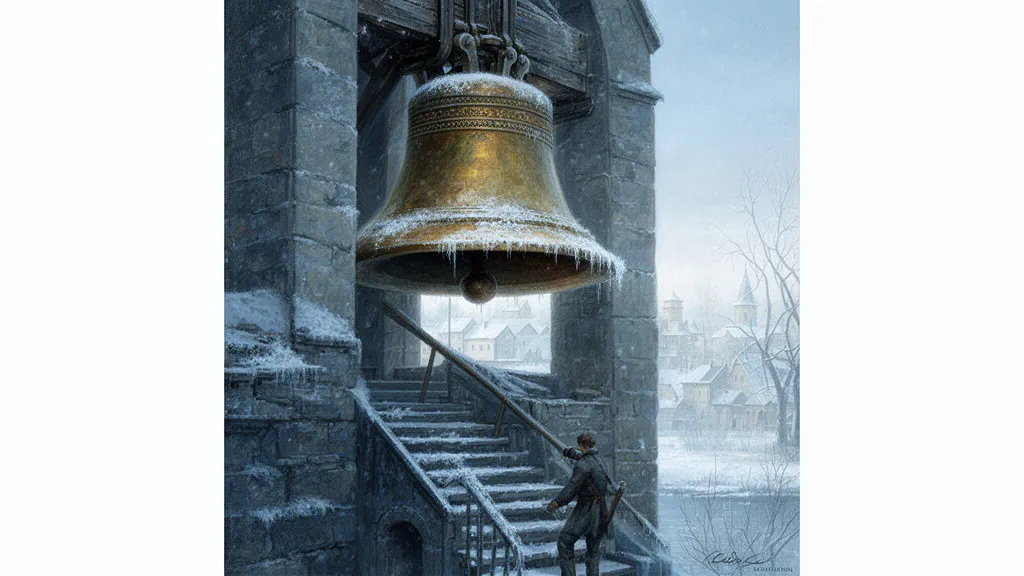
The frost began on the third Thursday of May, when no frost had business arriving anywhere.
Clara found it first on the clapper of the chapel bell, the oldest of her foundry's work—a half-ton of bronze cast when her grandmother's grandmother had still been mixing the alloy. The bell hung in its tower above the shuttered chapel at the edge of the river town, and it rang at noon each day because the mechanism that triggered it had outlasted three bellmakers and showed no sign of admitting mortality.
Except now it rang at eleven fifty-three.
Seven minutes early, and when Clara climbed the tower to inspect the works, she found the clapper beaded with frost like winter had touched only that single piece of iron and left the rest of summer undisturbed.
The frost melted under her thumb. It tasted of river water.
The chapel had been shuttered for sixteen years, ever since the dock master's daughter had tried to drown herself in the font and succeeded only in soaking the floorboards and forcing the parish to admit that no one had attended services in a decade. The building stood with its back to the water, facing the town as if it were still attempting to shepherd a flock that had wandered into secular concerns and never quite returned.
Clara walked the perimeter that afternoon, counting her own footsteps because the silence required some sound to make it bearable. The windows were boarded. The door was nailed shut with the kind of carpentry that suggested someone had wanted to ensure nothing got out as much as nothing got in.
But the bell rang early again the next day, at eleven fifty-one, and this time Clara heard something underneath the tone—a vibration that felt less like bronze and more like a question the metal had been asked and could not refuse to carry.
She climbed the tower again. The frost had thickened.
And this time, she noticed the rope.
It descended through the mechanism housing and vanished into the chapel's attic, which was supposed to be sealed. Clara followed it down, prying loose boards that came away with the ease of wood that had been waiting for permission. The attic smelled of old hymnals and the particular dust that accumulates when a space has been left to consider its own obsolescence.
The rope dropped through a gap in the floorboards.
Clara descended into the chapel proper.
The child sat in the front pew, directly beneath the hole where pale spring light entered through a crack in the roof. Their sleeves were soaked to the elbows, dripping onto wood that had been dry for sixteen years. Around their throat, on a cord of braided river reed, hung a wedding ring—tarnished silver, worn thin on one side where a thumb had rested for decades.
The child did not look up when Clara entered.
"The bell rang early," Clara said, because it seemed important to begin with facts.
"It rang true," the child replied. Their voice was not a child's voice. It was the sound of water moving under ice, patient and absolutely certain of its direction. "The rest of the day is what arrives late."
Clara approached slowly, her own footsteps loud in the vaulted space. The child's hair was dark and wet, plastered to a skull that seemed too angular, too knowing. Their eyes, when they finally lifted them, were the colour of deep river channels where the light does not quite reach.
"What are you?" Clara asked.
"A promise," the child said. "Or the memory of one. The river isn't always sure which." They touched the ring at their throat. "This was thrown from the bridge on the autumn equinox, twenty-three years ago. The man who threw it said: Let the water take what I cannot carry."
"And the water carried it here."
"The water carried it everywhere. Rivers do not forget. They accumulate." The child's fingers moved to the cord, tracing its braid. "But this ring was loud. It struck the riverbed and rang like bronze, and the sound travelled through silt and stone until it found your bell, which remembers what it means to be struck."
Clara felt the air in the chapel shift, as though the walls had taken a breath.
"The bell rings early now," the child continued, "because it is calling the other promises home. The ones this town threw into the current, hoping distance would make them disappear."
By dusk, seventeen people had gathered outside the chapel without knowing why.
Clara watched them from the tower. The dock master stood with his hands in his pockets, staring at the shuttered door as though it had asked him a question in a language he'd once spoken fluently. Beside him, the seamstress who had sewn wedding clothes for half the town worried the hem of her apron into knots. The baker. The woman who ran the boarding house. The carpenter who had sealed the chapel in the first place.
They did not speak to one another. They simply waited, drawn by the vibration of a bell that had rung seven minutes before noon and left frost in the middle of May.
Clara descended the tower and found the child still seated in the same pew, though now the ring around their throat had begun to glow with the faint luminescence of something that had lain too long underwater and learned to make its own light.
"What happens if I return the ring to the river?" Clara asked.
"The promises will follow it down," the child said. "The bell will ring at noon again. The frost will melt. The town will continue as it has, carrying only the weight it chooses to remember."
"And if I don't?"
The child looked at her with eyes that had been looking at this question since the ring first struck stone. "Then the chapel fills. Every oath spoken in haste, every vow broken in silence, every promise thrown into the current because it was easier to drown than to keep—all of them will come home. The bell will ring them in, one by one, until this space holds every word the town tried to bury."
"That's a lot of words."
"Yes," the child agreed. "The river is patient, but it is also thorough."
Clara walked to the window and looked through a crack in the boards. The crowd had grown. Twenty people now, then twenty-five. Some of them were weeping without knowing why. Others simply stood, their faces turned toward the chapel like flowers tracking light they could no longer see.
"Will it hurt them?" Clara asked. "To remember?"
"Yes," the child said simply. "But they will also know what they've carried in the dark, and knowing is its own kind of mercy."
Clara thought of her own bells, cast and hung and left to ring in towers across the river valley. Each one had been made to mark time, to call people to moments they might otherwise let slip past unnoticed. Noon. Vespers. The hour of the dead.
Time, her grandmother had told her, was what bronze measured best—not because metal could count, but because it could hold a note long enough for mortals to catch up.
"The ring," Clara said. "Who does it belong to?"
"The man who threw it is still alive," the child replied. "He lives in the house with blue shutters, three streets from the river. He has not spoken his wife's name aloud in twenty-three years, though he thinks it every morning when he wakes."
Clara knew the house. She knew the man—silver-haired now, quiet, the kind of person who moved through the world as though he were trying not to disturb the air.
"And if the chapel fills?" Clara asked. "If all the promises come home—what happens to you?"
The child smiled, and it was the saddest expression Clara had ever seen on a face that young.
"I go back to the river," they said. "I was only ever the bell's echo."
Clara made her decision as the light failed and the bronze in the tower began to hum with the low frequency of something preparing to ring.
She walked outside and opened the chapel door.
The crowd surged forward, then stopped at the threshold, suddenly uncertain. Clara stood aside and let them see: the empty pews, the water-stained floor, the child seated in pale light with a ring at their throat that glowed like a caught star.
"The bell rang early," Clara said, her voice carrying across the square, "because it's calling you home. Not to confess. Not to atone. Just to remember what you gave the river, and decide whether you're ready to carry it again."
One by one, they entered.
The dock master first, his footsteps slow and heavy. Then the seamstress. The baker. The carpenter. Each one found a pew and sat, and as they did, the chapel began to fill with sound—not voices, not words, but the low thrum of promises surfacing, of vows climbing out of silt and finding air again.
Clara watched the man with silver hair arrive last. He saw the child, saw the ring, and his knees buckled. He did not fall—instead, he knelt, and the child rose and walked to him and placed the ring in his palm.
"She forgave you before you threw it," the child said softly. "The river just wanted you to know."
The man closed his fingers around the silver and wept.
The bell rang at noon the next day, exactly as it had for a hundred years.
The chapel remained open, though the child was gone. Where they had sat, there was only a pool of water, clear and cold, that did not evaporate even in summer's heat.
People came, sometimes, to sit in the pews and speak to the silence. They brought their own promises now—not to bury them, but to say them aloud where the walls had learned to listen without judgment.
Clara returned to her foundry and cast a new bell, smaller than the others, its tone bright and sharp as river ice breaking in spring. She hung it in her own workshop, and it rang each dawn, calling nothing and no one.
Just measuring time.
Just holding the note long enough for the world to catch up.