The Bell That Rang from Underwater
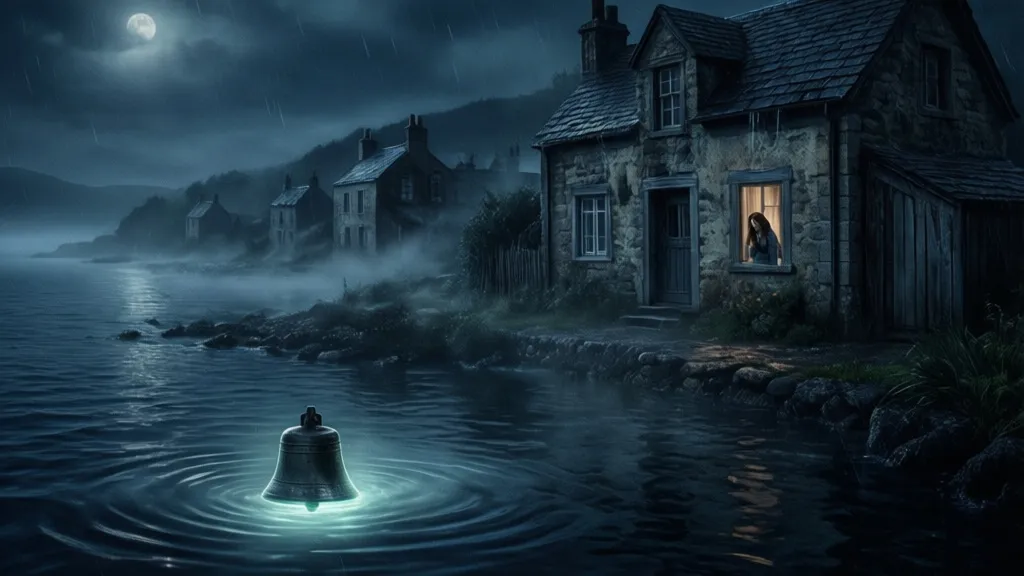
The bell began at seventeen minutes past midnight, which meant someone had counted the hours and chosen the threshold with care. Mara woke to the sound traveling through stone, through wood, through the walls of her grandmother's house where the plaster had begun to remember rain. The whole village woke. Dogs did not bark. They pressed themselves against doorways and would not be moved.
She dressed without lighting the lamp—old habit from the years when light could be seen from the orchard, when they'd learned what happened to houses that burned bright after dark. The bell struck again. Again. The rhythm was wrong. Too slow, as if each stroke had to travel a long way before it could arrive.
By the time she reached the square, others had gathered: Finn with his coat buttoned crooked, Sera holding a shawl closed at her throat, old Garrett leaning on his stick like it was the only thing preventing him from returning to bed and pretending this was someone else's emergency. The rain had started an hour before sunset and had not stopped. The cobbles gleamed black. Water ran in the gutters, swollen and purposeful, carrying leaves from trees that had stood for a hundred years and would not stand for many more.
The bell tower rose against the clouds, narrow and grey, the same color as the rain. It had been silent for twelve years. Since the summer they buried Callum Vey in the orchard and made the vow that kept the dead where they belonged.
"Someone's up there," Finn said.
"No one's up there," Sera said. "The door's been locked since—"
The bell struck again, and dust poured from the belfry, a grey cascade that caught the wind and disappeared into the dark.
Mara had the key. Her grandmother had given it to her the week before the fever took her, pressed it into her palm with hands that had forgotten how to be warm. You'll know when, she'd said, which Mara had thought was the delirium talking, the way the dying sometimes mistook you for people they'd loved decades ago. But the key had been real, and heavy, and now it hung on a cord around her neck, cold against her collarbone.
She crossed the square. The others followed at a distance that suggested they wanted to see what happened but did not want to be held responsible for it. The church door was older than the village, oak that had been cut when the river ran a different course and people built close to water because they did not yet know what would come looking when the water rose. The key turned. The bolt slid back with a sound like a breath released after being held too long.
Inside, the church smelled of stone and damp and the particular silence of places that have been left to themselves. Mara lit the lantern. Shadows assembled themselves into pews, into the small altar where candles had not been lit since the morning Callum Vey's wife tried to call him back and learned what it cost to ask the drowned to return.
The stairwell to the bell tower was narrow, steep, built for people smaller than the ones who lived here now. Mara climbed. The lantern swung. Her shadow preceded her, enormous and distorted, as if something much larger was ascending and she was only following in its wake.
The bell chamber was open to the weather, four stone arches and a floor thick with dust and old birds' nests and the brittle remains of things that had crawled up here to die. The bell hung in the center, iron dark as river mud, its surface slick with rain. No rope. The rope had been cut twelve years ago and burned, and the ashes scattered in the graveyard so nothing could be tied back together.
But there was a palmprint on the inside of the bell, wet and distinct, as if someone had braced themselves there and pushed, climbing out.
Mara set the lantern down. Touched the print with her fingertips. The metal was cold. The water was not rain. It tasted of salt, of depth, of things that lived where light did not reach.
She descended faster than she'd climbed, the lantern swinging wild, her pulse keeping time with footsteps that were hers and also—she was almost certain—something else's, following at a distance that never closed but never widened.
In the square, the others had moved back. They stood in a loose semicircle, facing the church, and in front of the church, standing in the rain with his hands open at his sides, was Callum Vey.
He looked as he had the day they buried him: shirt pale against the dark, hair pressed flat by water, feet bare. He did not look twelve years dead. He looked patient, and tired, and as if he had been walking for a very long time and had finally arrived at the place he was supposed to be.
"Mara," he said. His voice was the same. That was the worst part. Twelve years in the orchard and his voice had not changed.
"You can't be here," she said.
"I rang the bell," Callum said. "You heard. That means the threshold's open."
Finn stepped forward, hand on the knife he wore at his belt, the one everyone carried now but no one spoke about. "We buried you. We made the vow. The dead stay out."
"The water's coming," Callum said, and pointed.
Mara turned. In the distance, past the last houses, past the wall they'd built the year the river changed, she could see it: a dark line advancing across the fields, swallowing the low places, pressing against the stone. By morning it would reach the church steps. By noon, the square. They had a day, perhaps less, before the village became another story people told about places that used to be.
"We can leave," Sera said. "We've got carts, we can—"
"You can't outrun it," Callum said. "Not this time. It's not just water. It's what the water carries."
The rain drummed on the cobbles. On the church roof. On Callum Vey, who did not shiver, who stood as if cold was a thing that happened to other people.
"What do you want?" Mara asked.
"Let me in," he said. "Before dawn. Give me a place, and I'll hold the water back."
"You're dead," Garrett said. "Dead don't bargain."
"The drowned do," Callum said. "We remember what it was to want things. What it was to have a place that mattered. Let me back in, and I'll stand where the water wants to go. I'll be the threshold. It'll stop."
Mara thought of her grandmother, who had given her the key and said you'll know when. Thought of the bell, ringing from underwater, from the place drowned things went when they still had something to say. Thought of the vow they'd made twelve years ago, burning the rope, sealing the threshold, promising the dead would stay buried and the living would stay safe.
But vows were only as strong as the world that held them, and the world was changing. The water was proof.
"Where?" she asked.
Callum looked at the church. At the narrow door, the stone walls, the bell tower rising grey against the rain. "Where I was before," he said. "In the bell. Let me back in the bell, and I'll hold."
Finn swore. Sera made a small sound that might have been a prayer or a protest. Garrett turned away, leaning hard on his stick, as if he'd seen enough strange things in his life and did not need to see another.
Mara walked to Callum. Stood close enough to see that his eyes were still brown, still his, but behind them was something else—something vast and patient, the way the ocean was patient, the way deep water waited for everything to eventually fall.
"If I let you in," she said, "will you stay? Will you hold, or will you call the rest?"
"I'll hold," Callum said. "I've been holding for twelve years. I know how."
She believed him. That was the terrible part. She believed him because the dead did not lie—they had no reason to. They simply were, and what they were was the truth of what they'd become.
She led him into the church. Up the narrow stairs. To the bell chamber where the rain fell through the arches and turned the dust to mud. Callum looked at the bell, at the palmprint still wet on the inside, and nodded as if he'd expected this, as if he'd always known he would come back.
He reached up. Touched the iron. The bell did not ring.
"Thank you," he said.
Then he stepped forward, and the bell swallowed him—not violently, not with sound, but as water swallows a stone, and the stone becomes part of the water, and both are changed.
Mara waited. The rain slowed. In the distance, the line of floodwater stopped advancing. It did not retreat, but it stopped, held by something the village could not see but would learn to live beside: the threshold made flesh, the bargain made iron, the dead standing watch where the living could not.
She descended. In the square, the others stood silent, rain-soaked, waiting.
"It's done," Mara said.
Finn nodded. Sera pulled her shawl tighter. Garrett looked at the church, at the bell tower, and for a moment his expression was something like respect, or sorrow, or both.
The bell did not ring again. But Mara, standing in the square as dawn approached pale and grey over the water, thought she heard it—just once, very soft—the way you might hear someone breathing in the room next door, and know you were not alone, and feel safer for it, and also afraid.