The Bell That Rang Without Being Struck
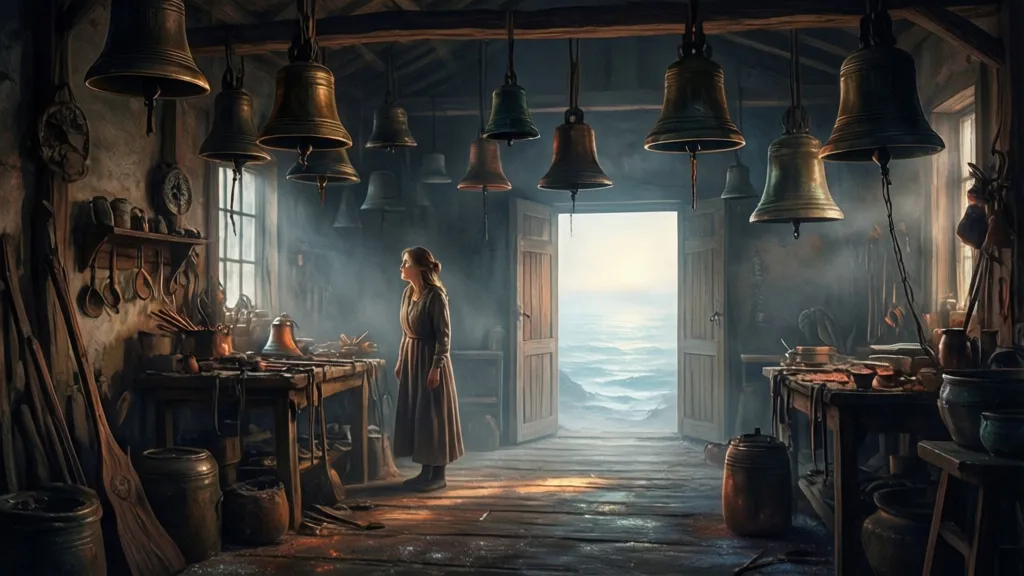
The bronze had been silent for seventeen years, which meant the sound, when it came, was both familiar and impossible.
Camille woke to it at dawn—not the deep, resonant voice of bells being rung, but something finer and more insistent, the way metal remembers being shaped when the temperature drops. She lay in the narrow bed above the workshop and listened to the rafters sing. All twelve bells, from the smallest prayer chime to the great storm-warning hung in oiled canvas, were sounding without their clappers moving.
She had inherited the workshop from her mother, who had inherited the bells from the sea. That was how the old woman had always put it: the sea gives up what it cannot hold. Bronze recovered from shipwrecks, recast and given new purpose. The bells of Margrave Quay had rung for weddings and funerals, for incoming tides and approaching weather, but never—Camille was certain of this—on their own.
She dressed in the cold and descended the ladder to the workshop floor.
The bells hung in ordered rows from the rafters, each wrapped in its history of sound. In the grey pre-dawn light, they looked like sleeping things, their clappers motionless as stones. Yet the ringing continued, a high, silver note that seemed to come from the bronze itself, as though the metal had grown tired of waiting to be struck and had decided to speak on its own terms.
Camille moved between them, laying her palm against each cool surface. The vibration travelled up her arm—not sound, precisely, but the memory of sound, or perhaps its intention. She had learned, in her years of casting and tuning, that bronze was a patient material. It remembered the fire that had made it malleable, the hammer that had given it shape, the first blow that had taught it to sing. But this was something else.
This was longing.
She crossed to the wide doors that opened onto the alley and pushed them back. The cold air rolled in, carrying the salt-and-rot smell of low tide. The bells' ringing intensified, a crystalline note that made her teeth ache, and then she saw what they had been calling toward.
In the alley, beneath a tarp of blue fishing nets that someone had stretched between the workshop wall and the chandler's storage shed, a child was sleeping.
The nets were old, their mesh repaired a dozen times over, and they pooled around the small figure like ceremonial fabric. The child—Camille guessed perhaps eight or nine years old, though hunger could make that calculation uncertain—lay curled on their side, one hand pillowed beneath a cheek gone grey with cold. The other hand was closed in a fist so tight the knuckles had gone white.
Camille knelt beside them, careful not to disturb the nets. The child's breathing was shallow but steady, their lips slightly parted. A girl, Camille thought, though the cropped hair and salt-stained clothes made it difficult to be certain. She had the look of the lower district about her—the kind of thinness that spoke of fishing boats and seasonal work, of families who measured wealth in what the tide brought in.
The bells were ringing louder now, a sound that seemed to originate from somewhere behind the world, and Camille understood with the clarity of dreams that she was meant to look at what the child was holding.
She reached out slowly, touched the white-knuckled fist.
The girl's fingers were locked around something metal. Camille could see the edge of it, dark bronze worn smooth with handling. She knew it immediately—not from having seen it, but from having heard it described in the stories that moved through the Quay like the tide itself: three times a day, someone had to turn the key in the floodgate mechanism to keep the lower district from drowning. The key was kept in the mayor's office, in a box of rowan wood, and it was never, under any circumstances, to leave the building.
Yet here it was, clutched in the hand of a sleeping child who had wrapped herself in fishing nets and hidden in the shadow of bronze bells.
Camille sat back on her heels.
The floodgate was a necessity born of the Quay's particular geography—built where the river met the sea, the town existed in a constant negotiation with water. When the tide came in and the river ran high, the gate had to be opened to let the pressure through. When the tide went out, it had to be closed, or the lower district—where the poorest families lived in houses built on stilts and hoped—would flood from the river's spite. The mechanism was simple: a bronze wheel, a series of gears, and a key that had to be turned precisely at dawn, noon, and dusk.
Miss the timing, and the water would make its own decisions.
Camille looked at the sky. Perhaps two hours until noon.
She returned to the workshop and filled a kettle from the rain barrel, set it on the small stove that had been her mother's before her. While the water heated, she took down the oldest bell—a hand-chime cast from bronze that predated the workshop, that might have predated the town itself. Her mother had called it the listener, and had used it when the other bells needed tuning. It did not ring so much as respond, matching its voice to whatever sound it heard.
She carried it back to the alley.
The child had not moved, though the nets seemed to have settled more closely around her shoulders. Camille held the listener-bell over the girl's sleeping form and gave it the smallest shake.
The sound it made was soft, nearly inaudible—less a ring than a question. And from the rafters behind her, the workshop bells answered in a cascade of voices, each one slightly different in pitch and timbre, but all speaking the same word in the language of bronze: Here. Here. Here.
The child stirred, her eyelids flickering but not opening.
Camille set the bell down and knelt again. "The water's rising," she said quietly, speaking to the nets as much as the girl. "You know that, don't you? That's why you took it."
No response, but the girl's breathing had changed—shallower now, the cadence of someone pretending to sleep.
"They'll come for it at noon," Camille continued. "The mayor's men. They'll check the office, find it missing, and they'll search the whole town if they have to. And when they find you—" She paused. "Well. The lower district will flood anyway, won't it? Because they'll have wasted the opening time."
The girl's eyes opened—dark eyes, river-colored, ancient with the particular knowledge that children of the Quay learned early: that the world was not constructed for their benefit, and that survival required attention to the movement of water.
"My da is down there," the girl said. Her voice was hoarse, barely more than a whisper. "In the lower district. And my sisters."
Camille nodded slowly. "And if the gate doesn't open at noon—"
"It floods," the girl finished. "I know. But if I give the key back—" She stopped, her face crumpling slightly before she mastered it again. "He was going to sell it."
There it was. The shape of the story becoming visible.
"The mayor?" Camille asked.
The girl shook her head. "The deputy. Heard him talking last night when I brought up the catch. Said a collector from the capital would pay enough for the key that he could leave the Quay, buy a house inland where the water couldn't reach. Said the lower district was going to flood eventually anyway—better to profit from it while he could."
Camille felt something cold settle in her chest. The key was bronze, yes—old bronze, probably cast before the floodgate itself. A collector would want it for the metal's provenance, for the way it held the memory of its making. But selling it meant the mechanism would be useless, and a replacement would take months to cast and calibrate.
By then, the lower district would be a memory.
"So you took it," Camille said.
"So I took it." The girl's fist tightened around the key. "Thought if I kept it safe until someone noticed, they'd have to do something. Make a new one. Fix the gate properly, maybe, instead of just turning the wheel and hoping."
The bells in the rafters were still ringing, a soft, continuous note that seemed to come from everywhere and nowhere. Camille listened to them and thought about her mother's hands, scarred from the forge, shaping metal into song. Thought about what bronze remembered, and what it could be taught to forget.
"Come inside," she said.
The girl hesitated, then unwrapped herself from the nets and followed.
In the workshop, Camille poured hot water into two tin cups and added honey. The girl held hers in both hands, the key still trapped between her palm and the cup's warmth. Steam rose between them.
"The deputy will claim you're lying," Camille said. "When the men come looking."
"I know."
"And your father—will he believe you?"
The girl looked down. "Doesn't matter if he believes. Matters what happens to the water."
Camille set down her cup and crossed to the workbench where her mother's tools still hung in their ordained places. She selected a small crucible, a pair of tongs, and a wooden mold no larger than her palm. From a locked drawer, she withdrew a lump of bronze—scrap from an old ship's bell, salvaged years ago and never recast.
She lit the forge.
The girl watched in silence as Camille placed the bronze in the crucible and set it in the coals. The metal took time to soften, to remember that it had once been liquid, once been willing to change. While it heated, Camille prepared the mold—a simple shape, nothing ornate. A key.
"What are you doing?" the girl asked finally.
"Giving them what they expect," Camille said. "A key that opens the gate."
"But the real one—"
"Will stay with you," Camille said. "For now. Until we can prove what the deputy intended. Bronze remembers, you see. Every bell in this workshop was something else before—ship fittings, anchors, chain links. They carry their histories in the metal itself. A collector would know that. Would recognize the provenance."
The girl's eyes widened slightly. "You're going to trap him."
"I'm going to let the bronze speak," Camille corrected. She poured the molten metal into the mold and set it aside to cool. "And you're going to take this new key to the mayor's office. You'll say you found it in the alley, that someone must have dropped it. The deputy will be confused—he knows he has the real one hidden, ready for the collector. But he can't say that, can he? Not without admitting the theft."
"And the gate?"
"Opens at noon," Camille said. "With a key that will work once, maybe twice before the mechanism realizes it's being lied to. By then, we'll have alerted the mayor about the collector's visit, about a deputy with sudden plans to leave town. The evidence will speak for itself."
The girl was quiet for a long moment, watching the steam rise from her cup. Finally, she unclenched her fist. The key lay in her palm—dark bronze, warm from being held, older than either of them. Camille took it gently and wrapped it in a square of oiled cloth.
"Your father," she said. "And your sisters. They'll be safe."
"You can't promise that," the girl said, but there was hope in her voice, small and sharp as a bell's first ring.
Camille smiled. "No. But the water can."
She placed the wrapped key in a wooden box and set it on the highest shelf, among the bronze scraps and half-finished castings. The replacement key had cooled enough to handle. She burnished it quickly, giving it the appearance of age, of use, of having been turned three times daily in a lock that knew its shape.
When she handed it to the girl, the bells in the rafters sang—a single, clear note that resonated through the workshop and out into the morning.
The girl took the key. Held it up to the light. "It's beautiful," she said.
"It's a lie," Camille corrected gently. "But sometimes lies are how we tell the truth."
The girl nodded and slipped the key into her pocket. At the door, she paused and looked back at the rows of hanging bells, at the bronze shapes that held their histories in silence until they were asked to sing.
"Thank you," she said.
Camille watched her go, a small figure moving quickly through the cold morning toward the mayor's office, toward noon, toward the moment when the floodgate would open or fail to open and the water would make its decision.
In the rafters, the bells had finally gone quiet.
But they were listening still.