The Bell That Remembered Midnight
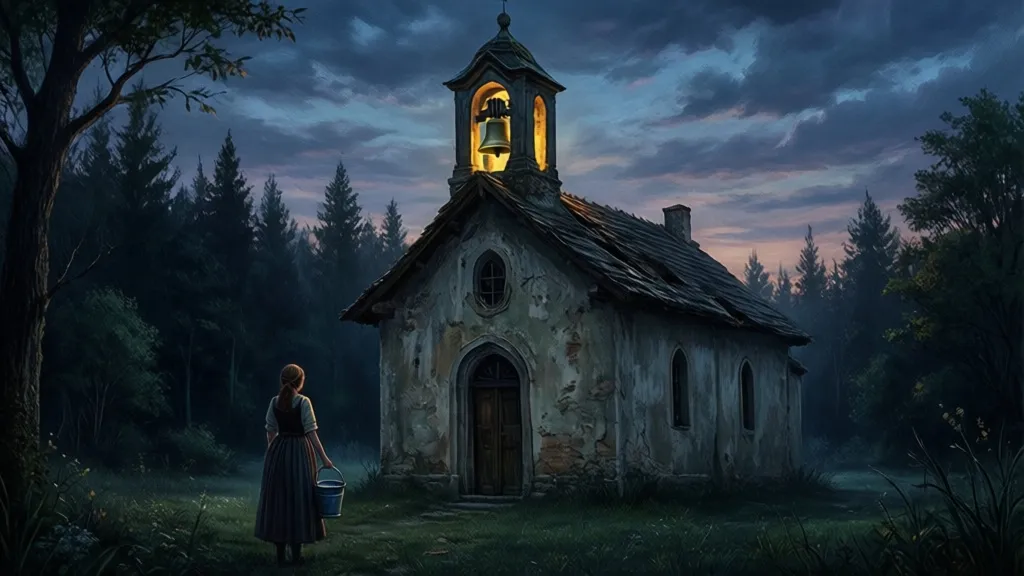
The bell began to shiver at dusk, when the sun had half-disappeared behind the treeline and the air hung thick with the particular stillness that comes before birds choose where to roost for the night. Mara was carrying water from the well when she heard it—not a ring, not yet, but a tremor of bronze against bronze, the sound of something held too long in silence deciding whether it could still remember its purpose.
She set the bucket down carefully, water sloshing against the rim.
The chapel bell had not rung in eleven years. The rope still hung from the tower, grey with weather and fraying at the bottom, but no one touched it. There were reasons—Mara knew them the way she knew the placement of stones in the path home, the way anyone knows the shape of an absence that has settled into architecture. Her mother had been the last to ring it, calling the village to witness something that should not have been witnessed, and afterward the rope had simply hung there, untouched, while the village learned to tell time by other means.
The bell shivered again. This time the sound carried farther—a warning, perhaps, or a question.
Mara left the water where it stood and walked back to her cottage. The door was open, as she had left it, and the hearth was cold except for the grey accumulation of yesterday's fire. She had been meaning to clean it. She had been meaning to do many things.
But there, in the ash at the hearthstone, something gleamed.
She knelt. The key was iron, long-shafted and heavy, its bow worked into a pattern she did not immediately recognize—something between a knot and a star, or perhaps a knot that had become a star through repetition. When she lifted it, the metal was warm enough to fog her palm, and she understood with the clarity that comes from being her mother's daughter that it had not been there this morning, and would not be there tomorrow if she did not take it now.
The bell rang once, properly this time—a deep, resonant strike that rolled out across the village like a stone dropped into still water.
Mara closed her fingers around the key.
The chapel stood at the edge of the village green, its door locked with a chain that had rusted into near-permanence. No one had questioned this. The lock had been added the night after Mara's mother rang the bell for the last time, and the village had collectively agreed—without ever speaking of it directly—that there were worse things than leaving certain doors unopened.
But Mara had the key now, warm and insistent against her palm, and the bell was ringing in a rhythm that felt less like a summons and more like a countdown. She could see others emerging from their cottages, faces turned toward the tower, expressions caught between alarm and something older than alarm—recognition, perhaps, or resignation.
No one approached the chapel. No one approached Mara.
She fit the key into the lock. The chain fell away with a sound like a sigh, and the door swung inward on hinges that should have been rusted shut but moved as smoothly as water.
The room beyond should have been empty. The chapel had been stripped eleven years ago—pews removed, altar dismantled, even the small stained-glass window at the back carefully extracted and relocated to the meeting hall, where it could cast its coloured light on matters less dangerous than devotion. Mara remembered watching the men work, methodical and silent, while her mother stood in the doorway with her hands folded and her face very still.
But the room was not empty.
There was a bed, narrow and iron-framed, made up with a white sheet embroidered along the hem with a pattern Mara knew by heart—her grandmother's work, the sheet her mother had been married under, the same sheet that should have been buried with her when the fever came. And beside the bed, a basin on a small wooden stand. The basin was filling slowly with water so black it seemed to drink the light, and the sound of it—drip, drip, steady and purposeful—matched the rhythm of the bell overhead.
Mara stepped inside. The door remained open behind her.
The bell rang again. Twice now, and she could feel the vibration in her teeth.
"It will keep ringing until midnight," said a voice from the corner of the room, where there should not have been enough shadow to conceal anyone. "Your mother would have explained this to you, I think, if there had been time."
Mara turned. The woman standing there was not her mother, though for a moment—just the briefest moment—Mara's heart performed a complicated motion somewhere between hope and grief. The woman was older, or perhaps younger, or perhaps age was simply not a category that applied. Her dress was grey, the colour of the bell rope, and her hands were folded in exactly the way Mara's mother used to fold hers when she was thinking about something she would not say aloud.
"Who are you?" Mara asked, though she was beginning to suspect the question was not quite the right shape.
"I am what the bell calls," the woman said. "Or I was, once. It becomes difficult to remember the distinction after enough time has passed. Your mother rang the bell because she thought she could undo what her own mother had done—that is the way of it, isn't it? Each generation trying to correct the previous one's choice." The woman's expression was neither kind nor unkind. "It did not work. She called me back, but could not bear to let me stay. So she locked the door, and the village tried to pretend there was nothing on the other side."
The basin dripped. The bell rang. Three times now.
"What happens at midnight?" Mara asked.
The woman tilted her head, and for a moment Mara saw something beneath the human shape—something that had been old when the chapel was built, old when the village was founded, old when the first bell was cast and hung to mark the hours of devotion. "At midnight, the threshold opens or closes. The bell is ringing to tell you it is time to choose. Let me through, or seal the door before I cross."
"What are you?"
"What was I," the woman corrected gently. "Your grandmother's sister. Your mother's aunt. The firstborn daughter, who should have inherited the cottage and the hearth, except that I was born at midnight on a night when the moon was doing something complicated, and the village midwife took one look at me and said threshold child. They tried to keep me. It did not go well. So my mother rang the bell—the first time it was ever used for that purpose—and sent me back to wherever it is that threshold children belong."
The water in the basin was nearly full now, black and perfectly still.
"My mother tried to bring you back," Mara said slowly. "And couldn't."
"She tried to bring back what she remembered of me," the woman said. "But I was six when I left, and she was four. Memory is not a reliable architect. She called, and I came, but I was not the sister she had made herself remember. So she locked the door and hoped the bell would forget."
Four rings. Five. The bell was tolling steadily now, each strike reverberating through the chapel walls, and Mara could feel something shifting in the room—the air growing thicker, the shadows deepening, the space between herself and the woman becoming less certain.
"What happens if I let you through?"
The woman considered. "I return. I take up residence in the world again, though I will not be precisely what I was—threshold children do not age in the usual manner, and I have been gone a very long time. I will be strange. I will make things complicated. The village will have to accommodate something it tried very hard to forget."
"And if I seal the door?"
"Then I go back, properly this time. The bell will be silent. The threshold will close. And you will spend the rest of your life wondering if you made the same choice your grandmother made, or a different one."
Six rings. Seven.
Mara looked at the bed, at the wedding sheet carefully tucked and smoothed. Her mother had made this, she understood—prepared it in secret, in the brief window between ringing the bell and losing her nerve. A place for her sister to return to. A gesture of welcome that had never been completed.
"Why didn't she let you stay?" Mara asked.
The woman's expression softened, just slightly. "Because she looked at me and saw all the years we had lost, and could not forgive herself for not remembering me correctly. Because I frightened her. Because I reminded her of our mother's grief, and grief is a difficult thing to invite back into your house."
Eight rings. Nine.
The basin overflowed. The black water spilled across the floor, moving toward the threshold, and where it touched the stone, the stone seemed to thin, as if the boundary between inside and outside were becoming negotiable.
"I am not my mother," Mara said, and was surprised by the steadiness of her own voice. "And I am not my grandmother."
"No," the woman agreed. "You are yourself. Which is why the bell called you, and why the key came to your hand."
Ten rings.
Mara thought of her mother standing in the doorway, hands folded, watching the men strip the chapel bare. She thought of the rope hanging untouched for eleven years, and the way the village had learned to tell time without it. She thought of thresholds and the things that live on them, and the way every generation inherits a choice they did not ask for but must nevertheless make.
The woman was standing very still, almost translucent now, as if she were already half-gone.
"Come through," Mara said.
Eleven rings.
The woman stepped forward. The black water parted for her feet, then closed behind her, and as she crossed the threshold the room seemed to exhale—or perhaps it was the village, or perhaps it was something larger than either, something that had been holding its breath for longer than anyone could properly count. The woman's form solidified. Her hands uncurled. Her dress shifted from grey to blue, a colour Mara recognized from old photographs tucked away in her mother's things.
"Thank you," the woman said, and her voice was different now—warmer, or perhaps simply more present.
The bell rang twelve times, a full and final strike, and then fell silent.
The water in the basin drained away, leaving only a damp circle on the wood.
Mara walked her great-aunt back to the cottage. The village watched from windows and doorways, silent but not hostile—more curious than afraid, and perhaps that would be enough. The key was still in Mara's pocket, cool now, its work completed.
"You will have to explain me," the woman said. "They will ask questions."
"Let them," Mara replied. "We have been too quiet for too long."
Inside the cottage, the hearth was still cold, but Mara knelt and built a fire—methodically, the way her mother had taught her, coaxing flame from ash and possibility. When it caught, the light spilled across the room, warm and ordinary, and her great-aunt sat at the table and folded her hands and looked, for the first time in seventy years, like someone who had finally come home.
Outside, the bell rope swayed gently in the night wind, its work complete, waiting—patient and unhurried—for the next time it would be needed.