The Body That Spoke With Ash
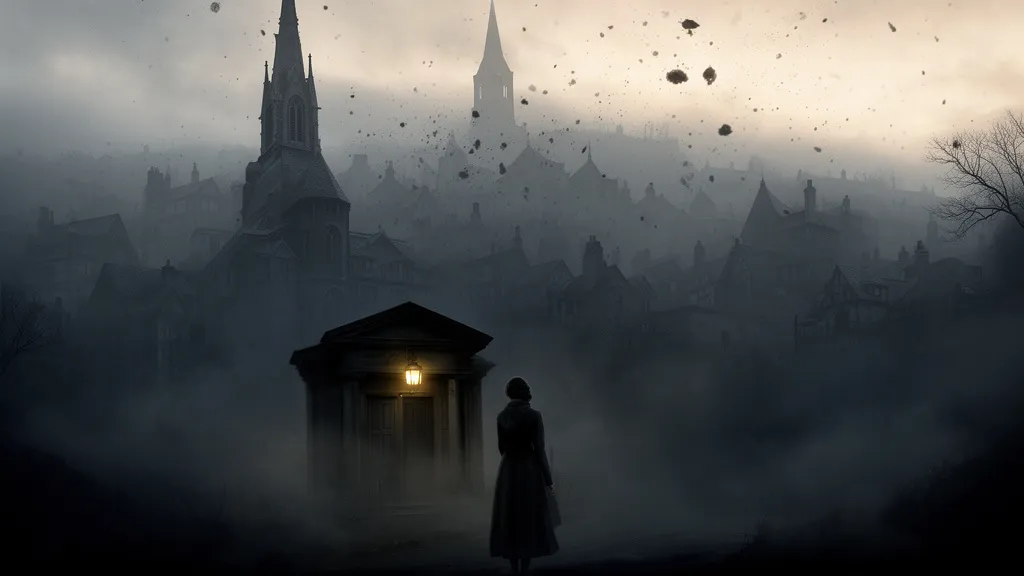
The fog arrived first, thick as grief and twice as patient, settling into the cobbled streets of Margrave Hill before the telegram could find its way to Isobel's door. By the time the boy knocked — his cap dark with rain, his eyes carefully averted — she already knew what the folded paper would say. The words body and identification and regret arranged themselves in the expected order, and she took her coat from its peg without speaking, because grief had its own grammar and she had learned it young.
The mortuary sat below the church, where the ground stayed cold even in summer. The attendant was a man named Croft, who had once been taller but had spent thirty years among the dead and it had bent him into the shape of apology. He led her through corridors that smelled of lime and silence, his lantern casting shadows that climbed the walls like ivy remembering sunlight.
"The crescent scar," he said, not looking at her. "On the left wrist. That's what you're here to confirm."
Isobel nodded, though he wasn't watching. Her brother Thomas had earned that scar falling from the apple tree in their mother's garden, twenty-three years ago, when the world was still a place where children climbed things and the only bodies in mortuaries belonged to the genuinely dead.
Croft drew back the sheet.
The man beneath it was not Thomas.
She knew this immediately and with a certainty that moved through her like cold water, not because the features were wrong — they were close enough, unsettlingly so — but because the body had Thomas's front tooth missing, the left incisor he'd lost in a fight outside the glasshouse seven months ago, and Thomas's coat with the frayed collar and the careful mend she'd sewn herself. But the wrist that should have borne the crescent was smooth and unmarked, and when Isobel reached for the coat's hem, her fingers found what they had no business finding: a pocket sewn into the lining, and inside it, wrapped in oilcloth, exactly one spoonful of ash.
"Is it him?" Croft asked.
Isobel's hand closed around the ash-packet. The dead man's face was Thomas's face worn by someone who had learned it recently, the way an actor learns lines — accurate in detail, wrong in substance. She thought of her brother's last letter, three weeks ago, written in his familiar scrawl: The glasshouse remembers things it shouldn't. I'm going back tonight to see what it's been keeping.
"No," she said.
Croft exhaled slowly, a sound like wind through a crack. "Then we have a problem, Mrs. Davenport. Because three men have already sworn it was him."
"Three men are mistaken."
"Three men want him identified by morning." Croft's voice had gone quiet, the kind of quiet that carried warning. "The magistrate says if family confirms, the body goes to potter's field before dawn. No questions, no delays. There are people in this town who prefer certain stories to stay unfinished."
Isobel looked at the body again. Someone had closed its eyes, but she could feel them watching her anyway, the way the dead sometimes did when they'd been given the wrong name.
"I need to think," she said.
Croft shook his head. "Thinking's for daylight. You've got until the bells strike four to say yes or no, and after that the decision gets made without you."
Outside, the fog had thickened into something almost solid, pressing against the churchyard walls like a living thing that had learned patience. Isobel stood beneath the lych-gate, the ash-packet burning cold in her pocket, and watched a fox pace the cemetery's eastern boundary. It moved in a perfect circle, returning to the same starting point every seventeen steps, and its eyes when it looked at her were the color of blown glass.
She knew that fox.
She knew it the way you know a story you've been told in childhood, even when you can't remember who told it — knew it was not exactly a fox, though it wore the shape well enough to pass in lamplight. It stopped mid-circuit and looked at her, and she understood that it was waiting.
The first lantern went out as she crossed Cripplegate Street.
The second died as she reached Market Square, its flame guttering to nothing though the oil reservoir was full. By the time she turned up Ropemaker's Lane, heading for the old glasshouse at the town's edge, darkness was following her like a tide, snuffing lights in her wake with systematic intention.
Someone wanted the naming done before dawn.
Someone wanted the body buried under the wrong name, and the real Thomas — if he still existed to be real — forgotten.
The thread appeared at the mortuary's back door.
It was blue, the particular blue of cornflowers or summer sky or the dress her mother had been buried in, and it ran along the cobbles like a vein of impossible color in the lampless dark. Isobel followed it because there was nothing else to follow, her footsteps careful, the fox padding behind her just beyond the reach of her vision.
The glasshouse rose from the hillside like a memory of winter, its panes dark and starred with cracks, its iron frame bent by decades of wind into something that resembled a ribcage. Thomas had worked there once, before the place closed, learning to blow glass from a man named Fenton who had died under circumstances the town preferred not to examine too closely. After Fenton, the glasshouse had stood empty — or had seemed to stand empty, which in Margrave Hill was not remotely the same thing.
The blue thread led to the eastern door.
Inside, the air tasted of old smoke and something sharper, metallic, the way blood tastes when you've bitten your tongue. The furnace in the corner had been cold for five years, but someone had filled it recently with ash, enough to reach the brim, and in that ash were things that had been burned but not consumed: glass beads shaped like vertebrae, copper wire twisted into letters Isobel couldn't read, and at the very center, one leather glove with the left thumb missing.
Thomas's glove.
She knelt beside the furnace, her hands shaking, and the fox stepped through the doorway behind her. In the darkness its edges had begun to blur, becoming something larger, more angular, with too many joints in its legs and eyes that reflected light there wasn't any source for.
"He made a trade," the fox said, its voice like glass bells heard underwater. "Your brother. He wanted to know what Fenton had been making, so he offered his name as payment. Names open doors, you see. Names let you remember things the world has been trying to forget."
"And the body in the mortuary?"
"A placeholder. A skin for the name to wear until the substitution is complete. At dawn, when they bury it as Thomas Davenport, your brother stops having been. The world forgets him backward. Childhood stories revise themselves. Photographs go blank. You'll wake tomorrow with a brother-shaped gap in your memory and won't know to mourn it."
Isobel's fingers found the ash-packet in her coat. "What's this?"
"Part of the trade. Ash from what he learned, sewn into the coat of what he'll become. If the burial happens, the transformation finishes. If you can return it to the furnace before the bells strike four, the bargain breaks."
Outside, church bells began their preliminary tolling. Not the hour yet, just the warning — fifteen minutes until four, until dawn, until the magistrate signed the papers and the body went into unconsecrated ground under a stolen name.
Isobel stood. Her hands were steadier now, because grief had its grammar but so did rage, and she had learned both. She emptied the ash-packet into the furnace, watched it settle among the glass vertebrae and copper letters, and then — because stories have their own requirements, their own symmetries — she drew her brother's glove from the pile and held it to her chest.
"Where is he?" she asked.
The fox's edges solidified back into animal shape, as if her question had reminded it what form it was supposed to hold. "Where he's been since the trade: learning what Fenton learned, seeing what Margrave Hill has been trying to forget for two hundred years. The glasshouse keeps memory like vessels keep water. Your brother's been drinking deep."
"Can I bring him back?"
"You already have. The ash is returned. The name is his again. But he won't be the same — no one comes back from inside the glasshouse unchanged."
The bells struck four.
The sound moved through the town like water finding level, and in the mortuary, Isobel knew, Croft would be standing beside the nameless body with his pen poised over the ledger, ready to write Thomas Davenport in the space marked identified by. But the body would be empty now, wouldn't it? The name would have slipped free, returning to its rightful owner, leaving only the placeholder husk that had never been anyone at all.
The fox turned to leave, then paused. "He'll come home," it said, "when he's finished learning. Could be days. Could be years. Things that go into the glasshouse don't keep mortal time very well."
"I'll wait," Isobel said.
And she did, though it took seven months and the loss of most of her certainty about what her brother had been before the glasshouse claimed him. When Thomas finally walked back into Margrave Hill on a morning white with frost, he carried a satchel full of glass birds that sang in frequencies that made the town's dogs howl, and his eyes had gone the color of furnace-fire, and he never did explain what Fenton had been making down there in the dark.
But he was Thomas — unquestionably, undeniably Thomas — and his name fit him again, the way a coat fits after you've grown into it, and that was enough.
The fox, for its part, stopped circling the cemetery gate.
The lanterns, one by one, learned to stay lit.