The Bottles That Held the Tide
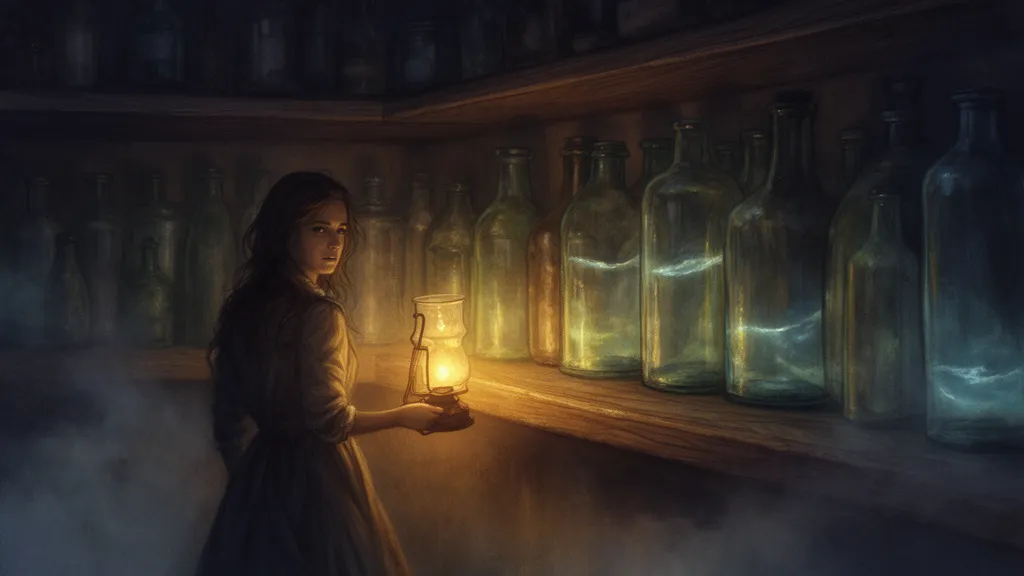
The first warm night of the season arrived without warning, and the bottles in Miren's pantry began to hum.
She had been banking the furnace when the sound reached her—low, insistent, like wind across the mouth of a cave. Not one voice but seventeen, layered and precise. The kind of sound that sits beneath the threshold of hearing until it doesn't, and then it is all you can hear.
Miren crossed the workroom, lamp in hand, and pushed open the pantry door.
The bottles stood where she had left them, arranged on the oak shelf according to date of sealing. Each one stoppered with wax pressed flat and marked with initials: clients who had paid for their breath to be caught and held, for reasons Miren had learned not to ask about. Some people wanted their grief contained. Others, their joy, so they could revisit it on days when joy seemed like something that had happened to someone else.
The wax on every stopper had begun to sweat.
Not clear, as wax does in heat. Blue. The colour of river ice at twilight, beading on the surface and sliding down the glass in thin rivulets.
Miren set the lamp on the shelf and touched one bottle with the back of her hand. Cool. The glass was cool. But the humming climbed through her palm, into her wrist, and settled somewhere beneath her ribs.
She counted the bottles twice. Seventeen sealed before midnight. Seventeen singing.
The one at the far left bore the initials T.V. Carved into the wax with the tip of her smallest glass knife. Theron Voss. Her brother, dead two years now, drowned when the ferry landing gave way beneath him during the flood season. He had asked her to seal his breath the week before he died—said he had a feeling, wanted something left behind that wasn't just memory.
Miren had refused to open it since.
She reached for the bottle now, fingers closing around the neck, and the humming stopped.
All seventeen bottles fell silent at once.
The night pressed in against the walls. Outside, the river murmured to itself, as it always did when the season turned and the snowmelt began its long journey down from the hills.
Miren lifted the bottle and held it to the light.
The wax had stopped sweating. The surface gleamed, slick and blue.
She twisted the stopper free.
The voice that rose from the neck of the bottle was Theron's—unmistakably, undeniably his. Not an echo. Not a memory shaped by longing. His voice, exact and unhurried, as though he were standing behind her in the workroom, one hand on her shoulder.
"The ferry landing," he said. "Eighteenth piling from the north shore. The rot goes deeper than they thought. It will give way at dawn when the spring tide peaks. Bring this bottle to the chapel. Set it on the altar before the first light touches the water. Tell no one what you have heard."
The voice stopped.
Miren stood very still, the bottle cool in her palm, and waited for more.
Nothing came.
She pressed the stopper back into place, wax yielding and then holding. The blue sheen faded. The bottle was simply a bottle again, glass and breath and silence.
Someone knocked at the door.
Lyra stood on the threshold with a lantern in one hand and water pooling around her boots. Theron's widow. Miren had not seen her in three months—not since the midwinter market, when they had passed each other between stalls and nodded without speaking, the way people do when grief has made language unreliable.
"The bottles," Lyra said. "I heard them from the road."
Miren opened the door wider. "You heard them."
"Everyone heard them." Lyra stepped inside, lamplight swinging across the workroom. "Half the town's awake. They think it's the river—some kind of flood warning. But it's not the river, is it?"
Miren closed the door and leaned against it. "No."
"What are they singing?"
"I don't know," Miren said, which was not precisely a lie. She knew what one bottle had said. The other sixteen remained sealed, humming or silent, she could not be sure anymore. The night had grown too full of sound—the river, the wind, the blood in her own ears.
Lyra set the lantern on the workbench and looked at her with the steady, patient expression Miren had always found unnerving. Theron had been mercurial, prone to enthusiasms and despair in equal measure. Lyra was something the river would recognize: constant, erosive, impossible to divert.
"You opened one," Lyra said.
"Yes."
"Theron's."
"Yes."
"What did he say?"
Miren felt the weight of the instruction settle more firmly into her chest. Tell no one. But Lyra was not no one. Lyra was the woman who had pulled Theron from the water, who had carried him up the bank and laid him on the grass and pressed her hands to his chest until the ferry master said enough, Lyra, enough. If anyone had a right to hear his voice again, it was her.
But the tide was turning. Miren could feel it even from here, the river beginning its slow inhalation, the way it did when the melt arrived and the water remembered it was part of something larger. Spring tide. The highest of the year. If the piling gave way—
"He said," Miren began, and stopped.
Lyra waited.
Miren thought about the ferry landing. About the eighteenth piling, counted from the north shore. About how many people crossed that landing every morning. The market vendors. The children on their way to the mainland school. The fishermen with their nets and their small, overlapping griefs.
About how Theron had been standing on that landing when it gave way beneath him, and how the river had taken him not because he deserved it but because the river takes what it wants, and wood rots, and no one notices until it is too late.
"He said the ferry landing is going to collapse at dawn," Miren said. "The eighteenth piling. It's rotten. I have to take the bottle to the chapel before first light."
Lyra's face did not change. "Did he say why the chapel?"
"No."
"Did he say what happens if you don't?"
"No."
Lyra looked toward the pantry, though the door was closed and the bottles were silent now, or singing too quietly to be heard through wood. "The other bottles. Did you open them?"
"No."
"Maybe you should."
Miren had considered this. But the instruction had been precise: tell no one what you have heard. If she opened the other bottles, she would hear more. And hearing more meant carrying more, and there was a logic to these things, a structure that felt older than the town, older than the river.
One bottle. One instruction. One choice.
"I don't think they're meant for me," Miren said.
Lyra studied her for a long moment. Then she picked up the lantern. "I'm going with you."
"He said—"
"He said tell no one what you heard. He didn't say go alone." Lyra turned toward the door. "And my shoes are already wet."
The chapel sat at the edge of the water, where the river widened before it met the sea. It had been a fishermen's chapel once, back when the town was smaller and the fleet larger, and the old gods were still being negotiated with in earnest.
Miren and Lyra walked in silence, the bottle wrapped in cloth and tucked inside Miren's coat. The lantern swung between them, casting their shadows long and restless across the path.
The river murmured. The tide was rising, Miren could see it now—the water creeping higher on the pilings, dark and purposeful.
They reached the chapel as the eastern sky began to pale.
The door was unlocked. It was always unlocked. Inside, the air smelled of salt and old wood and something else—something that had no name but which every person who had ever stood at the edge of water and asked for passage would recognize.
Miren unwrapped the bottle and set it on the altar.
The wax gleamed, faintly blue again in the dim light.
Lyra stood beside her, lantern lowered. "Now what?"
"I don't know," Miren said.
They waited.
The light crept higher. Through the narrow window, Miren could see the ferry landing, just visible in the growing dawn. The eighteenth piling, counted from the north shore. It looked like all the others. Solid. Reliable.
Then the tide peaked.
The river surged, sudden and silent, and the piling—that piling—shuddered.
But it did not give way.
Instead, the water pulled back. Not a retreat. A correction. The river adjusting itself, finding a new path, as though something had reminded it of an older agreement.
The bottle on the altar cracked.
Not shattered. Cracked—one clean line from neck to base, the kind of flaw that happens in the furnace when the glass cools unevenly and the memory of heat remains.
Miren picked it up. The stopper had loosened. She twisted it free, but no voice emerged. Just air. Just the faint, salt-edged scent of the river at dawn.
Lyra touched her arm. "Look."
On the altar, where the bottle had stood, the wood had darkened. A stain, or a shadow. No—a mark. Seventeen marks, small and precise, arranged in a half-circle like a calendar or a constellation.
Seventeen bottles. Seventeen breaths. Seventeen people who had asked Miren to hold something they could not carry alone.
One of them had been her brother. And her brother, it seemed, had remembered.
Miren wrapped the cracked bottle and tucked it back inside her coat. Outside, the sun touched the water, and the ferry master rang the bell for the morning crossing.
The landing held.