The Child Who Remembered Names
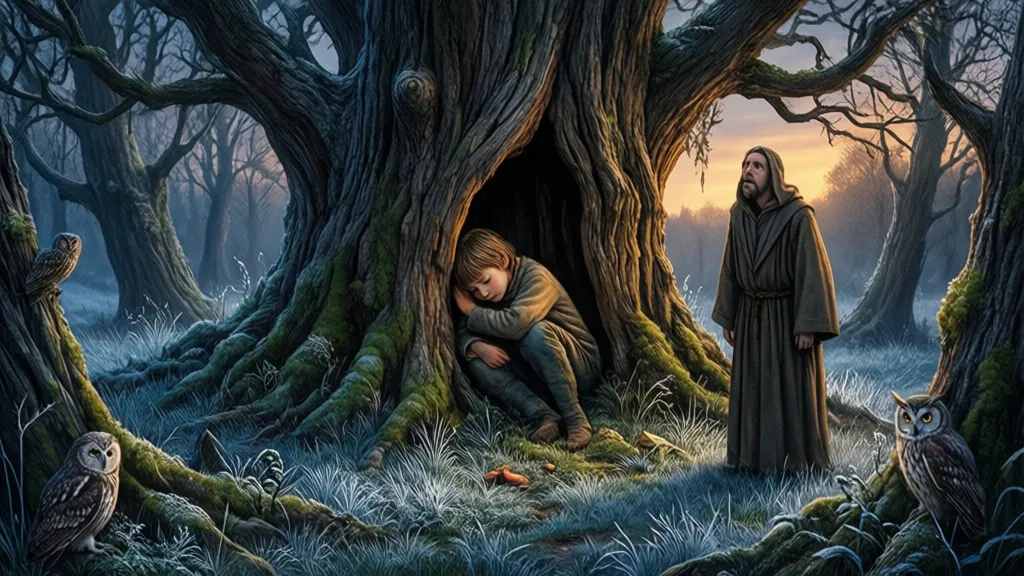
The yew tree had been hollow for three hundred years, and in that time it had held owls, rot, offerings wrapped in linen, and once — according to the oldest stories — a woman who refused to die until she had seen her son's face.
Brother Aldric found the child at dusk, when the light had turned the color of cold honey and the frost was already beginning to silver the grass. The child was curled inside the trunk, asleep, their small body folded into the ancient dark wood as if the tree had grown around them. Their boots were wet with black river mud, the kind that came from the deep places upstream where the water moved slowly and remembered things. On their forehead, someone had drawn a crown in ash — careful lines, deliberate, the sort of mark that belonged to rituals Aldric had only read about in books the diocese preferred to keep locked.
He stood for a long moment, his breath misting in the cold air, and considered walking away.
But the child's hand was blue with cold, and their lips had begun to pale, and Aldric had spent thirty years as a hedge-priest in a village that barely remembered God's name. He had learned, in that time, that walking away from a cold child was not something he could do twice.
He lifted them carefully. They weighed almost nothing. Their head lolled against his shoulder, and he felt the ash on their forehead smudge against his rough wool habit. The river mud left dark prints on his sleeves.
The village lay half a mile downhill, its slate roofs catching the last of the light. Aldric walked slowly, his boots crunching on the frost-hard path, the child's shallow breathing the only sound between his steps.
Then the bells began.
The chapel had three bells — bronze, cracked, so old their maker's marks had worn smooth. They had not rung in years except when Aldric climbed the tower and pulled the ropes himself, and even then they sang reluctantly, as if they had grown tired of announcing time to people who mostly ignored it.
Now they rang without ceasing, a cascade of sound that rolled down the valley and made the crows lift from the fields in a single black sheet.
Aldric stopped walking. The child stirred in his arms.
Their eyes opened — gray, the color of winter sky reflected in still water — and focused on Aldric's face with a clarity that did not belong to someone waking from cold sleep.
"Where is Maren?" the child asked. Their voice was quiet, perfectly calm. "She should be here."
Aldric's throat closed. He said nothing.
"Maren," the child said again, more insistent now. "Maren Grey, who kept the mill. She died in the spring, five years ago, when the ice broke early and the river rose. You buried her in the chapel yard under the hawthorn, but you didn't say her name at the grave because the lord's men were watching and she had been—" The child paused, tilted their head as if listening to something Aldric could not hear. "—she had been difficult about the taxes."
The bells rang louder.
Aldric began walking again, faster now, his heart a hammering thing behind his ribs. The village came up to meet him — low stone houses, smoke rising thin and gray from evening fires, faces beginning to appear in doorways and windows as the bells continued their impossible song.
Elder Hew stepped into the road, his gray beard frosted, his eyes sharp. "What have you brought us, priest?"
"A child," Aldric said. "Found them in the yew."
"That's no child," said Betta from her doorway, her hands white-knuckled on the frame. "That's something else."
The child looked at her with those gray, still-water eyes. "You are Betta Ashwood. You had a daughter named Cora who died of fever when she was six. You buried her favorite doll with her, the one with the blue dress, but you have never stopped looking for it in the corners of your house."
Betta made a sound like grief and turned away.
"Stop," Aldric said quietly. "Stop naming them."
The child looked up at him. "But they want to be named. They have been so quiet for so long."
The bells rang and rang.
From across the frost-silver fields, where the road came down from the lord's estate, Aldric saw horses. Three riders, moving fast, their cloaks dark against the pale grass.
Elder Hew saw them too. "The lord's men. They'll have heard the bells."
"What do they want with a child?" Betta asked, though her voice suggested she already knew.
Hew spat into the frost. "Same thing they always want. Control. They'll take the child to the lord's house, lock them up, call it protection. Or they'll—" He did not finish.
Aldric looked down at the child in his arms. The ash crown had smudged but not disappeared. The black river mud was already drying on their boots.
"The crypt," he said.
"The chapel crypt?" Hew's eyebrows rose. "The one that hasn't been opened in—"
"Twenty years. Yes." Aldric was already moving toward the chapel, its small stone bulk hunched at the edge of the village like something that had grown up from the ground rather than been built. "The candles keep going out down there. Guttering blue. Something in that place remembers."
"Or something's waiting," Betta muttered, but she followed, and so did Hew, and so did half the village, their footsteps quick and quiet on the frozen ground.
The chapel door was oak, iron-bound, heavy as sin. Aldric shouldered it open and carried the child inside. The bells overhead were deafening now, their sound filling the small nave until it felt like the air itself was vibrating.
The crypt entrance was behind the altar — a stone slab set into the floor, its edges worn smooth by centuries of rain leaking through the roof.
"Help me," Aldric said.
Hew and two others grasped the slab's iron ring and heaved. It came up slowly, grudgingly, exhaling cold air that smelled of earth and old wax. Stone steps descended into darkness.
Aldric looked down at the child. "Can you walk?"
The child nodded. Their eyes were very bright.
He set them on their feet and watched as they descended without hesitation, their small hand trailing along the damp stone wall. Aldric followed, his knees protesting, his breath coming short.
The crypt was small, low-ceilinged, lined with niches where long-dead priests had been laid. Candles stood in sconces along the walls — thick tallow things that Aldric had lit three days ago and found guttering blue the next morning, as if they were burning something other than wax.
The child walked to the center of the space and sat down on the stone floor, their wet boots folded beneath them.
"They're here," the child said softly. "All of them. Maren. Cora. Old Thomas who died in the barn fire. Elswith who drowned herself in the pond. They've been waiting."
Above, the church door crashed open. Boots on stone. Voices raised in command.
Aldric looked up at the rectangle of light, at Hew's face peering down, creased with worry.
"If they ask," Aldric called up, his voice steady, "you have not seen a child."
"And if they search?" Hew asked.
"Then they will find a hedge-priest praying over old bones."
Hew nodded once and lowered the slab.
Darkness fell, absolute, and then the candles began to burn again — not blue this time, but gold, warm as summer sun on wheat. The light filled the crypt, gentle and old, and in it Aldric could see the child's face, peaceful now, the ash crown glowing faint on their forehead.
"What are you?" he asked, though he thought he already knew.
"A remembering," the child said. "The river carries them. The trees hold them. And when enough have been forgotten, when enough names have gone unspoken, I come to say them aloud."
"And when you're done?"
The child smiled — a small, luminous thing. "Then I go back. The river takes me. And the village remembers, for a little while, that its dead were people with names."
Above, voices shouted. Boots rang on stone. The lord's men were searching, overturning benches, their anger a palpable thing seeping down through cracks in the floor.
Aldric sat down beside the child in the golden candlelight and waited.
The dead, he thought, have been waiting much longer.
He could wait a little while more.