The Child Who Slept in the Hive Box
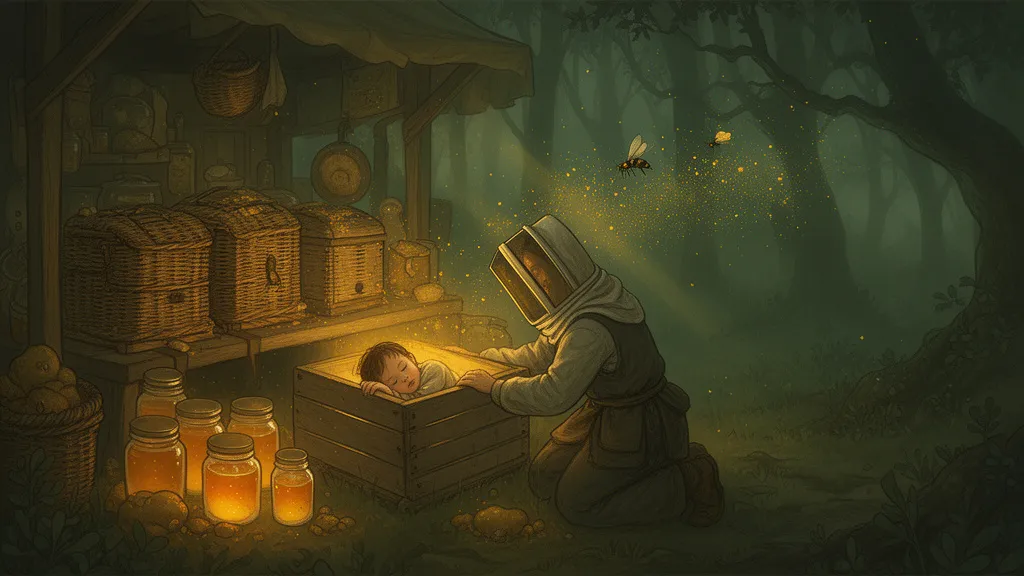
The box had been left open, which meant someone had looked inside and decided to walk away.
Cael found her three hours before the market would close for the season, when the light had begun to slant through the canvas awnings and the honey-sellers were wrapping their unsold combs in waxed cloth. The child was curled in the largest of his wicker hive boxes, the one he transported queen cells in during spring, her knees drawn up to her chest and her hair dusted gold with pollen that had not come from any flower he kept. Her shoes—small, leather, worn at the toes—were packed with river mud that had dried in layers, dark to pale, as though she had walked through the shallows at many different hours.
He did not touch her. He had been keeping bees for forty years, and he knew when something had been placed deliberately.
The market stretched along the old stone bridge that crossed the Mirrow where it widened before the falls. On the final day of midsummer trading, the bridge became a village unto itself: fabric merchants at the north end, livestock at the south, everything else arranged according to hierarchies Cael had stopped trying to understand decades ago. His stall occupied the eastern rail, where the light was good and the spray from the falls kept the air cool enough that his beeswax candles would not soften in their moulds.
The child breathed quietly. Her dress was blue, or had been—now it carried the grey patina of river fog and wood smoke. One of her hands rested against the wicker, fingers curled as though she had fallen asleep holding something that was no longer there.
Cael glanced toward the centre of the bridge, where the bell tower rose from the old guardhouse that had once controlled passage across the Mirrow. The bell-ringer—Osanna, who had held the position since her mother died—stood in the tower window, watching the hills.
She had not rung yet. But she would.
The Mirrow gathered itself in the high country after the summer storms, pooling in the grey granite bowls where the snowmelt mixed with rain, and then it remembered it was a river. When it came down, it came fast. The bridge had stood for three hundred years because the old builders had known to make the arches tall and the pylons deep, but the market was canvas and wood, and the people who built their stalls each midsummer were not old builders.
Cael had been packing his remaining stock—candles, small pots of honey, a few chunks of propolis wrapped in muslin—when he noticed the hive box had been moved. He kept three of them stacked beneath his worktable, lids secured with leather straps. The largest box now sat in the narrow space between his stall and the fabric merchant's, lid open, wicker pale in the slanting light.
He had looked inside because he was a man who checked his equipment.
The child stirred. Her eyelids moved, delicate as moth wings, and then opened. Her eyes were dark—river-stone dark, the kind of grey that holds brown and green depending on the light. She looked at him without sitting up, without speaking, and he felt the weight of her gaze as though she were taking inventory.
"Caelan," she said.
He had not been called that in twenty years. Not since his wife had died and he had asked the priest to stop using his full name in the harvest blessings, because hearing it spoken aloud made him feel like a man who had failed to arrive at his own life.
"How do you know that name?" His voice came out quiet, which surprised him. He had meant to sound firm.
The child sat up slowly, pollen drifting from her hair like fine snow. "The bees told me."
Cael kept bees. He knew what they told and did not tell. They spoke in movement, in the angle of their bodies against the light, in the scent they left on the air when they returned from forage. They did not speak in words, and they did not carry names.
"What are you?" he asked.
The child looked past him, toward the bell tower. "The water is coming."
"I know."
"It will take the bridge this time."
Cael followed her gaze. Osanna still stood in the window, but she had lifted the rope. The first bell was the warning: start packing. The second bell was the command: leave now. There had never been a third bell, because no one had ever stayed long enough to require it.
"The bridge has stood for three hundred years," Cael said.
"Yes," the child agreed. "But the water has been walking for longer."
She climbed out of the hive box with the careful movements of someone who had recently been something else—a bird, perhaps, or a fish, or a piece of river fog that had briefly entertained the idea of having hands. Her shoes left prints of damp mud on the stone.
The first bell rang.
It was a low, heavy sound, more felt than heard, and the market responded as it always did: voices rising, canvas snapping as stalls were dismantled, the wooden clatter of crates being stacked. Cael had done this twenty times before. He knew the rhythm.
The child took his hand.
Her fingers were cool and slightly damp, as though she had been holding stones in a stream. "We have to go now."
"I'm not finished packing."
"You will be."
She was right, of course. He had been packing when he found her, and the rest could be done in minutes: stack the remaining candles, strap the hive boxes closed, load everything onto the handcart he kept tied to the rail. He did not need an hour. He barely needed twenty minutes.
But the child's hand tightened on his, and he understood that she was not concerned with his packing.
"Where are we going?" he asked.
"Away from the bridge."
Osanna rang the second bell.
The sound was sharper, more urgent, and the market shifted from orderly departure to something close to flight. The livestock sellers had already gone—Cael had watched them drive their sheep and goats across the bridge an hour ago, when the light first began to change. Now the fabric merchants were rolling their bolts, the candle-makers were shoving unsold stock into sacks, and the woman who sold apple cider from a barrel was tipping the remainder into the river.
The child pulled him toward the north end of the bridge, where the road climbed into the hills and the forest began. She moved through the crowd as though she knew exactly where each person would step, slipping between bodies with the fluid certainty of water finding its path.
Cael followed. He did not know why. He had not followed anyone in twenty years.
They passed the herbalist's stall, where the old woman was muttering at her unsold tinctures, and the blacksmith's, where the apprentice was frantically unhooking horseshoes from their display board. The child did not look at any of them. She watched the river.
It had changed. Cael could see it now—the colour had gone from grey-green to brown, and the sound had deepened, no longer the steady rush of water over stone but something lower, more deliberate, the voice of something large remembering how to speak.
They reached the north end of the bridge just as the third bell rang.
Cael had never heard the third bell. He had not known Osanna even could ring it—there were only two ropes in the tower, and he had assumed that was all the bells the old builders had installed.
But the sound that rolled across the market was not a bell. It was older than that, deeper, the kind of sound that should have come from the earth itself, and it carried a single, unmistakable message: too late.
The bridge shuddered.
Cael felt it through his feet, a slow vibration that ran the length of the stone, and he turned in time to see the water arrive. It came from upstream in a wall of brown and grey, carrying branches and stones and things that had once been part of the forest, and it hit the first arch with the weight of something that had been withheld too long.
The bridge held. For a moment, Cael believed it would stand, as it had stood for three hundred years.
Then the centre arch folded, slow and strangely graceful, and the market went into the river.
The child's hand tightened on his. "We're safe here."
Cael stood at the edge of the road and watched the water take everything—the stalls, the canvas, the careful work of a hundred merchants who had built the same temporary village every midsummer for as long as he had been alive. The river did not seem angry. It seemed, if anything, satisfied, as though it had been owed this for some time.
When the water finally began to recede, leaving only wreckage and the two intact arches at either end of what had been the bridge, the child released his hand.
"You can go home now," she said.
Cael looked down at her. "What are you?"
"I am what the river remembers," she said. "And the river remembers you were kind to your bees."
She walked away down the road, her shoes leaving prints of drying mud, and Cael did not follow. He stood and watched her until she reached the edge of the forest, where the shadows were deep enough to hold small, deliberate things, and then she was gone.
The bees, when he returned to his workshop that evening, were louder than usual, moving in patterns he did not recognize. But the honey they made that autumn was the clearest he had ever harvested, and it tasted faintly of river water and pollen from flowers that did not grow anywhere near his hives.