The Door That Waited in the Snow
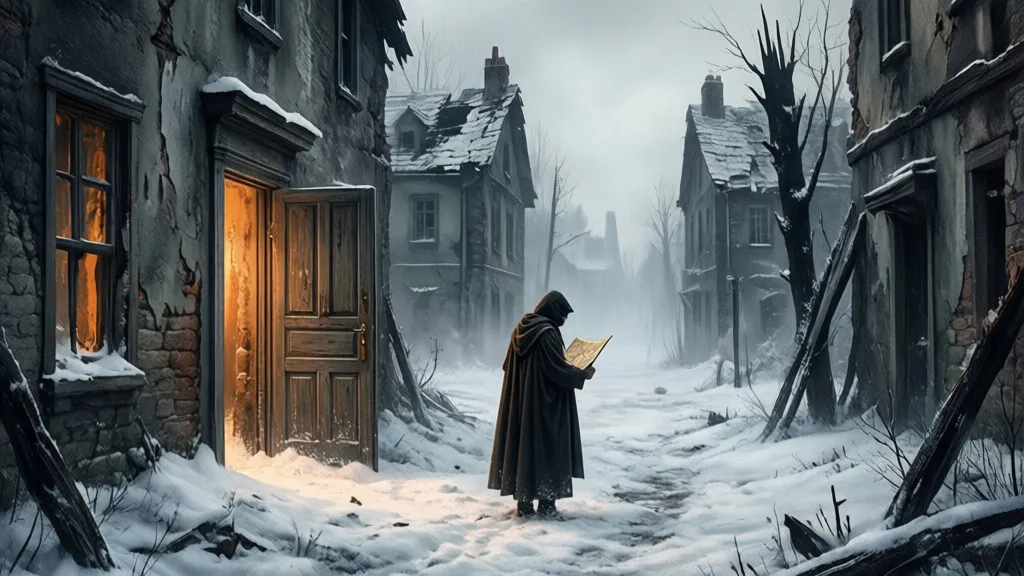
The mapmaker accepted salt because coin had stopped meaning much after the fires. Three handfuls, coarse and grey, wrapped in linen that smelled of the smokehouse—enough to keep her through winter if the river froze early, which it would. The woman who paid her had ash in the creases of her palms and would not meet Kael's eyes.
"The route runs through Aldgate," the woman said. "From the cooperage to the miller's yard. My daughter needs it drawn."
Kael knew Aldgate. Knew it in past tense, the way one knows childhood homes seen only in dreams. The district had burned six weeks past, and the snow that followed found nothing to interrupt it—no eaves to gather beneath, no chimneys to melt around. Just a white hollow where forty houses used to lean against each other like tired dancers.
"There's nothing to map," Kael said gently.
The woman's fingers tightened on the linen. "Please. She says the way is still there. Says she needs to see it drawn, or she won't believe it's gone."
Kael understood grief. She had mapped plenty of vanished things—a coastline before the storm, a forest before the logging, streets that had been renamed when the new duke wanted to forget the old wars. Cartography was, after all, the practice of drawing things as they were supposed to be, not as they stubbornly remained.
She took the salt. She would draw the map.
The market emptied as the light failed. Kael worked at her table until the last of the fishmongers packed their unsold catch in ice and trudged toward the bridges. The air tasted of incoming snow and the particular silence that comes when a city prepares to sleep beneath white.
She finished the map by candlelight. Aldgate as it had been: the cooperage with its three chimneys, the narrow passage behind the tinsmith's where children played at warriors, the miller's yard with its two willows leaning over the fence. She marked the route in red ink—a line that curved and doubled back because Aldgate had grown without plan, accretions of wood and need piled atop older accretions until the streets were more like thoughts than thoroughfares.
When she set down her pen, the city bells were ringing the hour between dusk and dark, which some still called the wolf's mouth, though there had been no wolves in the valley for a hundred years. Longer, perhaps. Long enough that only the bells remembered.
Kael rolled the map, but did not tie it.
She had drawn a route. It seemed only proper to walk it.
The snow lay thick where Aldgate had stood. Kael's boots broke through the crust with sounds like small breakings, and she followed her own red line as though it were painted on the air before her. Here, the cooperage. Here, the tinsmith's passage. The city had not rebuilt—there was talk of leaving the site empty, letting it become a commons, though what one did with a commons that smelled of char and loss, no one had decided.
The map insisted on a path. Kael followed.
She walked where walls had been. She turned at corners that no longer interrupted the white. The route doubled back, and she doubled with it, moving through absence as though it were substance. The snow was darker here, or perhaps the dusk was—some quality of the light made everything uncertain, edges blurred, the real and the remembered trading places like partners in a dance.
And then: the door.
It hung in the air above a hollow filled with black water—meltwater, perhaps, or a spring that had been capped by houses and now ran free. The door was narrow, painted blue once but weathered to grey, with iron hinges that should have been attached to a frame but simply ended, brackets dangling in empty air. It was closed. It was impossible. It was exactly where the map said the miller's yard should be.
Kael stood at the hollow's edge and breathed out slowly, watching her breath silver in the dusk.
The door opened.
The boy wore a fox-fur cap pulled low over his ears and a coat too large for his frame, sleeves rolled back to expose thin wrists. He stood in the doorway—in the door frame, though there was no frame, in the threshold, though there was no building to cross into—and looked at Kael with the expression of someone who has been waiting a very long time and is relieved, finally, to be proven right.
"You came," he said.
Kael's throat was dry. "I didn't know I was expected."
"Since the fire," the boy said, as though this explained everything. Perhaps it did. He glanced behind him, into the space beyond the door, which should have shown the snow and the hollow and the darkening sky but instead revealed a room: small, cluttered with familiar shapes—barrels, sacks, the corner of a wooden counter. The miller's storehouse, Kael thought, though she had never been inside it.
"I've been waiting," the boy continued, "because someone had to remember the way. And then you drew it, so I knew you'd come."
"The map," Kael said slowly. "You felt the map being drawn."
"The city did." He smiled, small and careful. "Or what's left of it. The fire took the wood and the people, but it couldn't take the paths. Those are older. Those remember."
Kael thought of the route she'd traced, the red line winding through vanished streets. She had drawn it from memory, yes, but also from something deeper—the logic of how a district grows, how foot traffic wears certain turns smooth, how desire and necessity carve channels through a city the way water carves channels through stone.
"What are you?" she asked.
The boy tilted his head. His eyes were dark and reflective, like water at night. "The same thing as the route," he said. "Still here. Still waiting. The houses burned, but I was already ash by then, so the fire didn't bother with me."
He had died in an earlier burning, Kael understood. Years ago, perhaps decades. Some small tragedy that Aldgate had built over and forgotten, the way cities forget all their small tragedies, paving them with new foundations and pretending the ground is solid.
"Why did you wait for me?"
"Because you're a mapmaker." He said it as though it were obvious. "You draw things so they can be found. I needed to be found one more time before the snow covers everything."
Kael looked at the door, at the boy, at the black water that should have been frozen by now but moved in slow, oily currents beneath the impossible threshold. She thought of the woman with ash in her palms, the daughter who needed to see the route drawn so she could believe it was gone.
Belief and grief were both forms of cartography, she supposed. Ways of marking what had been, so one could navigate its absence.
"What happens," Kael asked, "if I step through?"
The boy's smile widened slightly. "You find what you're mapping. That's how it works, isn't it? You draw the route, then you walk it. Then you know if it's true."
"And is it?"
He looked back into the room behind him, the storehouse that shouldn't exist, stocked with supplies for a mill that had burned to ash and memory. When he turned back to Kael, his expression was gentle, the gentleness of something that has outlasted its own sorrow and found, on the far side, a mild and patient amusement.
"The map is true," he said. "The city just isn't finished deciding what that means yet."
Kael stood at the edge of the hollow. The wolf's mouth hour was ending; full dark would arrive soon, and with it the snow the air had been promising all day. She could walk back to her table, deliver the map to the ash-palmed woman, take her payment of salt and survive the winter in the reasonable, mapped world where doors required frames and ghosts did not wait in blue-grey thresholds.
Or she could step forward.
She stepped forward.
The threshold was cold and tasted of snow-melt and old smoke, and for a moment Kael was neither in the hollow nor through the door but suspended in the space between, where the city kept its discarded routes and forgotten turnings. She could feel the weight of every path she'd ever drawn, every line of red ink insisting that this way, yes, this way had meaning.
Then she was through, standing in the miller's storehouse, and the boy in the fox-fur cap was closing the door behind her with a soft, definitive sound.
"Now," he said, pleased, "you can add it to your map. The route that goes through Aldgate and ends here, in the place that didn't burn because it burned before."
Kael looked around. The storehouse was exactly as she had imagined it while drawing: barrels stacked in corners, sacks of grain leaning against walls, the smell of flour and wood. Real, or real enough. She could spend the winter here, she thought, if winters could be spent in places that existed only because someone had bothered to draw them.
"Will the door stay?" she asked.
The boy shrugged. "As long as the snow remembers where Aldgate was. After that—" He smiled. "You're the mapmaker. You tell me."
Kael thought of the map rolled on her table, the red line winding through absence. She thought of the woman's daughter, who needed to see the route drawn so she could believe it was gone. But gone and gone were different things. The city had not finished deciding.
She would stay here tonight, in the storehouse that shouldn't exist. In the morning, she would redraw the map, adding this final stop: the door that waited in the snow, the threshold that remembered.
Someone had to mark these places. Someone had to draw the routes the city kept, even after the fires.
That was what mapmakers did.
Outside, the snow began to fall, soft and determined, covering the hollow and the empty white expanse where Aldgate used to lean against itself. Covering, but not erasing. The paths were older than the snow. The paths would wait.