The Eyes That Watched from Plaster Walls
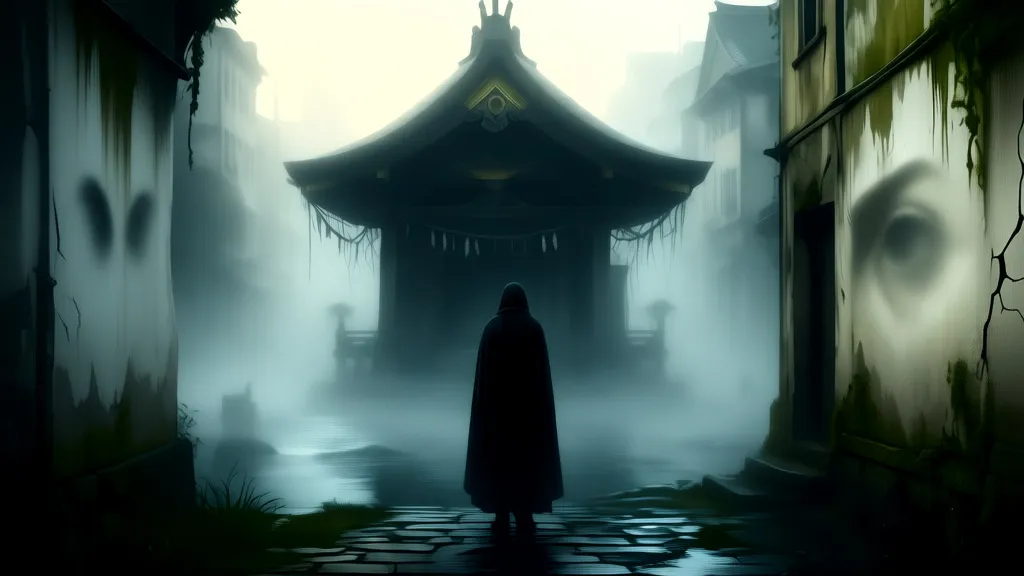
The plaster wept before Maren arrived, which meant the shrine had been waiting.
She crossed the lower ward at dawn, when the river fog still clung to the quay stones and the water had not yet decided whether to rise or retreat. The magistrate's summons had come by messenger at the fourth bell, the kind of early knock that meant something old had been disturbed, something the city would prefer to understand before the tides changed and brought witnesses.
The shrine stood where the canal met the eastern wall, one of the thousand small devotions tucked into corners where the architecture permitted prayer. This one honored the Keeper of Departures, which was the polite name for the current that pulled bodies downriver when the floods came. Someone had plastered over the niche three generations back, during the reforms, when the magistrates had decided the old gods encouraged fatalism.
The plaster was weeping.
Maren set her tools on the cobblestones and ran her fingers across the wall. The moisture was cold and clean, beading like condensation but moving upward, against gravity, gathering at the sealed threshold. The wall sweated toward the shrine itself, as if something inside was drawing the dampness home.
"You're certain of the date?" she asked.
The ward keeper, an elderly man named Torrin who had summoned her, consulted his ledger. "Sealed on the twelfth of Ash, year forty-seven of the reform. My grandfather did the work himself."
Seventy-three years. Long enough for memory to become myth, for the citizens who remembered the shrine's original function to pass quietly into the estuary mud. Long enough for the city to forget what it had locked away.
Maren retrieved her chisel.
The plaster came away in curved sheets, like bark peeling from a wet birch. It should have taken hours—proper lime plaster, applied correctly, bonded to stone with a grip that outlasted dynasties. But the wall was eager. Each tap of the mallet revealed more of the niche, the plaster lifting as if it had been waiting for permission.
Torrin stepped back when the first eye appeared.
It was blue glass, the size of a child's fist, set directly into the mortar where the shrine's back wall should have been. Not decorative. Not symbolic. An eye, anatomically precise, with a dark pupil that caught the dawn light and held it.
Maren kept working.
More eyes emerged as the plaster fell. Seven, then twelve, then twenty—a nest of them pressed into the mortar like fossils in shale, each one oriented outward, each one regarding the ward with a different angle of attention. The blue glass was old, hand-blown, full of bubbles and striations. The kind of glass they had stopped making when the furnaces moved upriver and the sand changed.
And each eye was clouding over.
Maren watched it happen, a slow fog spreading from the edges of the glass toward the pupils, like breath on a mirror. One by one, the eyes developed cataracts, the blue deepening to pearl-grey, the watching dimming to blindness.
"They've finished," Torrin whispered. "Whatever they were watching, it's done."
Maren didn't answer. She was staring at the largest eye, set in the exact center of the nest. It hadn't clouded yet. It was still blue, still clear, and as she watched, it moved.
Not the glass itself. The image inside it.
The pupil darkened, then lightened, and suddenly she was looking at a face.
Her brother's face.
Lucien. Drowned eight months ago when the autumn floods took the northern bridges. They'd found his coat on the quay, his boots wedged between the pilings, but the river had kept the rest. The magistrates had declared it an accident, closed the inquiry, offered the stipend for a memorial stone.
She had not believed them.
The eye showed him in profile, turning away, water streaming from his hair. Behind him, a wall she didn't recognize—dark stone, slick with moss, torches burning green. He was walking. Not floating, not drifting. Walking, as if the river had floors.
"What is it?" Torrin asked.
Maren didn't answer. She reached for the eye, fingers trembling, and the glass was warm.
Behind her, the river rose against the quay.
The magistrates would arrive by midday. Torrin had already sent the second messenger, the formal notification required when a sealed shrine yielded relics. They would bring assessors and historians, lamplighters and clerks. They would catalog the eyes, debate their origin, argue about the cult that had installed them. And then, because this was the lower ward and the river was prone to flooding and the city had protocols for contaminated devotions, they would open the sluice gates.
They would flood the ward for inspection.
It was an old technique, older than the reforms. Water revealed what stone concealed—hidden shrines, forgotten offerings, channels carved into the city's foundations. The flood would last six hours, rising to the height of a man's chest, slow and cold and thorough. Anyone who wished to remain would need to move to the upper floors. Anyone who wished to preserve something would need to do so quickly.
The eyes would be underwater by evening.
Maren ran her thumb across the warm glass. Lucien turned in the image, still walking, and she caught a glimpse of the corridor beyond him—a long throat of stone descending into darkness, water ankle-deep on the floor, walls lined with more shrines, more eyes, more watchers.
The river had floors.
She had been telling herself for eight months that the river was simply a river, that drowning was simply drowning, that there was no deeper architecture to the estuary's hunger. But the eyes knew otherwise. The eyes had been watching the river for seventy-three years, tracking its geography, mapping its intentions. And now they had finished watching.
Except for one.
Lucien glanced over his shoulder, directly at her, and she realized: he could see her. Not the eye—him. He was looking back through the glass, through the shrine, through the eight months that separated drowning from discovery.
He mouthed something. Two syllables, urgent.
Follow.
The shrine began to ring.
It was a soft sound, delicate and high, like a spoon tapping the rim of an empty cup. It came from deep inside the wall, from somewhere behind the nest of eyes, a vibration traveling through stone and mortar and ancient devotion. The ringing had a rhythm—three short taps, a pause, three more. A signal.
Or a countdown.
Torrin was backing away. "We should close the ward. Evacuate before—"
"Before what?" Maren asked.
"Before it opens."
She looked at him. "The shrine?"
"The river."
He was old enough to remember stories, even if he'd dismissed them as superstition. The river was not simply water moving toward the sea. The river was a seam, a place where the world folded over itself, where things that should have stayed drowned occasionally rose to the surface. The shrines had been built as watchpoints, as early warnings, as places to seal bargains with the current.
The reforms had stopped the bargains. Had plastered over the shrines. Had declared the river tamed.
The river, it seemed, had thoughts of its own.
Maren pressed her palm flat against the central eye, against Lucien's image, and the glass grew warmer. She could feel something beneath it, something hollow and vast, a space that should not fit inside a wall. The shrine was not a niche. It was a threshold.
She could report the discovery. Could step back, let the magistrates arrive, let them flood the ward and catalog the eyes and seal the shrine again, properly this time, with lead and iron and official wax. Could accept that Lucien was gone, that drowning was final, that the river took what it took and gave back nothing.
Or.
The glass was warm. The ringing continued. The image showed Lucien still walking, descending deeper into the stone throat, following the corridor to wherever the river kept its floors.
She could follow.
But the magistrates would arrive by midday, and the ward would flood, and the threshold—if it was a threshold—would be submerged. Six hours underwater. By the time the sluices closed, the shrine would be sealed again, this time by depth and current, inaccessible until the next century, the next reform, the next conservator with a chisel and a summons.
If she was going to follow, she had to go now.
She had to hide the discovery.
Maren turned to Torrin. "How long until the magistrates?"
"Four hours. Perhaps five, if the tide is against them."
She nodded. Looked at the nest of clouded eyes, the one clear pupil, the warm glass beneath her palm. Thought about protocols and stipends and memorial stones. Thought about her brother, walking through water, glancing over his shoulder as if to say: I found something. Come see.
"Help me replaster the wall," she said.
Torrin stared at her. "You can't. It's a relic. It's—"
"It's mine," Maren said quietly. "He's mine. And I'm not letting them drown him twice."
They worked quickly. The plaster was still damp, the sheets intact enough to press back into place. Maren mixed fresh mortar from the supplies in her satchel, working it into the gaps, smoothing the seams. It wouldn't pass close inspection, but it would hold through the morning, long enough for the magistrates to glance at the wall and see nothing but old repairs, ordinary maintenance, a shrine properly sealed.
The ringing grew louder as she worked.
Torrin handed her tools without speaking, his hands shaking. He understood what she was doing—not just hiding a relic, but preparing to step through it. The shrine would only open once. The river only offered passage to those who had been called, and the calling came through the eyes, through the watching, through the moment when the glass warmed and the image moved.
Lucien had been called eight months ago. Had walked into the water and found the floors.
Now Maren was being called in turn.
She pressed the final sheet of plaster into place, sealing the nest except for the central eye. That one she left exposed, just barely, a circle of blue glass no larger than a coin. She carved a small recess around it, made it look intentional, devotional—a peephole for prayer, the kind of aperture the old shrines sometimes featured.
The magistrates would see it and think nothing.
The glass pulsed warm beneath her fingers.
Lucien's image had changed. He was standing still now, at the bottom of a long stair, waiting. Behind him, she could see a door made of river-stone, its surface carved with words she didn't recognize. An old language. A true language, the kind that named things into existence.
He gestured: Hurry.
The water was rising. She could hear it lapping at the quay, higher than the tide should have brought it, pressing against the ward's foundations. The river was responding to the ringing, to the opening, to the threshold preparing to unlock.
Maren looked at Torrin. "When the magistrates come, tell them I went upriver. Tell them I'm checking the northern shrines."
He nodded, pale. "Will you come back?"
She didn't know. The river didn't make those promises.
She pressed her palm flat against the warm glass, and the eye opened.
It did not open like a door. It opened like a decision.
One moment Maren was standing in the ward, her hand against the shrine, the morning light slanting across the cobblestones. The next, she was standing in water, ankle-deep and cold, in a corridor of dark stone that stretched downward into depths the dawn could not reach.
The air smelled of salt and wet stone and something older—petrichor, perhaps, or the particular dampness of caves that had never known sun. Torches burned along the walls, their flames green and smokeless, casting light that moved like water itself.
Lucien stood at the bottom of the stair, exactly where the image had shown him.
He looked the same—soaked, exhausted, but whole. Not drowned. Not lost. He smiled, and it was the smile she remembered from before the floods, before the autumn, before the river had decided to collect its debts.
"I knew you'd follow," he said.
Maren walked down the stairs, her boots splashing in the shallow current. Behind her, the threshold shimmered—still open, but only just, the connection to the ward growing thin. She could hear, faintly, the sound of the city waking, the calls of the gulls, the ringing of the shrine fading to silence.
"What is this place?" she asked.
Lucien gestured at the corridor, at the shrines set into the walls, at the eyes watching from their niches. "The river's memory. The part it keeps below the surface. I found it by accident—fell through during the floods, landed here instead of drowning."
"And you stayed?"
He shook his head. "I tried to get back. But the river only opens when it's ready. When someone else is called."
Maren understood. The river was not cruel, but it was patient. It waited until the need was sufficient, until the grief was sharp enough to cut through plaster and protocol and the city's careful forgetting. Then it opened. Then it called.
Then it offered passage.
"Can we go back?" she asked.
Lucien looked at her, and his smile faded. "I don't know. The river hasn't said."
Behind them, the threshold flickered. The ward was flooding now, the magistrates arriving, the sluices opening. The shrine would be underwater soon, the connection severed, the watching complete.
Maren thought about the city she had left behind—the protocols, the stipends, the careful conservation of things the magistrates permitted. Thought about her brother, standing in the river's memory, whole and waiting.
Thought about the door at the bottom of the stair, carved with words that named things into existence.
"Show me," she said.
Lucien nodded and turned, leading her deeper into the corridor, past the watching eyes, toward the door that opened onto whatever the river kept below the floods.
Above them, the ward filled with cold water, and the shrine rang softly one last time, like a spoon in an empty cup, and then fell silent.
The watching was finished.
The following had begun.