The Glove That Remembered Her Brother
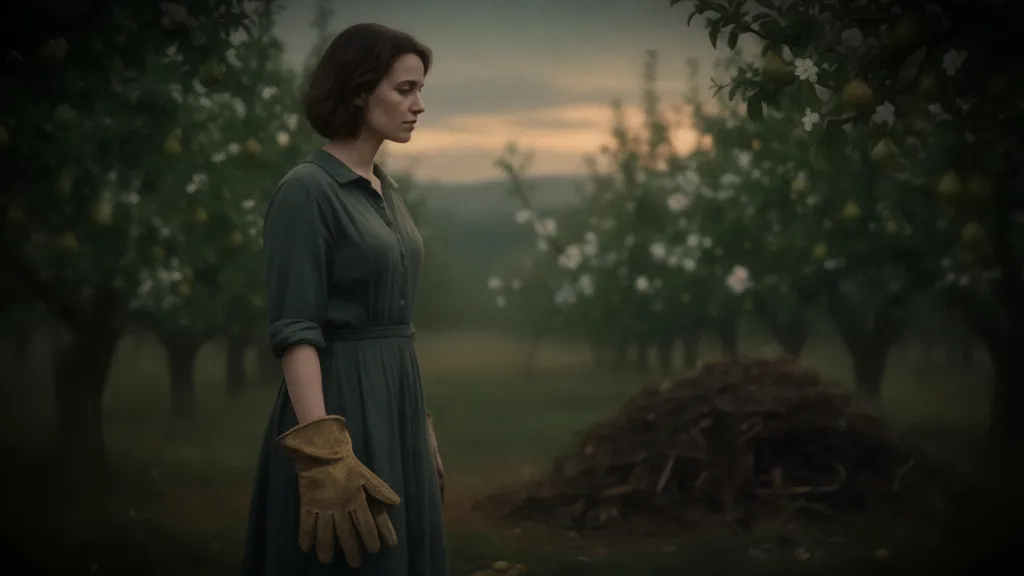
The pear trees had finished their forgetting by the time Nessa found the glove in the compost heap behind the shed, which meant the orchard had decided to remember something it should not have kept.
She had been turning the pile with the old fork, breaking apart the clumped leaves and windfall fruit, when the leather surfaced among the rot. A field glove, split along the thumb seam, the kind their mother had worn when grafting rootstock. Nessa lifted it out with the tines and let it hang there, dripping dark water onto the gravel.
The name was stitched into the wrist lining in small, careful letters: Owen.
Her brother.
Who had been gone eleven years.
The thread was blue—indigo, specifically, the colour their mother had used for mending winter coats—and it was damp. Not mouldy-damp, not rot-soft, but wet as if someone had just now pulled it through fabric with a needle held between their teeth to keep their hands free for knotting.
Nessa turned the glove inside out. The stitching was neat, unbroken. The letters ran along the inner seam where a hand would press against wrist bone, where sweat would darken the leather over years of use. She counted the stitches. Forty-two.
Her mother had been buried in the left glove, the matching one. Nessa had folded it herself into the coffin, placing it over the woman's heart because that was what you did with a grafter's hands when the grafting was finished. This right glove—the one with Owen's name—had been missing since the funeral. Nessa had assumed it lost, dropped somewhere between the house and the burial plot, claimed by grass or mud or the general entropy of grief.
She had not imagined it would surface here, eleven years later, stitched with a name her mother had sewn in the weeks before Owen left. A claim of ownership, or a blessing, or perhaps simply the thing you did when your son took up grafting and needed gloves of his own: you gave him one of yours, marked it so he would know whose hands had taught him, and kept the other so you would remember whose hands you were teaching.
She looked at the compost heap. At the fork. At the rows of pear trees stretching up the hillside, their branches stripped clean, the last of the harvest already sorted and crated in the barn. The trees stood in their lines and did not offer explanations.
Nessa carried the glove inside.
The stitching continued.
She found it that afternoon while hanging the glove to dry above the sink: a second line of thread emerging from the cuff, trailing out and away as if the needlework had simply kept going after the name was finished. The thread ran along the windowsill, down the cabinet face, across the floorboards toward the door.
She followed it.
It led through the yard, past the shed, into the grass at the orchard's edge. The thread disappeared into the ground near the old irrigation access—a stone culvert half-buried in bindweed, the iron grate rusted through in places but still mostly intact. The county had stopped using the tunnel fifteen years ago when they rerouted the water line. Her mother had planted honeysuckle over it. The vines were thick now, woody, the flowers long finished for the season.
Nessa knelt and pulled the grate aside.
The thread went down.
She fetched the electric torch from the shed and climbed in.
The tunnel was narrow, brick-lined, older than the orchard itself. It smelled of clay and wet stone and something else—paraffin, she thought. Candle wax. The thread continued along the floor, glowing faintly blue in the torchlight, and she followed it deeper, the tunnel sloping downward until she could no longer hear the wind in the trees above.
The living space appeared after thirty yards: a widening in the passage where someone had arranged flat stones into a crude bench, a tin cup on the ground beside a blackened circle of ash. The blue thread ended here, knotted around a nail driven into the mortar between bricks.
On the wall above the nail, someone had written in soft pencil:
The dead pass slowly. They leave messages in the roots because the roots remember water, and water remembers mouths. If you are reading this, check the older trees. The ones that fruited before the county came. They will tell you who still wants to speak.
Nessa touched the words. The pencil was recent. The handwriting was not her brother's—Owen had written in cramped, left-leaning script, and this was open, loose, the letters round and unhurried.
She looked at the tin cup. At the ashes. Someone had been living here. Was perhaps still living here, though the tunnel felt empty now in the way places feel empty when their inhabitants have only briefly stepped away.
She sat on the stone bench and waited.
The surveyors arrived at dusk.
Nessa climbed out of the tunnel as their truck pulled into the yard, its headlights washing over the shed, the compost heap, the rows of trees on the hillside above. Two men in county vests. The older one carried a clipboard. The younger one carried something that looked like a small detonator, though Nessa supposed it was probably just a radio or a measuring device of some kind.
"Nessa Haldane?" the older man said.
"That's right."
"We're here about the culvert. County's sealing it off. Structural concern—the hillside's been slipping after the rains, and the tunnel's compromising the integrity of the root systems. We'll pack it with cement, shouldn't take more than an hour."
Nessa looked at the tunnel entrance. At the thread, still visible if you knew where to look, trailing down into the dark.
"The trees are fine," she said.
"They're fine now," the younger man said. "Won't be if the tunnel collapses and takes half the hillside with it."
The older man was already walking toward the culvert, pulling on work gloves. Not field gloves. Rubber ones, the kind you wore when you were not trying to feel what the soil was saying.
Nessa thought about the message on the wall. About the thread that had come from her mother's grave and her brother's name stitched carefully into leather that should have been ten years rotted. About the older trees, the ones that had fruited before the county came, and what they might still be trying to say if anyone stopped long enough to listen.
"Wait," she said.
The man stopped. Looked back.
Nessa walked to the culvert and knelt beside it. She put her hand against the stone, and the stone was warm, the way skin is warm when someone has just been touching it.
"The tunnel stays," she said.
The older man frowned. "Ma'am, this isn't a request. The county's already authorised—"
"I know what the county's authorised," Nessa said. She was still kneeling, her palm flat against the stone. Beneath her hand, she could feel it: a faint vibration, rhythmic, patient, like a pulse travelling up through the hillside from something very old and very deliberate that had been waiting a long time to be asked the right question.
"But the orchard's mine," she said. "And the tunnel's part of it. So it stays."
The surveyors looked at each other. The younger one opened his mouth, closed it again.
Finally, the older man shrugged. "Your liability, then," he said, and turned back toward the truck.
Nessa stayed kneeling until the headlights disappeared down the access road and the sound of the engine faded into the general susurrus of wind moving through branches that were, for the moment, still standing.
She climbed back into the tunnel.
The tin cup had been refilled with water.
Nessa sat on the stone bench and waited for whoever had been living there to return, or for the roots to finish saying what they had started, or for her brother's name to unstitch itself and lead her somewhere new.
Above her, the orchard continued. The pear trees held their bare arms to the sky. The hillside did not collapse. And in the dark beneath it all, the dead passed slowly, as they always had, leaving their messages in the patient, remembering dark.