The Key That Opened the Winter Door
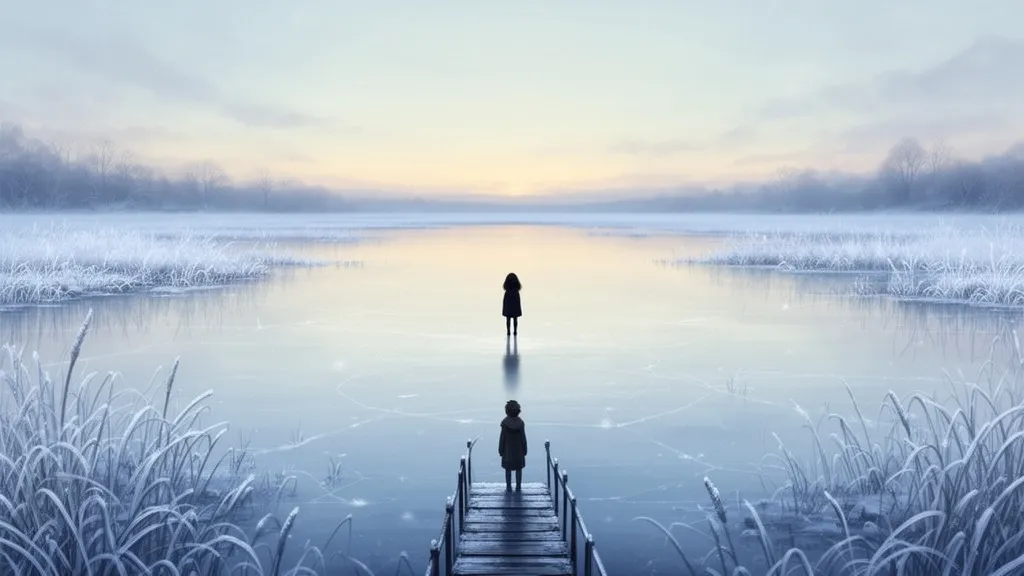
The marsh froze in a single night, which had never happened in Riala's twenty-eight winters, and when she walked out at dawn with her gathering-knife the ice reflected the sky so perfectly she felt suspended between two pale heavens.
The child was standing in the exact center where the channels met.
Riala saw her from the footbridge: small and dark-haired, barefoot on the glassy surface, utterly still. No breath steamed from her mouth. No tremor disturbed the ice beneath her weight. For a moment Riala wondered if she was looking at a sculpture, some prank carved from driftwood and propped there as a jest—but then the child turned her head, and Riala saw the black mud packed between her teeth.
She ran.
The ice held her weight but sang beneath her boots, a crystalline keening that made her jaw ache. The child watched her approach with eyes the colour of deep water in winter. When Riala reached her, she saw the key tied to the girl's thin wrist with red thread, the old kind that shepherds used for binding wounds. The metal was black and oddly warm, and shaped like nothing Riala had seen: too many teeth, too many angles, as if it had been folded in on itself until geometry gave up.
"Where did you come from?" Riala asked, but the child only opened her mouth wider, displaying the mud like an offering. It smelled of iron and old rain and something else, something that made Riala think of the year the river had run backward for three days and everyone had stayed indoors with salt on their thresholds.
She lifted the child—light as cattail fluff, cold as river stones—and carried her back across the singing ice.
The elder's house stood on the high ground where the marsh gave way to solid earth, and its door was painted with wards so old they had faded to silver ghosts of themselves. Riala had to knock three times before Merrith answered, her grey braids pinned in the old style, her face creased with the particular weariness of someone who has just woken from a dream she was not meant to remember.
"She was on the ice," Riala said, and Merrith's expression did not change, which was answer enough.
"Bring her in. Quickly."
The child sat at the table and did not touch the bread Merrith set before her, though her eyes followed the movement of the knife as the elder cut slices from the loaf. The key lay on the scarred wood between them, and in the lamplight its teeth seemed to shift, as if testing locks that were not yet present.
"Where did you find her?" Merrith asked, but she was looking at the key, not at Riala.
"The center. Where the channels meet."
"Of course." Merrith was silent for a long moment. Then: "Did she speak?"
"No. But she—" Riala hesitated. "She had mud in her mouth. From the riverbed."
"Yes," Merrith said, very quietly. "She would."
The child reached for the key and held it up, teeth-first, as if offering it to someone who was not there. Then she pointed at the floor.
"Not here," Merrith said sharply. The child lowered the key but kept pointing, her small arm unwavering, aimed at something beneath the boards.
"Under the cattails," Riala said, understanding arriving like a stone through thin ice. "There's a door."
"There has always been a door," Merrith said. "We simply agreed, all of us, not to mention it. Not to look for it. Not to wonder what it kept sealed." She stood, her joints cracking like spring ice. "Get Torven. Get Sielle and Mared. Get anyone who remembers the silence we made. We have until sunset to decide."
"Decide what?"
Merrith looked at the child, who was now pressing the key against her sternum as if trying to push it through her ribs. "Whether to let her use it."
By midday, eight of them had gathered in Merrith's kitchen, and the air was thick with the smell of strong tea and old reluctance. Torven the fisherman. Sielle who kept the bees. Mared who had been born in the house where the marsh met the forest and who some said could hear the reeds whispering news from upstream. Others. All of them old enough to have lived through the year the name was removed from the village records, letter by careful letter, until the pages themselves forgot what they had held.
The child sat among them and did not eat and did not speak, but occasionally she would open her mouth and a thin trickle of black water would run down her chin, pooling on the table in shapes that might have been letters if anyone had been willing to look closely enough.
"We sealed the door," Torven said. "My grandfather helped dig the clay that filled the frame. We had reasons."
"The reasons," Sielle said slowly, "were good ones at the time."
"Are they still good?" Riala asked, and the silence that followed was so heavy she thought the floorboards might crack beneath its weight.
"She drowned," Merrith said finally. "In the channels. In the spring, when the melt comes fast. She was seven years old. Her mother—" She stopped. Started again. "Her mother could not bear it. Could not bear the house. Could not bear the marsh. Could not bear waking every morning to the sound of water moving beneath the ice. So we gave her what mercy we could. We took the name away. We buried the door. We agreed not to remember."
"But someone does," Riala said, looking at the child. "Someone always does."
The child held up the key and pointed at Riala, and the gesture was so deliberate, so precise, that Riala felt something shift in her chest like a door finding its frame.
"No," she said. "Not me. I wasn't even born—"
But Merrith was watching her with an expression Riala had seen before, in the faces of people recognizing a pattern they had pretended not to notice. "Your mother left," the elder said. "When you were barely walking. Went downriver and never returned. You were raised by the whole village because there was no one else to do it."
"That's not—" Riala's mouth was dry. "That's different."
"Is it?"
The child stood and took Riala's hand. Her fingers were wet and cold, and where they touched, Riala's skin remembered things: the shape of a door beneath black water, the weight of a name held underwater until it stopped struggling, the slow and patient grief of a marsh that had been asked to swallow something it could not digest.
"If we open it," Torven said, "what comes through?"
"Nothing," Merrith said. "Or everything we tried to bury. I don't know which would be worse."
Riala looked down at the child, who was looking back at her with eyes that held no malice, no judgement, only the infinite patience of deep water. You know, those eyes said. You have always known.
The door was where the child had been standing, a hand's-breadth beneath the ice and the silt. The villagers had to break through with picks and spades, and the marsh bled black water that steamed in the cold air. The door itself was oak gone grey with age, its hinges bone-pale, its surface carved with spirals that hurt to look at directly.
Riala knelt on the broken ice and fitted the key into the lock.
"Her name," Merrith said from the bank, her voice carrying across the marsh like a reed-call, "was Kessa. And her mother's name was Lira. And Lira is alive, I think, in a city downstream where no one knows what she lost or what she buried."
Riala turned the key. The lock opened with a sound like winter breaking, and the door swung inward onto darkness that smelled of spring.
The child stepped forward and took Riala's hand again, and together they looked down into the space that was not a grave, had never been a grave, but was instead the exact shape of an absence that a village had agreed to carry in its centre.
Kessa's ghost was not there. Of course she wasn't. The dead do not wait in locked rooms for permission to leave; they wait in the memories of the living, in the silence where their names should be, in the black mud at the bottom of channels where children are warned not to play.
But something was there: the shape of a grief that had been compressed so tightly it had become solid, a sorrow so old it had learned to walk, to unlock doors, to stand barefoot on ice with a mouthful of river truth.
"She needs to be remembered," Riala said. "Not buried. Not erased. Just—spoken."
"Then speak her," Merrith said.
Riala spoke the name. Kessa. It tasted of spring water and mud and the particular sweetness of cattail roots. She spoke it until the darkness in the doorway softened, until the child beside her grew warm, until the ice beneath them began to crack not with cold but with the slow thaw of something long-frozen finally permitted to melt.
When she looked up, the child was gone. The key lay on the ice, its thread unraveled. The door stood open, showing nothing but silt and stones and the patient bones of reeds.
The marsh, which had been holding its breath for seven years, exhaled.
Riala closed the door and left the key where it lay. By morning, the ice would melt. By spring, someone would find the door again, or they wouldn't. Either way, the name was spoken now. It existed in the air and in the water and in the memory of eight people who would tell others, who would tell others still, until the silence was finally, gently, broken.
She walked back across the settling ice as the sun touched the horizon, and the marsh sang beneath her weight: not a warning, not a mourning, but something very old and faintly relieved, like a river finally permitted to remember its own course.