The Key That Tasted of Promises
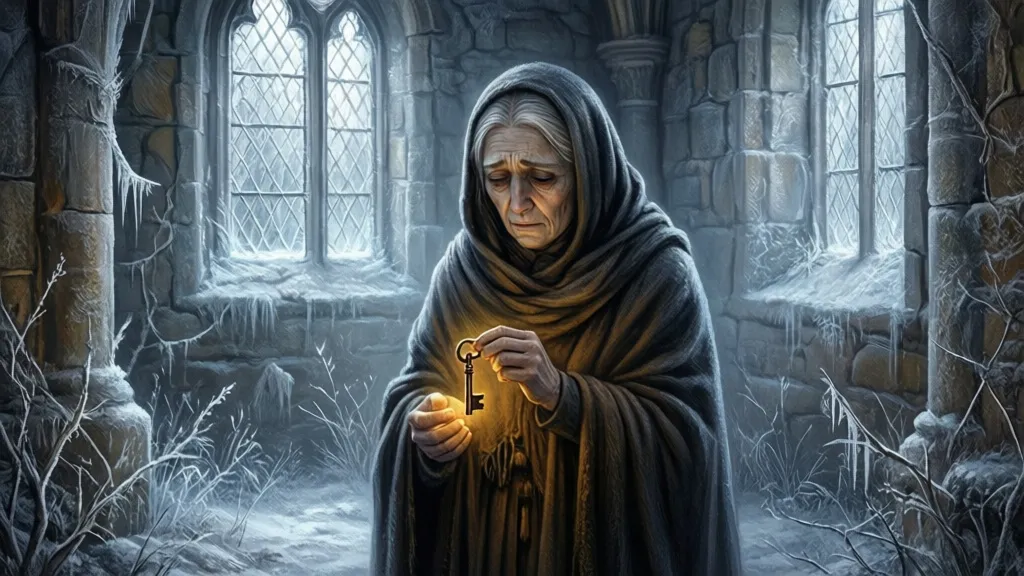
The frost had written its name on the inside of the chapel windows, which meant winter had come to claim even the spaces where prayer was supposed to keep warmth alive. Maren stood beneath the nave's highest arch, her widow's shawl drawn close, and turned the brass key over in her palm for the third time that morning.
It was still warm.
The curate had found it when they washed Thomas for burial—lodged between his molars like a word he had been trying to say and could not. The undertaker had handed it to her wrapped in muslin, apologizing for the strangeness of it, for the way death sometimes rendered up small mysteries along with larger griefs. Maren had unwrapped it in the vestry while they were nailing down the coffin lid, and the metal had been fever-hot against her fingers, as though Thomas had been holding it in his fist all the while his heart was stopping.
She had meant to drop it. Had intended, in that first stunned moment, to let it fall and roll away beneath the pews where the church mice could make whatever use of it they pleased.
But then she had seen the crest.
A serpent wound around a compass rose. The sigil her sister Isolde had worn on her travelling cloak the day she left for the northern estates, twelve years ago, before the war came down like a hammer on everything the valley had built. Before the manor had been shuttered and half its rooms bricked up to keep the soldiers from quartering there. Before Isolde herself had become a name no one spoke aloud, as though silence could unwrite the fact of her.
Maren closed her fist around the key. The warmth pulsed once, then settled into something steadier—not heat, exactly, but the sense of a thing that had been awake a long time and did not intend to sleep again.
"You're still here."
She turned. The curate stood in the chapel doorway, his breath fogging in the cold. He was young enough that the war was something he had only heard about in stories, old enough to know not to ask too many questions of widows who lingered after the burial rites were done.
"The bells will ring at dusk," he said. "For the opening."
Maren nodded. Once a year, the manor was unsealed and the village allowed inside to take what they needed from the stores—firewood, preserves, the last of the salted meat. A charity older than memory, enacted every winter since the first lord had died without heirs and left the house to the valley entire. It was the one night the shuttered rooms breathed again, the one night the past was permitted to speak.
"I'll be gone by then," she said.
The curate hesitated. "Your husband—Thomas was a good man. If there's anything—"
"He never spoke of my sister."
The words came out harder than she had meant them to. The curate blinked, opened his mouth, closed it again. He was too young to remember Isolde, too new to the parish to know what questions were safe and which were doors that had been locked for reasons.
"I'm sorry," he said finally, and left her alone with the frost and the key.
The manor crouched at the top of the hill like something that had been carved from the valley's own stone and set there to watch. Maren climbed the path slowly, the key heavy in her pocket now, colder than it had been in the chapel. The frost had etched patterns across the shuttered windows—spirals within spirals, as though something inside were trying to write its way out.
She had not been here in twelve years. Not since the day the soldiers left and the village elders had bricked up the western wing, declaring it unsafe. Structurally unsound, they had said. Too many rooms with floors that remembered different weights. Too much history pressing down on rafters that were never meant to hold it.
But Maren knew which room the key belonged to.
The third floor. The study at the end of the eastern corridor, where Isolde had spent her last three months transcribing old maps and making notes in margins that grew smaller and more frantic as winter closed in. The room with the door that had always been warm to the touch, even in the coldest dawns. The room that had been empty when Maren finally went looking, the morning after Isolde disappeared, and found nothing but a chair pushed back from the desk and a window standing open to the snow.
She pushed through the manor's front entrance. Inside, the air was thick with the smell of dust and the faint mineral tang of stone that had not been disturbed in years. The villagers would come at dusk with their carts and baskets, but for now the house was hers alone.
She climbed the stairs.
The eastern corridor was darker than she remembered. The shutters here had been nailed from the inside, and the only light came from cracks where the wood had warped. Maren counted doors as she walked—one, two, three—until she stood before the one at the hall's end.
It was not bricked up.
She stared. She had been certain—the elders had sworn the whole wing was sealed. But the door stood plain and ordinary, its wood scarred with age, its handle tarnished but intact. And when she pressed her palm against it, the warmth came flooding back, the same fever-brightness the key had held.
Something inside the room exhaled.
Maren drew the key from her pocket. It gleamed in the dim light, and for a moment she thought she saw words etched along its shaft—tiny, spidery script that might have been a name or a plea or an instruction she was meant to follow.
She could still leave. Walk down the hill, dig a hole in the frozen churchyard, bury the key deep enough that spring would never find it. Let whatever Thomas had carried in his mouth stay unspoken. Let Isolde remain a name the valley had agreed to forget.
But the key was warm again, and the door was breathing, and Maren had spent twelve years not asking questions.
She turned the key in the lock.
The door swung open onto a room that was not empty.
Isolde sat at the desk, exactly as Maren remembered her—dark hair pinned back, ink-stained fingers, eyes that were the grey of winter mornings. She looked up when Maren entered, and her expression was not surprise but something older. Recognition, perhaps. Or relief.
"You're late," Isolde said quietly.
"You've been dead for twelve years."
"I've been here for twelve years. It amounts to nearly the same thing." Isolde set down her pen. The desk was covered in maps, dozens of them, each one showing the valley from a different angle. The river ran through all of them, but its course changed in each rendering, as though the water could not make up its mind which direction the past had flowed. "I made a bargain. A poor one, in retrospect."
Maren stepped inside. The room smelled of old paper and something sharper—pine resin, or perhaps the mineral scent of a glacier calving. "With what?"
"With the house. Or the valley. Or whatever it is that remembers things longer than people do." Isolde gestured at the maps. "I wanted to know where the river came from. Before the war, before the lords, before any of us. The house said it would show me. It did not mention the cost."
"Which was?"
"That I would have to stay until someone came looking. Until someone turned the key I gave to Thomas and asked the right question."
Maren looked at her sister—at the way the light did not quite touch her, at the faint transparency of her hands. "What question?"
Isolde smiled, and it was the saddest thing Maren had ever seen. "Whether you wanted to know what I found. Or whether you wanted to let me go."
The maps rustled, though there was no wind. Maren realized, slowly, that the room was not breathing. Isolde was. Or the memory of her was. The same breath, drawn in twelve years ago, held until someone came to witness its release.
"I can't have both?"
"The house does not deal in kindness."
Maren looked down at the key in her hand. It had gone cold now, the warmth finally spent. In the distance, she could hear the first of the evening bells beginning to ring. The village would be gathering at the base of the hill, lighting torches, preparing to climb.
She thought of Thomas, who had carried this key in his mouth and never spoken of it. Who had loved her in the way of men who understand that some griefs are not meant to be solved, only witnessed.
She thought of Isolde, who had wanted to know the world's oldest secrets and had paid for them in the coin the world demanded—time, and solitude, and the slow forgetting that came when no one spoke your name aloud.
"Tell me," Maren said. "Tell me what you found."
Isolde's smile widened, just a little. "The river doesn't come from anywhere. It's always been here. It's the valley that moves."
And then she was gone—not vanishing, but dissipating, the way frost does when the sun finally remembers its work. The maps remained on the desk, their ink still wet, the river winding through them in patterns that would take a lifetime to understand.
Maren stood alone in the empty room and listened to the bells ring and ring and ring.
Outside, the village was coming to claim what the manor owed them. Firewood and meat and the warmth of a house that had outlived everyone who built it.
Inside, Maren folded the first map carefully and slipped it into her pocket.
She would have time, she thought, to learn what Isolde had spent twelve years discovering.
The river, after all, was not going anywhere.