The Key That Warmed Before Dawn
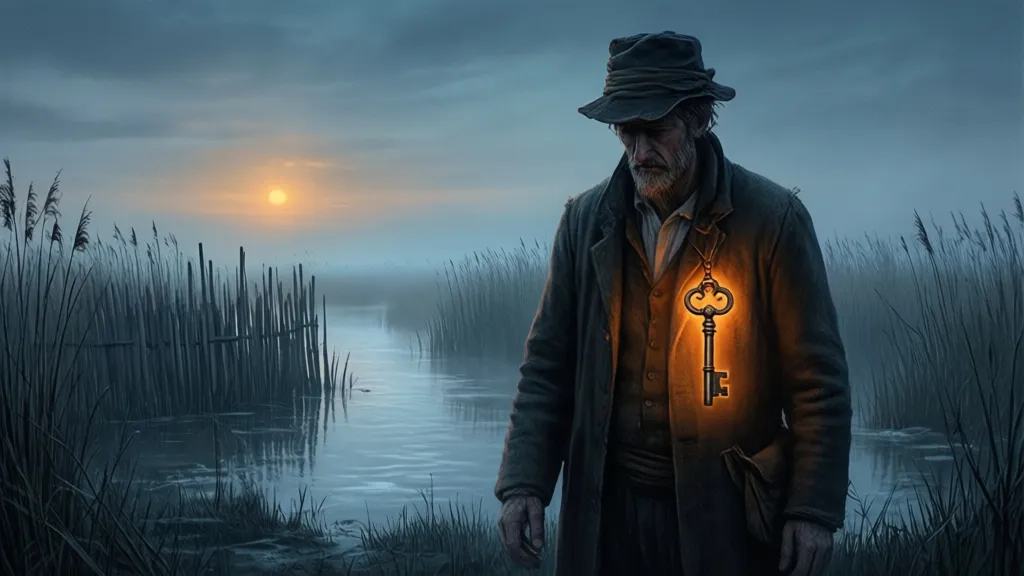
The key had been cold against his chest for nineteen years, which was how Marek knew something had changed when it woke him with its heat three hours before sunrise.
He lay still in the ferryman's cottage, listening to the marsh breathe its salt-thick air through the reed walls. The key hung on a leather cord beneath his shirt, and it had burned a circle into his skin while he slept. Not badly. Just enough that when he pressed his palm against it through the fabric, he could feel the shape of its complaint.
He had inherited the key from his father, who had inherited it from his father, who had received it from the shrine keeper on the night the old bargain was made. Three generations of ferrymen had worn it against their hearts, and it had never been anything but iron-cold and silent.
Marek dressed in the dark and went down to the water.
The marsh market was already half-awake, vendors arranging their reed baskets and fish traps by lamplight, the wooden platforms creaking as boats nudged against their moorings. No one looked at Marek as he passed. The ferrymen were a separate thing here, neither merchants nor fishers, their work conducted in the spaces between what the village acknowledged and what it required.
He walked to the shrine at the marsh's eastern edge, where the platforms ended and the water opened into something older and less interested in human construction. The shrine was small, reed-roofed, built on stilts that had been standing when Marek's grandfather was young. A single door faced the marsh, and above it, carved into the weathered wood, was the mark that every child learned not to question: a circle bisected by a descending line, like a setting sun or a closing eye.
Marek had passed this shrine every morning of his working life and had never approached it. The ferrymen carried people across the marsh channels, collected their coins, and did not ask about the shrine. That was the arrangement.
The key was hot enough now that it had begun to hurt.
He pulled it from beneath his shirt, and the leather cord came away damp with sweat. The key was black iron, longer than his palm, its teeth worn smooth by decades of being handled and then deliberately not handled. It felt like holding a coal that had not quite decided to burn.
The door had no visible lock, but when Marek pressed the key against the wood where the latch should be, something inside the shrine made a sound like a held breath being released.
The door opened inward, and the smell that came out was mud and copper and something else—something that reminded Marek of the way the air tasted before lightning.
Inside, the shrine was a single room, and the room held a girl.
She lay in a cradle of black mud that had been shaped to hold her body, her hands folded across her chest, her face turned slightly toward the door as though she had been waiting for someone to arrive. She was perhaps fourteen, dressed in a shift that had once been white but was now the grey of old bone. Her skin was pale, her hair dark and unbound, and she was breathing.
Marek stood in the doorway and felt the world rearrange itself around what he was seeing.
The mud cradle sat in the centre of the room, and around it, carved into the wooden floor, was a pattern of spirals and crossed lines that Marek recognized from his childhood—the marks his father had made him memorize before teaching him to ferry, the shapes that meant boundary and exchange and this is the price we do not speak of.
The tide was still low, but Marek could hear it beginning to shift outside, the water pressing against the shrine's stilts with the kind of patience that implied inevitability. By dawn, the channels would be full. By mid-morning, the platforms would be underwater. By noon—
By noon, the shrine keeper would come.
Marek had seen the shrine keeper only twice in his life, both times from a distance. An old woman, or perhaps not old but simply worn in the way that stone is worn by water, her face expressionless, her hands always carrying something wrapped in dark cloth. She came once a year, always at noon, always on the day the tide ran highest.
She came with a ceremonial knife, and she went into the shrine, and when she left, the village had another year of safe passage through the marsh.
Marek looked at the girl in the mud and understood, with the slow terrible clarity of someone who has always known something without ever letting himself think it, what the bargain had been.
The key was cooling now against his palm, its work finished.
He could leave. Close the door, walk back to his cottage, return the key to its place against his heart. The shrine keeper would come at noon as she always did, and the bargain would continue as it always had, and Marek would ferry his passengers and collect his coins and not ask questions that had never been his to ask.
Or.
Marek stepped into the shrine and knelt beside the cradle.
The girl's eyes opened.
They were grey, the colour of deep water in winter, and they looked at Marek with neither surprise nor fear. She did not speak. The mud around her stirred slightly, as though responding to her breath, and Marek realized it was not mud at all but something older—silt, perhaps, from the bottom of the marsh, the kind of material that accumulated over centuries and remembered everything it had touched.
He reached out and took her hand.
Her fingers were cold but not dead-cold. Living-cold. The cold of something that had been sleeping and was now, slowly, considering whether to wake.
"The keeper comes at noon," Marek said, though he did not know why he was explaining this. "She has a knife. She has always had a knife."
The girl's expression did not change, but her hand tightened slightly around his.
"The village," Marek continued, and his voice was steadier than he had expected, "has been safe for nineteen years. No boats lost. No children drowned. The channels stay clear, and the fish come when called, and the storms turn aside before they reach us."
The girl looked at him and then, very slowly, looked past him to the open door, where the grey light of pre-dawn was beginning to gather.
"That is the price," Marek said. "You. Every nineteen years, the shrine keeper comes, and someone like you sleeps here, and the marsh accepts the arrangement."
The girl turned her gaze back to him, and Marek saw that she understood perfectly. She had always understood. She had been born understanding, or perhaps she had learned it during the nineteen years she had spent neither quite asleep nor quite awake, held in the mud that remembered everything.
She was waiting for him to choose.
Marek thought about his father, who had worn the key and never opened the door. He thought about the village, which had built itself on a bargain it did not question because questioning would require acknowledging, and acknowledging would require either accepting or refusing, and either one would change the shape of what they had become.
He thought about the ferrymen, who were always separate, always watching from the margins, always carrying people across thresholds they did not themselves cross.
And he thought about the girl, who had been sleeping for nineteen years and who would, if he walked away now, sleep for perhaps nineteen more before the knife found her and the bargain began again.
The tide was rising.
Marek pulled the girl from the cradle.
The mud released her with a sound like a sigh, and she stood on legs that remembered standing, though she swayed slightly and Marek had to steady her with one hand on her shoulder. She weighed almost nothing, or perhaps she weighed exactly as much as she needed to and no more.
"Can you walk?" he asked.
She nodded.
Marek led her to the door, and they stepped out into the grey light together.
Behind them, the shrine remained open, its door swinging slightly in the wind, the mud cradle empty and already beginning to dry. The spirals and crosses on the floor glowed faintly for a moment, as though recognizing what had been taken, and then faded.
The marsh was still breathing, salt-thick and patient.
Marek did not know what would happen at noon when the shrine keeper came with her knife and found nothing waiting. He did not know whether the village would have another nineteen years of safe passage, or whether the storms would return, or whether the channels would fill with silt and the fish would forget their way home.
He knew only that the girl's hand was warming in his, and that the key against his chest was cold again, and that the tide was turning.
They walked together toward the waking market, where the vendors were lighting their lamps and the first boats were pushing off into the channels, and the marsh, which had been watching for a very long time and which had outlasted many bargains, made no sound at all.
But the water, just once, lapped against the platforms with something that might have been laughter, or might have been simply the tide doing what tides do, which is to rise and fall and carry things away and sometimes, when the moon is right and the hour is strange, bring them back again.