The Key the Tide Kept Bringing
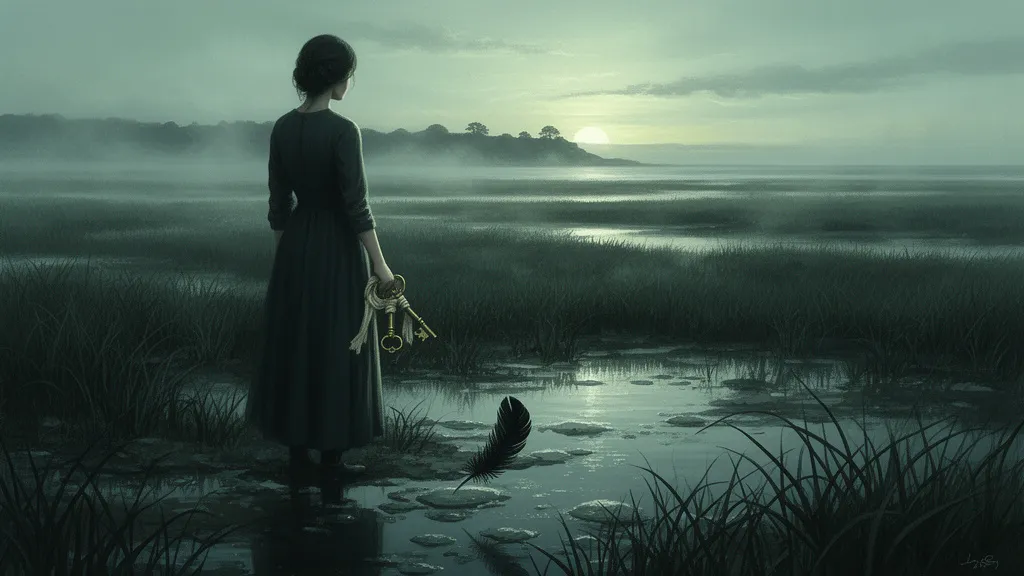
The key came back three mornings in a row, which meant something in the marsh had made a decision.
Lira found it first on a Monday, caught in the cord grass where the tide pooled at dawn. Brass, salt-dulled but whole, wrapped in a strip of linen so old the weave had gone soft as cloth made from water. A blackened gull feather lay beside it, perfectly straight, as if someone had placed it there with intention.
She was surveying the eastern headland for the coastal survey—the Crown wanted accurate maps now that the shipping routes were shifting—and had been walking the tide line since first light. The marsh spread flat and grey under a sky the colour of wet slate, and the wind came in cold from the sea, carrying the smell of kelp and distance.
She picked up the key. It was warm in her palm, warmer than metal left overnight should have been.
On Tuesday the key was back, twenty yards south of where she'd found it the first time. Different linen this time, coarser weave, but the same blackened feather. The tide had been higher in the night; she could see the new line of debris marking where the water had turned.
She had taken the first key to the village, shown it to old Merrith who kept the tide tables and knew the names of things the sea brought in. Merrith had looked at it for a long time without touching it, and then said, "Put it back where you found it, and don't go looking for what it opens."
Lira had not put it back. She had wrapped it in oilcloth and kept it in her surveying kit, because a mapmaker collected what the land offered and drew conclusions later.
But the second key made her uneasy in a way the first had not.
On Wednesday she found it before dawn, walking out with a lantern while the stars were still bright and hard overhead. This time it lay in the centre of a tidal pool, three inches of cold seawater, and the linen was silk, old enough to have gone the colour of bone. The feather floated beside it.
She stood in the dark with the lantern hissing softly and the marsh breathing around her—the small sounds of water moving, reeds settling, something with wings relocating in the pre-dawn grey. The key gleamed up at her from the bottom of the pool, and she understood that it was not lost. It was being delivered.
Someone, or something, wanted her to have it.
The shrine sat a quarter-mile inland, where the firm ground began to rise and the cord grass gave way to salt-scrub and twisted pine. Lira had marked it on her preliminary map as ruins, partially submerged, and noted its position relative to the old coast road. She had not gone inside.
She went now, in the thin light just after dawn, with all three keys in her pocket and her surveying tools left behind.
The shrine was small and square, built from grey stone that had been shaped by hands that knew their work. The roof had fallen in on one side, but the walls stood firm, and the doorway was intact—a low arch, dark inside, with seawater pooling at the threshold. The tide had been coming in when Lira walked out, and already the water was ankle-deep around the shrine's foundation.
She stepped through the doorway and stopped.
An old woman sat on a low stool in the centre of the single room, her hands folded in her lap, her eyes on the far wall. She wore grey wool and her hair was white and unbound, and she did not look at Lira when she entered.
"You've been bringing them," Lira said.
The woman's mouth twitched, not quite a smile. "The tide brings them. I only put them where you'd find them."
"Why?"
"Because you're the one who keeps coming back to look." The woman's voice was soft and dry, like reeds rubbing together. "And because someone needs to know, now. Before the flood."
The shrine's interior was mostly empty—four walls, the broken roof open to the sky on one side, water darkening the stone floor in spreading patches. But at the back, set into the wall itself, was a door. Small, barely four feet high, made of wood so old it had gone black. Three keyholes, one above the other, in a vertical line down the centre.
Lira felt the keys grow warmer in her pocket.
"What's behind it?" she asked.
"Something that was put there a long time ago, when the marsh was smaller and the sea stayed where it belonged." The old woman still had not looked at her. "Something that sleeps when the water is low, and stirs when the tide rises. It's been stirring for three months now."
Lira crossed the room slowly, her boots squelching in the thin layer of seawater that had begun to seep up through the gaps between the stones. The door's wood was smooth, worn by salt and time, and when she put her hand against it she felt—not movement, exactly. Pressure. As if something on the other side was leaning very gently against the wood, testing its strength.
"It wakes with the flood," the old woman said. "With the spring tides and the autumn storms and the years when the sea remembers it's older than the land. Someone has to be here when it does. Someone has to make the choice."
"What choice?"
The woman finally looked at her. Her eyes were the colour of tidal pools, grey-green and depthless. "Whether to let it out, or hold it in until the water rises high enough to break the door from the inside."
The seawater was cold around Lira's ankles now, rising visibly, and the light coming through the broken roof had gone strange—flat and yellow, the way it did before a storm. The marsh birds, which had been calling to each other across the flats all morning, had gone abruptly silent.
"What is it?" Lira asked.
"The marsh," the old woman said simply. "The part of it that was here before the grass grew, before the tide learned its rhythm. The old water. It was bound here when people still knew how to make bargains that lasted, and it's been patient. But patience ends."
Lira pulled the three keys from her pocket. They lay in her palm, warm and bright despite the tarnish, and she understood now why they had been wrapped in different cloth—each piece of linen was older than the last. Someone had been keeping them for a very long time, waiting for the moment when they would be needed.
Or waiting for someone foolish enough to use them.
"If I open it," she said slowly, "what happens?"
"The marsh becomes itself again. The boundaries shift. The water goes where it wills." The old woman's voice was very calm. "The village floods. The coast road drowns. Everything built on this land in the last three hundred years learns that it was always borrowed."
"And if I don't?"
"The door breaks at high tide tonight. The thing inside comes out angry instead of simply awake. And you and I drown here in this room, because it will take the shrine first."
The water was mid-calf now, rising faster, and Lira could feel the pressure against the door intensifying—not violent, but inexorable, like the tide itself. The old woman had not moved from her stool, though the water was lapping at her ankles, darkening the hem of her grey dress.
"Why give me the choice?" Lira asked. "Why not just let it break?"
"Because there's a difference," the woman said, "between a thing that's freed and a thing that breaks free. One remembers courtesy. The other remembers only confinement."
The shrine was darkening as the stormlight failed outside, and through the broken roof Lira could see clouds the colour of deep water moving in from the sea. The tide was coming, the big one, the autumn equinox surge that turned the marsh into a temporary ocean.
She had been mapping this coast for six months, walking its boundaries, learning the way the land met the water and where the solid ground ended. She had drawn the village, the roads, the field boundaries, the careful human geometry imposed on a landscape that had its own much older shape.
She thought about maps, and what they were for. They were agreements, she had always believed—marks on paper that said this is where we are, this is what we know, this is the world we have made.
But maps could be redrawn.
The water was at her knees.
Lira fitted the first key into the lowest lock. It turned smoothly, without resistance, and something behind the door shifted—a sound like a sleeper rolling over, adjusting position, not quite waking.
The second key went into the middle lock. The pressure increased, and the water around her legs began to move, circling slowly, a whirlpool in miniature.
She held the third key and looked at the old woman, who was watching her now with something that might have been approval or might simply have been recognition.
"Will you be all right?" Lira asked.
The woman smiled, and for the first time Lira saw that her teeth were very white and very sharp, like a fish's. "I was here before the shrine was built. I'll be here after it falls."
Lira put the third key in the topmost lock and turned it.
The door swung open onto darkness and the smell of deep water, and the sea came in.
It came in gently, which surprised her. Not a flood but a rising, the way the tide moved when nothing opposed it. The water lifted her off her feet and carried her backwards, out through the shrine's doorway, and she surfaced in the marsh under a sky that had split open to pour rain.
The old woman was gone. The shrine was sinking, slowly, settling into the soft ground as if it had been waiting for permission to rest.
And the marsh was changing.
Lira swam for higher ground, pulling herself up onto a low rise where twisted pines grew, and watched as the water spread. It moved with intention, finding old channels that had been dry for generations, filling depressions that had been ploughed under and built over. The village was an island now, houses standing in a lake that had appeared in the space of an hour, and the coast road had become a causeway, water lapping at its edges.
But the village stood. The houses were not swept away. The water rose around them and stopped, exactly at the height where it could be waded through, where boats could be launched, where the land and sea met on new terms.
Lira sat in the rain and the rising water, shivering, and understood that the bargain had been renegotiated. The marsh had taken back what it needed and left what it would permit.
Somewhere in the grey distance, a bird called—tentative at first, then confident. Others answered. The marsh was not silent anymore.
When the rain stopped and the stormlight cleared, Lira would go back to the village. She would tell them what had happened, and they would not believe her until they saw the new waterline, the way the land had changed overnight.
And then she would redraw her maps, marking the new boundaries, the places where the sea had come in and decided to stay. Because that was what a mapmaker did—recorded the world as it was, not as people wished it to be.
The tide was turning. Somewhere beneath the water, something old and patient settled into its reclaimed territory and slept again, content.
And on the shore of the new marsh, still tangled in the cord grass where the storm had left them, three brass keys lay gleaming in the mud, waiting for the next person who would need to know where the boundaries really were.