The Lamp That Held a Drowning
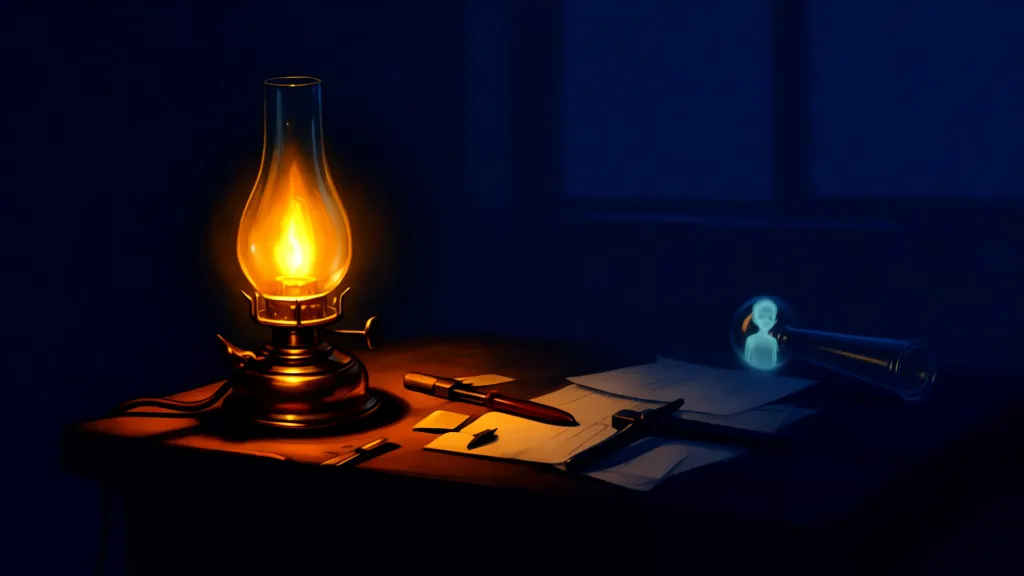
The glass had been perfect when Mariel sealed it—clear as a winter stream, without bubble or flaw. She had blown it herself in the angled light of morning, feeling the gather turn and swell at the end of her pipe, and when she tapped it free and set it in the annealing oven she had been certain of its soundness. Three days later she fitted it with brass and wick, poured in the first measure of oil, and lit it to test the flame.
The boy appeared on the fifth evening.
She had been trimming the wick low, preparing the lamp for a customer who wanted something gentle for a sickroom, and when she glanced at the glass she saw him: barefoot, blue-lipped, his hair moving as though underwater. He stood very still inside the curve of the lamp, his hands pressed against the glass from within, and when Mariel jerked back the flame guttered and he was gone.
She lit it high again. Nothing. The glass held only the ordinary gold of firelight, the small dance of heat against metal. She trimmed it low once more, slowly, and the boy returned—clearer now, his face turned slightly away as though listening to something she could not hear.
Mariel lived alone in a saltwind village where the roofs were shingled with slate and the walls whitewashed against the spray. She had learned her trade from her grandmother, who had learned it from the lighthouse keeper's wife, and she made lamps that burned steady in the hardest gales. People trusted her work. They brought her their oil and their broken chimneys and sometimes, in winter, their grief, because a well-made light was a kind of promise that the dark could be endured.
She did not know what to do with a lamp that held a drowned boy.
For two days she kept it in the back of her workshop, covered with a canvas cloth. She filled other orders. She blew new glass. At night she lay awake and thought about the way his hands had pressed against the inside of the lamp, flat-palmed, the gesture of someone trying to be seen.
On the third day she uncovered it and trimmed the flame low.
He was still there. Clearer than before. She could see the fine bones of his wrists, the way his shirt clung to his narrow chest. His eyes were open but he was not looking at her. He was looking past her, toward the door, toward the village, toward something.
Mariel wrapped the lamp in wool and carried it through the narrow streets to the sea wall.
The sun was going down over the water, turning the waves to hammered bronze. The wind smelled of kelp and distance. She set the lamp on the wall's broad stone cap and turned the flame as low as it would go without dying.
The boy appeared at once, and this time he moved. He turned his head slowly, deliberately, until he was facing inland. Mariel followed his gaze.
Up on the cliff, above the harbor, a house stood silhouetted against the red sky. Even from here she could see the dark shapes of people moving behind the windows, the flutter of black cloth hung above the door. A wake. She had heard about it in the market that morning—the Carrick boy, they said. Took a boat out in the fog and never came back.
The lamp grew cold in her hands.
She looked down and saw frost forming on the glass, delicate as ferns, spreading from where the boy's palms touched the inside. The flame shrank to a blue pinpoint. She could feel the cold radiating through the wool, through her gloves, into the bones of her fingers.
"Stop," she whispered, and fed it more oil.
The flame brightened. The frost receded. The boy remained, his face still turned toward the house on the cliff.
The tide was coming in. She heard it hissing against the rocks below the wall, and when she looked down she saw something pale rolling in the surf. She climbed down the iron ladder, careful of the wet stone, and retrieved it before the backwash could take it.
A silver comb. Small, delicate, with three teeth missing. Salt water ran from it onto her palm.
She climbed back up and set it beside the lamp. The boy's eyes moved, just slightly, and she thought she saw recognition there—or perhaps only the reflection of her own face, distorted by the curve of the glass.
The next tide brought a ribbon, blue as a summer dusk, wrapped in eelgrass. The tide after that, a key—iron, old, threaded through with weed.
Mariel laid them in a row on the sea wall. Comb, ribbon, key. A sequence. A message written by the water.
The lamp had begun to warm again in her hands, but it was the wrong kind of warmth. Not the clean heat of burning oil but something thicker, something that pulsed like a heartbeat. When she held it close she could hear a sound inside the glass, faint and rhythmic—the sound of breathing.
She should have smashed it then. Thrown it against the rocks and let the sea take the pieces.
Instead she carried it home and set it in the window, and all through the night she fed it oil.
The boy grew clearer. By morning she could see the freckles on his arms, the torn place on his collar, the small scar above his left eye. He was perhaps twelve years old. His mouth was slightly open as though he had been trying to speak when the water took him.
The lamp was warm now even when the flame was high. She could no longer touch the glass without flinching.
At midday someone knocked on her door. A woman, thin-faced and red-eyed, in mourning black. Mariel recognized her from the village—Carrick's wife, the drowned boy's mother.
"I heard," the woman said, "that you make lamps for the dead. Ones that burn for a year and a day."
"I do," Mariel said.
"I'd like one. For my son." Her voice was steady but her hands twisted the edge of her shawl. "His father says it's foolishness, that it won't bring him back. But I want something. I want a light."
Mariel nodded. "Come in. I'll show you what I have."
But the woman's eyes had already found the lamp in the window, and she went to it as though pulled. She stood very close, staring into the glass, and her breath caught.
"That's—" She reached out, hesitated. "That's Finn's lamp. The one he took on the boat. I'd know it anywhere, I filled it myself the morning he left. But it was lost. It went down with him."
"This is a new lamp," Mariel said. "I made it myself."
"Then why—" The woman's face had gone white. "Why can I see his face in it?"
Mariel said nothing. The lamp burned between them, and inside the glass the boy turned his head and looked at his mother.
The woman made a sound like a sob or a prayer. She pressed her hands against the glass, and Mariel saw the frost bloom under her palms—the same delicate ferns, the same cold spreading outward. The flame dipped and the boy leaned forward, his mouth shaping words.
Mariel grabbed the woman's wrists and pulled her back. "Don't."
"He's trying to tell me something."
"He's trying to come back." Mariel kept her grip firm. "And if you let him, he'll be cold forever. He'll be the thing that drowned, not the thing that lived."
The woman's face crumpled. "How do you know?"
Because the lamp had grown a heartbeat. Because the glass was warm as skin. Because when Mariel looked into it now she could see not just the boy but the water behind him, the dim green depths, the slow shapes moving in the dark. The lamp was not holding a reflection. It was holding a drowning, and the drowning wanted a body to finish itself.
"Take this instead," Mariel said, and pulled a different lamp from her shelf—plain glass, steady flame, nothing inside it but light. "Burn it for him. Remember him warm and breathing and alive. Let the sea keep the rest."
The woman took it with shaking hands. She looked once more at the lamp in the window, at the boy's pale face, and then she turned and left without another word.
Mariel waited until full dark. She wrapped the lamp in canvas and carried it down to the tide line, where the sand was still wet from the last wave. The moon was up, thin as a fish bone, and the water looked black and smooth as glass.
She set the lamp down and trimmed the flame to nothing.
The boy appeared in the moment before the light died—clearer than he had ever been, so clear she could see the color of his eyes, the exact shape of his face. He pressed both hands against the glass and his mouth opened, and this time she heard him. Not words, exactly. The sound of waves. The sound of water filling lungs. The sound of something that had been trying to breathe for a very long time.
"I know," she said. "But you can't have it. Not from me. Not from anyone."
She picked up the lamp and walked into the water.
The sea was cold enough to stop her breath. It climbed her legs, her waist, her chest, and she kept walking until she was deep enough that the waves lifted her off her feet. The lamp was heavy in her hands, heavier than glass and brass should be, and when she looked into it one last time the boy was smiling—not glad, not grateful, but the way someone smiles when they are finally, at last, being understood.
She opened her hands and let it go.
The lamp sank quickly, the light winking out as the water poured in. She watched it disappear into the dark, and then she turned and swam for shore.
The next tide brought nothing. The tide after that, nothing. The house on the cliff went dark and the wake ended and the village returned to its ordinary sorrows.
Mariel made more lamps. She blew perfect glass and fitted it with brass and trimmed the wicks level. She sold them to widows and sailors and children afraid of the dark, and every one of them burned clean and steady and held nothing but the light she put there.
Sometimes, though, on nights when the wind came in hard off the water, she thought she heard breathing in the walls of her workshop—slow and rhythmic, like someone learning again how to let go.