The Lamps That Whispered Names
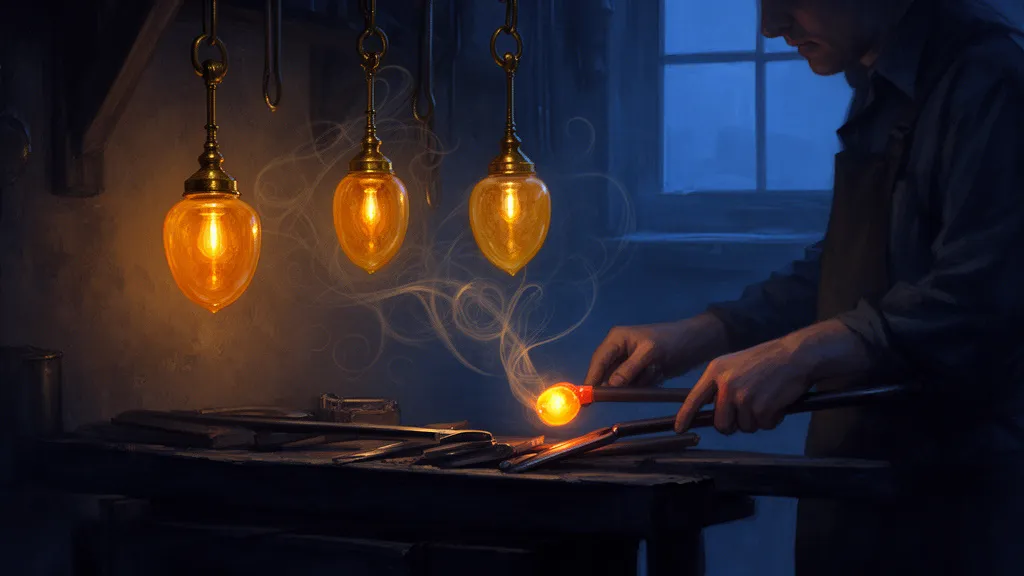
The glass was still cooling when the voices started, which meant Maren had been working past sunset again, her hands moving through the dark by memory alone. She set down the pontil rod and listened, head tilted, but the sound came from everywhere at once—a susurrus that filled the workshop like wind through reeds, except there was no wind, and the shutters were closed against the cold.
She moved toward the workbench where three lamps hung from their brass hooks, globes of amber glass still faintly warm, still holding the afternoon light trapped inside them. The voices rose from the bubbles suspended in the glass itself—flaws she hadn't intended, pockets of air she'd been too tired to notice. Now they shimmered like tiny moons, and each one was speaking.
Not speaking. Whispering. Names, mostly. Sometimes fragments of conversation, words without context: the wheat before winter and she promised me the belt and tell Mother I went east. Maren pressed her palms against the workbench and bent closer. The voices were faint, layered, overlapping, but they were unmistakable. She had been blowing glass in this workshop for eleven years, since she was fourteen, and glass did not speak. Glass held light and heat and sometimes memory, if you shaped it right, but it did not hold this.
Except now it did.
She reached for the first lamp, the one farthest left, and lifted it carefully. The voices grew louder, or perhaps more distinct, sorting themselves into individual threads. A woman's voice, low and steady: the orchard by the mill. A child's, high and wondering: I don't remember cold. And then—
"Maren, don't—"
She dropped the lamp.
It didn't shatter. She caught it again before it hit the floor, fingers closing around warm glass, and stood there frozen, breath caught in her throat. That had been Finn's voice. Her brother. Finn, who had been dead for seven years, drowned in the river when the spring ice broke too early and took him under before anyone could reach him. Finn, whose body they'd found three days later, caught in the bridge pilings with one boot missing.
She set the lamp down, very gently, and stepped back.
The workshop was silent again. Or not silent—the voices were still there, murmuring at the edge of hearing, but they had retreated into the glass, smaller now, more distant. Maren's hands were shaking. She pressed them flat against her apron and tried to think.
Glass was made of sand and heat and breath. She had learned that from her father, and he had learned it from his father, back through generations of glassblowers who had worked this same forge, this same bench, shaping vessels to hold the ordinary light of ordinary days. There was no magic in it. There was craft, yes, and attention, and the particular alchemy that happened when you heated silica past the point where it remembered being solid, but there was no magic.
And yet.
She picked up the lamp again. This time she was ready for Finn's voice when it came, still close to the surface, still carrying that particular rhythm he'd had when he was worried about something and trying not to show it.
"Maren, don't go to the bridge."
She turned the lamp slowly, watching the bubbles shift inside the glass. There were perhaps twenty of them, suspended at different depths, each one glowing faintly in the forge-light. Finn's voice came from the largest, near the base where the glass was thickest.
"Why not?" she said aloud, feeling foolish.
The bubble didn't answer. Or perhaps it couldn't. Perhaps it had only those words, that warning, preserved somehow in the air she'd accidentally trapped while blowing the lamp this afternoon. But that made no sense either. She hadn't been thinking of Finn. She'd been thinking about tomorrow's market, about the cost of lamp oil, about whether she had enough wicks prepared.
She hung the lamp back on its hook and reached for the second one. Different voices rose to meet her: an old man listing crops, a young woman humming something that might have been a lullaby. The third lamp held more names, more fragments, and underneath them all, a deeper sound like water moving over stones.
Maren set that lamp down and looked at her hands. They were stained with soot and the particular grey dust that accumulated around the glory hole, and they were still shaking, but they were her hands. She had made these lamps. Whatever was in them, she had put there, breath and heat and the motion of gathering molten glass, even if she hadn't known what she was doing.
She put on her coat.
The bridge was a ten-minute walk through the town square, past the chandler's shop and the weaver's and the row houses that fronted the millstream. The market stalls were already set up for tomorrow, empty frames waiting for dawn, and lamplight spilled from windows onto cobblestones slick with frost. Maren walked quickly, hands in her pockets, breath misting in the cold. She didn't know what she expected to find. Finn had said don't go, which meant there was something to go to, something worth warning her away from.
She had not been to the bridge since the funeral.
It rose over the river at the town's eastern edge, stone pilings sunk deep into the current, a flat span wide enough for two carts to pass. The water was frozen now, thick grey ice stretching upstream and down, and the bridge threw shadows across it that looked like bars. Maren stopped at the center and looked over the rail.
The boot was there.
It sat on the ice directly beneath her, about twenty feet out from the nearest piling—a leather boot, the kind a farmhand or tradesman might wear, fused into the frost as if it had been there since autumn. Since last spring, perhaps. Since seven springs ago, when Finn had gone under and come back missing one.
Maren climbed over the rail.
The ice held her weight, though it groaned once, deep and resonant, a sound that traveled through the soles of her feet and into her spine. She walked carefully, testing each step, until she stood beside the boot. It was his. She recognized the worn toe, the place where he'd mended the seam with waxed thread. She crouched down and touched it. The leather was cold, harder than stone, and it did not move when she pulled.
Something else was frozen beside it.
She scraped at the ice with her thumbnail, then with the handle of the knife she carried for trimming wicks, until she'd cleared a space the size of her palm. Underneath was paper—a ledger page, the kind shopkeepers used for accounts. The ink was still legible, names written in a careful hand: Thomas Weaver, Elsa Cooper, Finn Marenson, Old Peter from the mill.
Fifteen names, in total. She recognized eight of them.
All dead. All drowned, or lost to the river, or found in the reeds downstream with water in their lungs and no clear reason why. The river took people, sometimes, the way rivers did. It was a grief the town had learned to carry quietly, without questions, because questions wouldn't bring anyone back.
Maren pulled the page free. The ice cracked around it but didn't break, and the paper came away stiff and brittle in her hands. She turned it over. On the back, in different ink, someone had written: For the current. For the crossing. For the names that open the way beneath.
She looked at the bridge. Then at the boot. Then at the names.
Finn's warning made sense now.
She was back in the workshop before midnight, the ledger page spread flat on her workbench, weighted down with crucible tongs. The lamps hung above it, still whispering, and now she understood what they were holding. Not just voices. Names. The names of the drowned, given to the river and returned through glass and breath and the accident of her forgetting to smooth out the bubbles.
She had put them there without knowing. She had been thinking about the market, yes, but she had also been thinking—briefly, distantly—about Finn. About the anniversary coming up in spring. About how she still missed him in ways that surprised her, seven years later, when she reached for a tool and remembered he used to hand it to her before she asked.
The glass had caught that. And the glass had caught something older, too, something that had been waiting in the air itself, in the river's memory, in the space between the names on the page and the water that had claimed them.
Someone was feeding names to the river. Someone in town knew which names to give, and when, and how. Someone had written this ledger and left it under the ice where the river could read it, year after year, spring after spring.
Maren picked up the first lamp and looked into it. Finn's bubble was still there, still glowing faintly. She didn't know if he could hear her, or if the voice was just an echo, something the glass had shaped from memory and breath, but she spoke anyway.
"Who gave you to the river?"
The bubble flickered. The voice that came out was quieter now, fraying at the edges, but it was still his: "The one who blesses the square."
Maren set the lamp down.
The mayor would arrive at dawn to bless the market. He always did. He'd been doing it for twelve years, since before Finn died, standing in the square with his hands raised while the town gathered to watch. A small ceremony, traditional, harmless. Or so everyone thought.
She looked at the other lamps. At the voices trapped inside them. At the names on the ledger page, written in a hand she would check tomorrow against the town records, though she already knew what she would find.
If she broke the lamps, the voices would be gone. The evidence would shatter. No one would believe her, and the names would keep coming, fed into the river by someone who knew how to make a crossing, how to open a way beneath, how to bargain with the current for something she couldn't yet see.
If she kept them lit, the voices would keep speaking. And at dawn, when the mayor came to bless the square, she would be standing there with three lamps full of the dead, and he would know that someone had finally learned to hear them.
Maren sat down on the floor beside the workbench. Her hands were steady now. She thought about Finn, and the boot, and the fifteen names that had gone into the dark. She thought about the mayor's blessings, year after year, and the way the river always seemed to take someone in the spring, right after the ice broke, right after the ceremony.
She thought about the orchard by the mill, and the belt someone had been promised, and the child who didn't remember cold.
Then she stood up, hung the lamps from a carrying rod, and walked toward the square.
The stars were very bright, and the river was singing beneath its ice, and by dawn the whole town would know what had been offered to the current in their name. Whether they would believe it, whether they would act, whether they would stop the mayor before he spoke the next blessing—
That was not something Maren could decide. She was a glassblower. She made vessels to hold light.
She had made vessels that held voices, this time, and she would let them speak.
The market square was empty. She set the lamps down in the center, one by one, and arranged them in a circle. Then she went home to wait for sunrise, and the dead went on whispering in the glass, and the river remembered every name it had been given, and the town slept on, not knowing yet that someone had learned to listen.