The Lantern That Remembered Water
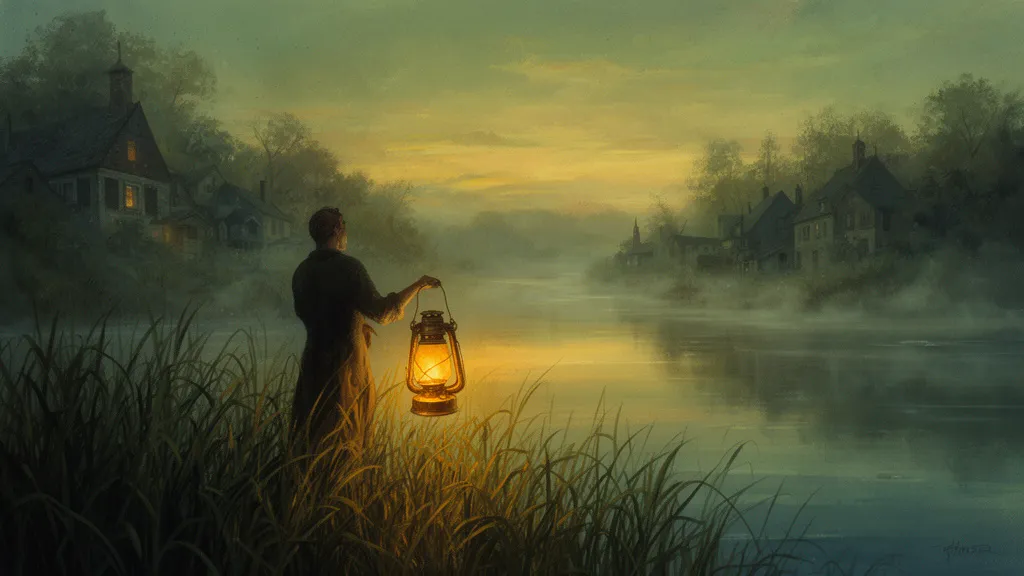
The river had been quiet for three generations, which was long enough that the village forgot rivers were not supposed to be quiet.
Silas found the lantern at dusk, when the reeds were just beginning to whisper and the last of the fishing boats had already surrendered their catches to the smokehouse. He was checking the ferry cables — the old routine, the one his grandfather had taught him before the river learned to behave — when he saw the glow caught in the sedge grass, warm and amber like a coal that refused to acknowledge it had been submerged.
The glass was dry when he lifted it free, which was the first wrong thing. The second was that it was humming, not with heat but with something closer to held breath, the way a person might sound if they were trying very hard not to speak.
Silas set it on the dock and watched it for a long moment. The flame inside moved like ordinary fire, but the shadows it cast were not shadows of flame — they were shadows of water, rippling outward in patterns that suggested current.
"Well," he said, because talking to strange objects was a habit the river had not yet broken him of, "you're not from here."
The lantern continued its humming. The river, which had been flat as glass all day, began to lap at the pilings with something that might have been curiosity.
Silas knew better than to open sealed things found in rivers. His grandfather had told him that, and his grandfather's mother before that, back when the river still remembered how to flood and the village still remembered how to be afraid. But the knowing-better was old knowledge, handed down through decades of a river that did nothing, and the lantern was new and warm and here, and sometimes old knowledge loses arguments with present objects.
He twisted the copper clasp.
The glass swung open on hinges so smooth they might have been oiled yesterday, and the flame inside guttered once — not going out, but recognizing — and then steadied. Something fell from the lantern's base into Silas's palm: a piece of paper, folded so many times it had become nearly square, warm as bread just pulled from the oven.
He unfolded it by the light of the lantern, which seemed polite.
It was a map.
Not of the village — he knew every bend and bridge of the village's portion of the river, had memorized them the way other people memorized prayers — but of water he had never seen. The lines were drawn in ink that looked wet, that seemed to move slightly when he wasn't looking directly at them, and they showed a river that curved through countryside that was almost but not quite the countryside he knew. The old mill was there, but upstream instead of down. The crossing stones were marked, but on the wrong bank. And running through the center of it all was a stretch of water labeled in script so small he had to squint: The Stretch That Was Given Back.
Silas looked up from the map to the river, which was no longer lapping curiously at the pilings but pulling at them, a steady insistent tug like a dog on a leash that has suddenly remembered where it buried something important.
The dock creaked. One of the mooring ropes went taut enough to sing.
"Given back by whom?" Silas asked, which was perhaps not the most urgent question but was the one that arrived first.
The lantern's flame bent toward him, though there was no wind. In its light, he could see that the map had more writing along its edges, tiny annotations in the same wet-looking script: Opened at dusk on the autumn-turning. Closes at midnight. The river will come for whoever looks unless they come for the river first.
Silas checked his pocket watch, the old brass one that had belonged to his grandfather and kept time the way rivers were supposed to keep courses: reliably, without consultation. Five hours until midnight.
Five hours to decide whether a river that had forgotten how to be a river might remember, if shown the right map.
Or five hours until something came looking for the ferryman foolish enough to open a lantern that had been sealed for a reason.
The current was stronger now. Silas could feel it through the dock boards, a thrumming that had not been there an hour ago, and when he walked to the edge and looked down, he saw that the water was no longer the placid brown-green of a domesticated river but something darker, something that moved with intention.
He spread the map on the ferry platform and weighted its corners with river stones that seemed, absurdly, excited to be useful. The lantern he set in the center, and in its light the map's lines grew clearer, more insistent. The Stretch That Was Given Back ran parallel to the current course for perhaps two miles, then diverged sharply east into country that — according to everything Silas knew about the land — was nothing but cow pasture and low hills.
Except.
Except his grandfather had once mentioned, in the way old people mention things they assume everyone knows and no one thinks to write down, that the river used to run a different course. Before the drought, he'd said. Before the village elders made the deal.
Silas had been young enough then to ask what deal, and old enough to notice when his grandfather did not answer.
The river pulled harder. The ferry cables groaned. Somewhere upstream, something that sounded very much like a sluice gate opening echoed across the water, though there were no sluice gates upstream, not anymore, not since they'd been dismantled when the river learned to behave.
Silas picked up the lantern. It was heavier than it should have been, as if the flame inside had accumulated weight, and when he lifted it the shadows it cast were no longer shadows of water but shadows of path.
He stepped onto the ferry.
The moment his weight settled on the deck, the current caught. Not violently — the river was not interested in violence, not yet — but with the certainty of something that has been waiting a very long time to remember what it was supposed to be doing. The ferry swung out from the dock, and Silas did not fight it. He set the lantern on the bow, where its light fell across water that was beginning to look less like water and more like old glass, the kind that holds images if you know how to look.
In the lantern-light, shapes moved beneath the surface: the ghost-lines of an older current, a deeper channel, the memory of a river that had carved the land before the land decided it wanted to be carved differently.
The ferry moved upstream, though Silas was not poling and the current should have been pulling him down. The map fluttered against the deck, its corners tugging free of the stones, and when Silas picked it up he saw that the ink-lines were moving now, actively moving, redrawing themselves to match whatever the lantern was showing them.
The river will come for whoever looks unless they come for the river first.
Silas understood, then. Or thought he did, which in matters of rivers and bargains that have lasted three generations is nearly the same thing.
The village had taken the river's course. Given it back, the map said, but that was the river's language, and in the river's language given back meant returned to the one who traded it away willingly but now wants it returned.
The lantern had come to him because he was the ferryman, and ferrymen knew rivers, and rivers — when they wanted something back — came to the people who might understand why.
The cow pasture appeared first as a shimmer in the lantern-light, then as a gap in the bank where no gap should be, and finally as an opening: a channel that smelled of deep water and old stone, of current that had been sleeping and had just been woken by its name.
Silas poled the ferry into the gap. The water here was black and quick and alive in a way the village's stretch had not been alive in three generations. The lantern's flame leapt higher, and the map in Silas's hand grew warm enough that he had to hold it by one corner.
The Stretch That Was Given Back unfolded around him like a room whose door had just been opened: wide and swift and running between banks that looked exactly like the land he knew except older, more itself, less apologetic about what it carved through. He could see, in the lantern's light, where the old mill should have stood, where the crossing stones should have broken the current, and he understood with the particular clarity that comes at dusk in the presence of magic that should is a word villages use when they want rivers to forget what they are.
At midnight, the lantern would go out. The Stretch would either vanish — sink back into the memory of water and old maps — or it would come looking for him, the person who opened the way.
But that was not quite right. The map had not said come for. It had said come for whoever looks unless they come for the river first.
Silas throttled the ferry into the fastest part of the current, where the water was so dark it looked like polished slate, and lifted the lantern high.
"I'm looking," he said. "And I came."
The river, which had been pulling at him since dusk, suddenly recognized him — not as a ferryman, not as someone who opened things he shouldn't, but as someone who had answered, which was different and older and more binding than either.
The lantern's flame went out.
But the Stretch did not vanish. Instead, it remained: a curl of quick water running through country that had almost forgotten it, cutting the course it had always meant to cut before the village elders made their deal and the river agreed to be smaller than it was.
Silas stood in the darkness, on a ferry in the middle of a river that had just remembered itself, and felt the current settle into something that was no longer pulling but simply running, the way rivers do when they know where they belong.
In the morning, the village would wake to find their ferryman gone and a new stretch of river where the cow pasture used to be, quick and broad and utterly unapologetic, and they would know — the way people know things that have been true for longer than their forgetting — that someone had finally returned what had been borrowed.
And Silas, poling slowly through water that whispered his name like an old friend remembering, thought that five hours until midnight had been exactly enough time to decide that some things, once opened, are not meant to be closed again.