The Lantern That Required Salt Water
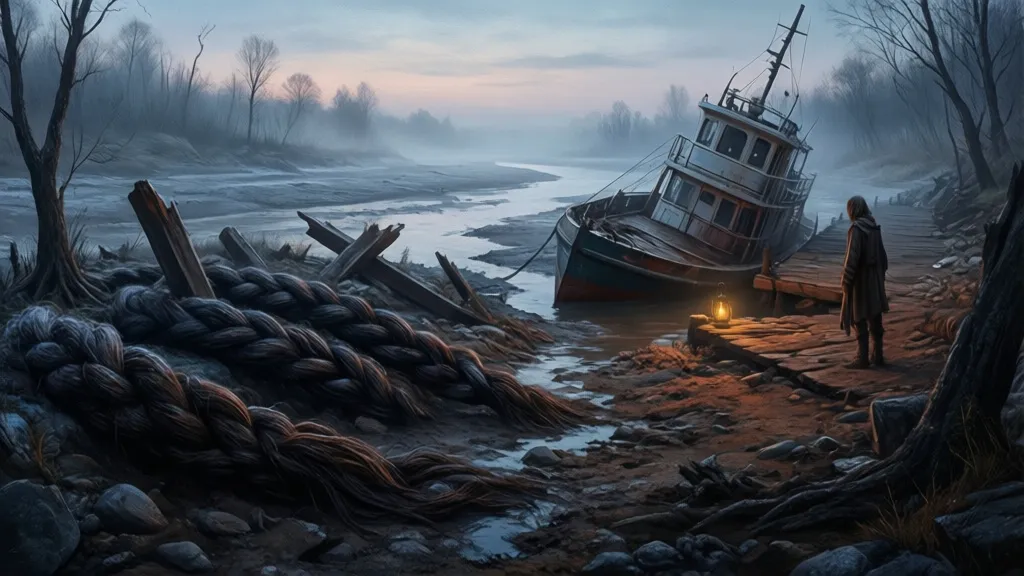
The river shrank overnight, which meant someone had broken a promise large enough to alter geography.
Thomas found it reduced to three black braids of mud when he came down to the dock at dawn, the ferry's hull settled at an angle that made the whole vessel look suddenly old. The water had pulled back a quarter mile, exposing stones he had never seen and the ribs of two boats he had thought were stories. The morning smelled of salt and turned earth and something else—something that reminded him of the year his wife died, when the air had tasted of absence for months afterward.
He was reaching for the mooring rope, intending to wait, when he noticed the coat.
It sat folded on the bench where passengers left umbrellas and fishing tackle, grey wool with bone buttons, the collar turned up against weather that was no longer falling. He recognized it before his hand touched the fabric: Maren's winter coat, the one she had been buried in six years ago. He had watched them lower her into the ground wearing it. He had chosen it himself because she had always said it made her look like someone worth listening to.
The coat was cold and smelled faintly of smoke and lavender, which were the smells of his wife when she came in from the garden in autumn. It was not damp. It had not been rained on. It had simply appeared, placed with intention on the bench where he would find it.
He lifted it carefully. Something shifted in the lining—not the rattle of coins or keys, but the specific weight of paper that has been folded and sealed. He found the stitching along the inner seam, small and precise, the kind of sewing Maren had done when she meant for something to last. He cut the thread with his knife.
The letter inside was sealed with black wax, no crest, and addressed in handwriting he did not recognize: For the ferryman, on the morning the river remembers.
He did not open it. Not yet. He had lived beside water long enough to know that some instructions required preparation, and that preparation began with understanding the shape of the day you were entering.
The coat was heavier than he remembered. Salt had begun to form along the cuffs, though it had not been near salt water. He set it back on the bench and looked at the shrunken river.
The lantern appeared an hour later, when the sun had risen high enough to make the exposed mud shine like poured iron.
It sat at the waterline, or what had been the waterline before the river withdrew. Brass, with a buckled handle and a door that latched with a pin. The glass was smoky but intact. Inside, something that was not quite a candle waited to be lit—a wick emerging from what looked like dried resin or amber, pale gold and faintly luminous even in daylight.
Thomas walked down to retrieve it. The mud sucked at his boots. Crabs moved sideways through the channels, disoriented by the sudden exposure. He picked up the lantern, which was warm, and found a small metal plate riveted to the base:
Upriver. The house with blue shutters. Before the second tide.
He returned to the dock and opened the letter.
The handwriting was his wife's.
He read it twice, standing beside the coat that smelled of her, while the ferry creaked in the mud and the morning continued without him.
Thomas—
If you are reading this, the river has done what I asked it to do, which means you have one day to correct the thing I could not tell you while I was alive in the usual way.
There is a child. Not ours, but mine—given away when I was sixteen, before we met, before I understood that keeping a thing and holding it tightly enough were two separate failures. Her name is Anna. She lives upriver in the house with blue shutters, and she does not know what I was, or what she might be, or why the water rises when she weeps.
The lantern is for her. You must carry it while the river is low, because when the tide returns, the path will close. If you deliver it before the water rises, she will understand what she is. If you open the lantern before you reach her, you will see what I was, and the understanding will take the place in your memory where I have been standing all these years. You will know me truly, but you will not love the knowing.
The choice is yours. I arranged it that way. I am sorry for the arranging, but not for the child, and not for the fact that some promises require salt water to dissolve.
The second tide comes at dusk. The path is seven miles.
With all that I was,
Maren
Thomas sat on the bench beside the coat. The lantern rested between his feet, warm and patient.
A child. His wife had borne a child and given her away and never once mentioned the fact in fifteen years of marriage. He tried to feel betrayed and found he could not locate the feeling. Maren had always carried herself like someone who had survived something—not dramatically, just in the way she checked locks twice and kept extra candles in drawers and never spoke about the years before they met. He had assumed grief or hardship of the common kind. He had not assumed this.
He looked at the river. The mud was drying in the sun, cracking into geometric patterns. Somewhere upriver, a woman who was not his daughter but was Maren's was living in a house with blue shutters, waiting for something she did not know she needed.
He could open the lantern now. He could see what his wife had been—what truth was large enough to require a river's consent to reveal. But the letter had been clear: understanding would replace memory. He would know, but he would lose the version of Maren he had loved. The woman who had laughed at his jokes and mended his shirts and died quietly in the back room while the rain fell and the ferry rocked at its mooring.
Or he could carry the lantern upriver. He could deliver it unopened and let the child have what she needed, and he would go home still believing his wife had been entirely his, that the marriage had contained all of her, that there had been no part of her life she had folded away and sewn into a coat lining.
The sun moved higher. The salt on the coat cuffs thickened, spreading like frost.
He began walking at noon, when the mud had dried enough to hold weight.
The lantern hung from his hand, its warmth seeping through the brass into his palm. The river's absence had revealed a path he had never seen—a ridge of stones that ran along the eastern bank, exposed now, smooth and black and placed with intention. An old road, perhaps. Or a boundary line laid down when the world was still deciding what shapes it would hold.
The coat he had left on the bench, folded as he had found it. He would return for it, or he would not. Either way, it would be there, growing stiffer with salt, a garment waiting for a body that would not return.
He walked for two hours before the first house appeared—stone and tile, shutters painted green, a garden full of beans and late roses. An old woman watched him pass from the doorway. She did not wave. He did not expect her to. People who lived along rivers understood that some journeys were private.
The second house had red shutters. The third had none at all.
The fourth house had shutters painted blue, and smoke rising from the chimney, and a woman in the garden pulling carrots.
She looked up when he arrived. She was perhaps thirty, dark-haired, with Maren's jawline and his wife's way of holding her shoulders—slightly raised, as though prepared for weather. She wiped soil from her hands and waited.
"I'm Thomas," he said. "I think you knew my wife."
The woman studied him. Her eyes were grey, the colour of the river on cloudy mornings. "Maren," she said. It was not a question.
"Yes."
She nodded slowly. "I've been dreaming about water for a week. Rising water. I thought it was a warning."
"It's a delivery," Thomas said, and held out the lantern.
Anna took it carefully, as though it might break or burn. She turned it in her hands, examining the latch, the smoky glass, the wick inside that had not yet been lit.
"What is it?" she asked.
"I don't know," Thomas said. "Your mother sent it."
She looked up sharply. "My mother is dead."
"So is mine," Thomas said. "But she arranged this before she left."
Anna's hands tightened on the lantern. "What does it do?"
"I think it shows you what you are."
She was quiet for a long time. The wind moved through the garden, rattling bean stalks. Somewhere inland, a dog barked. The sun had begun its descent toward the horizon, and Thomas could feel the pull of the tide in his chest—not arrived yet, but coming, the way weather arrives before you can see it.
"And you?" Anna asked. "What do you get?"
Thomas thought of the coat on the bench, stiffening with salt. He thought of his wife's handwriting on paper that should not exist. He thought of fifteen years of marriage that had been true but not complete.
"I get to go home still believing she was mine," he said.
Anna nodded. She understood, or she didn't, but either way she accepted the terms. She held the lantern close and looked toward the river, which was still absent, still pulled back, still waiting.
"Thank you," she said.
Thomas turned and began the walk back.
The tide returned as he reached the ferry.
It came quietly, the way important things often do—not a rush or a wave, but a slow filling, the river remembering its own shape and sliding back into the channels it had abandoned. By the time Thomas climbed onto the dock, the water was lapping at the hull, lifting the ferry into its proper angle.
The coat was gone from the bench.
He stood for a moment, looking at the empty wood, at the place where salt had formed and then dissolved. He felt neither relief nor grief, only the quiet understanding that some things returned to the world and some things left it, and the difference was often a matter of timing.
Upriver, in a house with blue shutters, a woman was lighting a lantern. He would never know what it showed her. He would never know what his wife had been, beneath the marriage and the garden and the years of quiet companionship. He had chosen not to know, and the choice sat in his chest like ballast, keeping him steady as the river rose and the ferry rocked and the evening came down over the water.
He untied the mooring rope. The current was running again, strong and dark and full of purpose.
Somewhere far out in the channels, something that had been held back was moving forward, and Thomas, who had spent his life carrying people from one shore to another, understood that he had just completed the most important crossing of his life without ever leaving the ground.
He stepped into the ferry and let the river take him home.