The Lantern That Would Not Cool
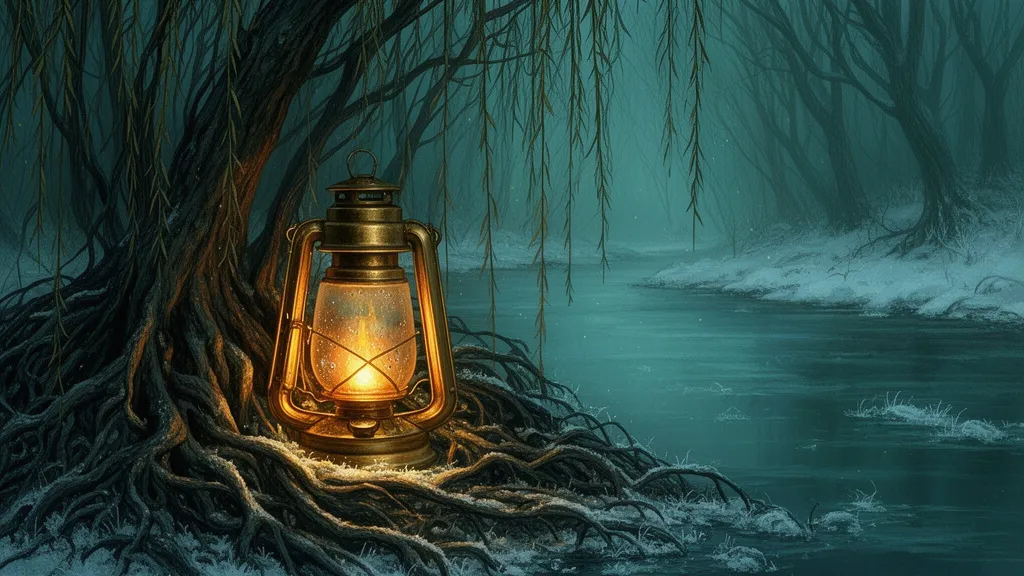
The lantern was still warm when you found it, which was the first impossibility. Glass does not hold heat through a winter current, and the river had been cold enough to numb your fingers through wool for three months now. But when you lifted it from the willow roots where the flood had left it, the panes fogged from the inside, a bloom of condensation that spread and faded like breath.
You wiped the glass with your sleeve. Inside, folded against the wick housing, was a scrap of paper with your brother's name written in charcoal: Finn Harrow.
Not his handwriting. You would have known his hand anywhere—the way he crossed his t's too high, like a child proud of reaching the top line. This was someone else's work, deliberate and level, each letter pressed hard enough that the charcoal had cracked at the edges.
The river was still rising. It had been rising for two days, swallowing the lower paths and turning the willows into islands. You could hear it working at the bank behind you, a patient erosion that sounded almost like speech if you listened long enough. Your mother said the river had moods. Your brother had said the river had a memory longer than the village, and that was why you had to respect what it took.
He had been missing for three winters. Long enough that his boots by the door had started to look decorative, like something placed there on purpose rather than left in the expectation of return.
You brought the lantern to the river-tender's house because he was the one who had sold you the first lead, eight months ago, when you were still desperate enough to pay for hope. He had taken your coins and told you about a man matching Finn's description seen working a lumber crew two valleys over. You had walked for three days. The man was sixty years old and missing his left eye.
The river-tender lived in a narrow house that leaned toward the water as if trying to hear it better. When you knocked, he opened the door already frowning, which meant he had seen you coming.
"I found this," you said, holding up the lantern.
He looked at it for longer than he should have needed to. Then he said, "Where?"
"Under the willow. The one that marks the flood line."
"Show me what's inside."
You held the lantern up to the light from his doorway. He leaned close, close enough that you could smell the fish oil he used to waterproof his nets, and read your brother's name through the glass.
When he straightened, his face had gone careful in the way that meant he was weighing what he would tell you against what he thought you could afford to hear.
"That's a lure," he said.
"A lure for what?"
"For you. Someone wants you at the ferry at dusk." He glanced past you, toward the river, which was close enough now that you could hear it clearly even through the walls of his house. "The water's too high for crossing. Has been since yesterday. Anyone asking you to meet them there now is asking you to stand on a pier that won't last the night."
"Who would do that?"
He was quiet for long enough that you understood he was deciding whether to lie. Finally he said, "The river remembers debts. Your brother—" He stopped. Started again. "Your brother made a promise to the ferry keeper three winters ago. Said he'd come back with payment for a crossing. Never did."
You had heard this story before, or versions of it. Finn borrowing tools he never returned. Finn agreeing to work a harvest and vanishing before the threshing. Finn promising your mother he would stay through the winter and leaving the week before the first snow.
But the ferry keeper had been dead for two years. You had attended the burning yourself.
"The ferry keeper's son, then," the river-tender said, reading your expression. "He inherited more than the boat. Inherited the resentments, too."
The lantern was still warm in your hands. You turned it slowly, watching the paper inside shift with the motion. Your brother's name, written by someone who wanted you to see it.
"If I go," you said, "what happens?"
The river-tender looked at you the way your mother used to look at Finn when he came home with excuses that were true but insufficient.
"You stand on a pier that's half-drowned already," he said, "and you wait for someone who might not come, and when the water takes the pilings you go into the river or you don't. Depends on whether you can swim in a current like that." He paused. "You can't."
He was right. You had never learned. Finn had tried to teach you once, but you had been afraid of the depth, the way the riverbed dropped away so suddenly, and he had laughed and said you were safer on land anyway.
"What if I break the glass?" you asked.
The river-tender's frown deepened. "Then you've got a piece of paper with a name on it and no lantern. What good does that do?"
You did not have an answer. You thanked him and left.
The ferry pier was exactly as he had described it: half-drowned, the pilings creaking under the weight of water that wanted to carry them downstream. The lantern was dimmer now, though you had not lit it. Its warmth had faded to something you could only feel if you held your palm directly against the glass.
The sun was going down. Dusk on a river is not like dusk in a field—it happens faster, as if the water pulls the light down with it. You stood at the end of the pier and waited.
No one came.
The water rose another hand's width. You could feel the pier beginning to sway, a motion that was almost soothing until you remembered what it meant.
You held the lantern up. Through the fogging glass, you could still see your brother's name. Not a message. Not a location. Just his name, written carefully, as if the act of writing it mattered more than what you were supposed to do with it afterward.
The river-tender had said it was a lure. But the river-tender had also sold you false hope for money, and maybe this was another version of the same transaction: tell you what you fear so you will stay away from what you want.
You thought about breaking the glass. About unfolding the paper and finding—what? Coordinates? A confession? Another name, the person who wrote this one, the person who knew where Finn had gone?
Or maybe just your brother's name, written once, preserved in glass and heat and flood water, and nothing else.
Behind you, the village was lighting lamps. You could see them through the trees, small and steady, the kind of light that meant someone was home and the door was open. Your mother would be lighting the lamp by Finn's boots, the same ritual she had kept for three winters, as if repetition could summon him back.
The pier groaned. The water was over your ankles now.
You looked at the lantern. It was nearly dark inside, the warmth almost gone. In an hour it would be cold glass and a scrap of paper, evidence of nothing, proof of less.
You turned and walked back toward the bank, water pulling at your boots, the pier shuddering under your weight. When you reached solid ground you kept walking, the lantern still whole in your hands, still warm enough that you could almost believe it had been lit for you, that someone had sent it downriver knowing you would find it, knowing you would carry it home.
Behind you, the river took the ferry pier. You heard it go: a crack, a groan, a sound like wood remembering it had once been a living tree and was tired of pretending otherwise.
By the time you reached your mother's house, the lantern had gone cold. But your brother's boots were still by the door, and you set the lantern beside them, two objects that had outlasted their usefulness but were kept anyway, because forgetting required a kind of cruelty neither of you had learned yet.
The river, which had been loud all evening, was suddenly quiet. You stood in the doorway and listened to the silence, which was its own kind of answer, and went inside.