The Ledger That Kept Its Salt
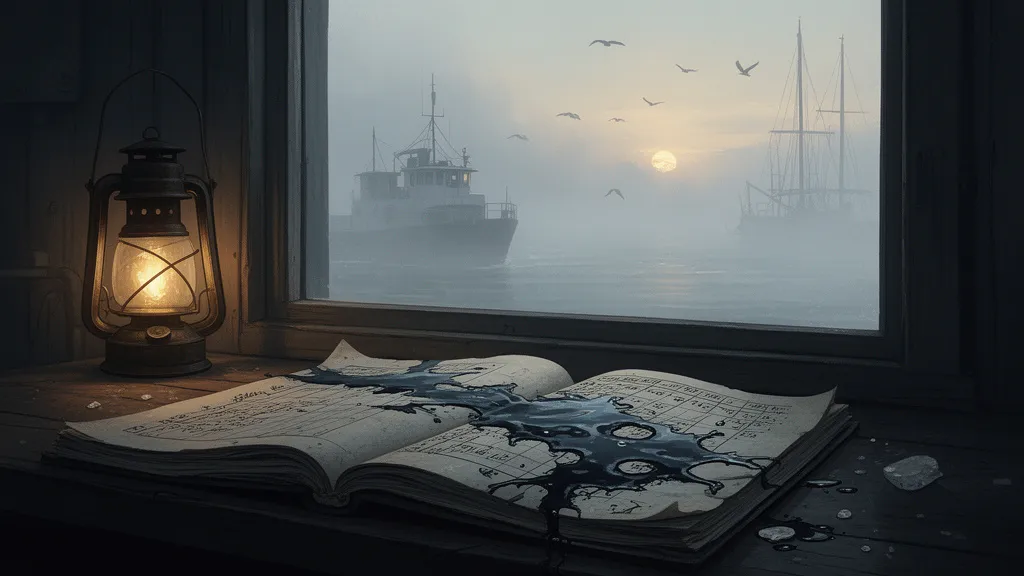
The ink had begun to weep just before dawn, which meant the harbor had remembered something it was not supposed to know.
Caris found it when she came to open the ferry office: the tide ledger lying open on her desk, its pages bowed and darkening, saltwater beading along the entries made after midnight. Four names. She recognized two—passengers who'd crossed on the last boat, the one that ran when fog made the lanterns difficult and the ferryman had to feel his way along the rope. The other two she did not know. But all four were bleeding.
She touched the page. Her fingers came away wet.
Outside, the gulls had begun to gather on the tin roof in numbers she had never seen, not in seven years of opening this office before the town woke. They were not crying. They were tapping—soft, deliberate—the way a visitor might knock when they were uncertain of their welcome but very sure of their need.
The river, when she looked through the window, was the wrong colour. Not the brown-grey it should have been, but green-black, like old bronze left in rain. And it was moving the way rivers do not move: slowly, deliberately inland, as though it had decided the shore was negotiable.
The harbour had a bargain. Everyone knew this the way they knew which wood did not burn cleanly and which saints to petition for fog. No one spoke of it directly, but the knowing was there, in the way mothers pulled children back from the water's edge after dark, in the way the ferry office was always built with its back to the hill and never closer than forty yards from the tide line.
Caris had been told, once, by the old clerk she'd replaced. Not the details—those had been eaten by whatever silence protects such things—but the shape of it. The river keeps account, the woman had said, standing in this same doorway on Caris's first morning, the tide ledger open between them like a third presence in the room. You write the names of those who cross. You write them true and you write them whole. That is the agreement. That is how the ferries run.
Caris had asked what happened if you didn't.
The woman had looked at her the way the very old look at the very young when the young have asked something that cannot be answered except by living long enough to no longer need the answer.
You write them true, she'd said again. And you close the book before midnight. If you close it after—if the names sit open through the dark hours—the river takes them as unfinished business. It holds them until you correct the debt. But—and here the woman had paused, her hand on the doorframe—if you close the book, even late, the agreement still recognizes the closing. The ferries will run. But what the river has claimed in those hours, it keeps. That is the interest on the debt.
Caris had not understood then. She thought she might be beginning to understand now.
She found the first piece of driftwood at seven, when she walked down to the ferry dock to see if Old Tam was still willing to make the crossing. He was not there. The boat was not there. But the driftwood was: pale, sea-smoothed, wedged upright in the sand like a grave marker.
The name carved into it was Margit Hollis.
Caris knew her. A widow. Took the late ferry twice a month to visit her daughter on the other side. She would have crossed last night, when the fog was thick and Caris had left the book open, and now her name was here, and the wood smelled of deep water and older things.
The second piece was five yards down the shore. Peter Venn. A trader. She did not know him well, but she knew the name from the ledger, from months of entries, from the rhythm of small lives crossing and re-crossing the boundary the river kept.
The third piece made her stop walking.
The fourth made her kneel in the wet sand, the cold soaking through her skirt, the gulls overhead now utterly silent.
Torren Moss.
Her brother.
Who had been missing for three years. Who had taken the last ferry one autumn evening and simply not arrived. The ferryman had insisted he'd crossed. The family on the other side had insisted he had not. The river, consulted in the desperate and indirect ways such things are consulted, had offered nothing.
And now his name was here, carved into driftwood, appearing with the others because someone—because she—had left the ledger open past midnight, and the harbor's old agreement had found a way to correct the accounting.
She returned to the office. The ledger was still bleeding. The names were darker now, the ink spreading into the fibres of the paper the way blood spreads into cloth, and she understood with the cold clarity that sometimes accompanies disasters that she had perhaps an hour before the first ferry was supposed to leave.
If she erased the names now and closed the book, the harbour would release them fully. The driftwood would sink back into the sand. The passengers would be allowed to finish their crossings, to return to the rhythm of their lives, to forget they had been briefly caught in something older than intention.
But Torren would be erased too. Torren, who she had been looking for in every face that disembarked, in every late-night passenger who'd seemed, for a moment, to have his walk. Torren, who the river had taken and kept and now—for reasons that had nothing to do with mercy and everything to do with accuracy—had returned to the page.
If she closed the book without erasing, the old clerk's words would hold true: the ferries would run again, the bargain would recognize the closing, but what the river had claimed in the hours between midnight and dawn—those four names, carved now into wood—it would keep. They would remain as markers. Unfinished business made permanent. The interest on her debt.
The gulls began tapping again. Harder now. Rhythmic. The sound a hand makes when it is trying to be patient but has been waiting a very long time.
Caris sat at the desk with the bleeding ledger open before her and thought about her brother.
She thought about the way he used to fold paper boats and set them in the rain barrels, watching them circle. She thought about the autumn he'd left, the fog that night, the way he'd waved from the ferry deck without looking back because looking back was considered unlucky.
She thought about the bargain. About the river keeping account. About how some agreements are not made by people but for them, written into the shape of the land before anyone thought to give it a name, and how the cost of maintaining such agreements is not paid once but continuously, in the small surrenders that accumulate like silt.
The water on the page had begun to pool. Small drops, perfectly round, falling onto the desk.
Outside, the river had reached the low fence at the end of the dock. It was not rushing. It was simply arriving, the way the tide arrives, with the patient inevitability of something that knows it has been invited.
Caris picked up the pen.
She had been a clerk long enough to know that some erasures are not corrections but surrenders. That the names in the ledger were not entries but anchors. That her brother had been missing because he had never finished crossing, caught in the space between shores where the river keeps its oldest memories and its least negotiable debts.
If she erased the names and closed the book, everyone would be released—passengers and brother alike—but Torren would return to being simply missing. Unfindable. A gap in the world where he had been.
If she closed the book without erasing, the passengers would become like him: markers the river kept. Four lives transformed into driftwood testimonies, held in the space between crossing and arrival. The ferries would run again—the bargain would recognize her closing, however late—but Margit Hollis would not visit her daughter anymore. Peter Venn would not complete his trade. And two others whose faces she could not recall would become wood and salt and memory.
The cost of finding her brother was four other names held permanently incomplete.
The cost of releasing them was losing him again to the unmapped spaces where even driftwood does not reach.
The gulls stopped tapping.
The ferry bell, which had not rung in three years without human hands, rang once.
Caris closed her eyes. She thought about Margit Hollis, who crossed twice a month. Who had a daughter waiting. Who had not deserved to be caught in someone else's grief.
She opened her eyes.
She picked up the cloth she used to clean the desk, dampened it in the cup of water by the window, and began to wipe the names from the page. One by one. Carefully. The way the old clerk had taught her to handle corrections, with respect for what was being erased.
Margit Hollis faded first. Then Peter Venn. Then the two she had not known.
Her hand hovered over the fourth name.
Torren Moss.
The river outside had reached the fence and stopped, as though waiting.
She had been looking for three years. The driftwood had given her an answer: he was here, somewhere in the accounting, held in the space the river kept. If she erased his name, she would lose even that.
But he had been her brother before he had been a name in a ledger. And he had folded paper boats because he liked to watch things that were made to sink instead float, briefly, before the water took them.
Caris wiped the last name from the page.
The saltwater on the desk began, very slowly, to recede.
She closed the ledger. She placed it in the drawer. She locked the drawer with the small brass key that had been given to her seven years ago by a woman who had known, perhaps, that some mornings the only choice is which debt to honour.
The river paused at the fence, then began its long movement back toward the sea.
Outside, the driftwood remained for perhaps three minutes more—four pale markers in the sand—and then they sank, slowly, as though the shore had decided they could be released after all, now that the book was closed and the names were gone and the debt had been paid in erasure rather than permanence.
When the first passengers arrived an hour later, the ferries were waiting at the dock.
And Caris, standing in the doorway of the office with the locked drawer behind her and the morning stretching ahead, understood that she had chosen to let her brother go unfound rather than trap four others in the space where he had been caught, and that this was the cost the bargain had required: not cleverness, not negotiation, but the simple, ordinary surrender of the thing she had wanted most.
The gulls lifted from the roof in a single motion, their wings dark against the whitening sky.
The river, satisfied or merely patient, returned to its brown-grey colour and its seaward motion.
And on Caris's desk, where the saltwater had pooled and receded, a single grain of sand remained: pale, sea-smoothed, small enough to be nothing at all, or to be the last memory of a name the river had briefly, accurately kept.