The Map That Smelled of Burning Names
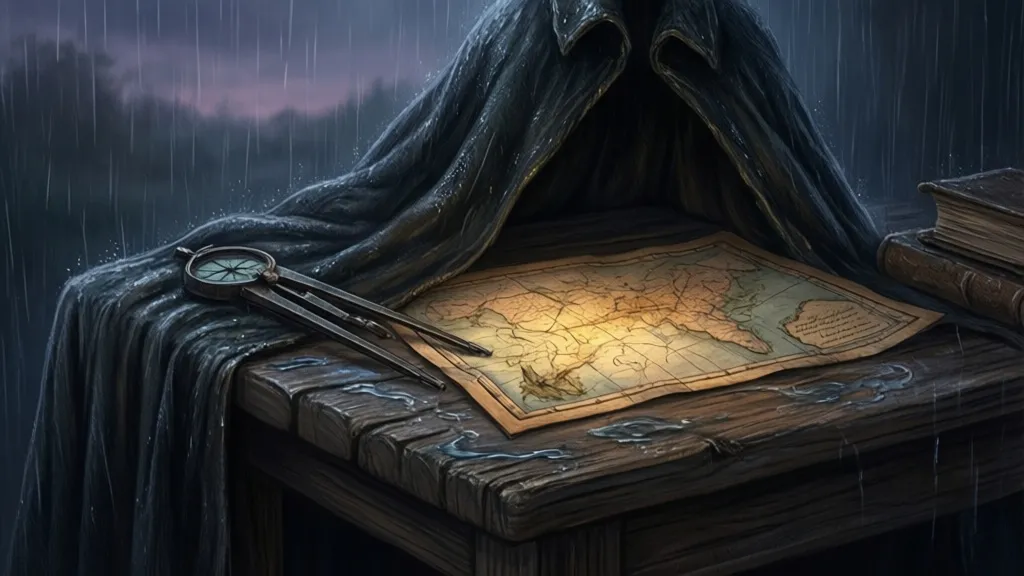
The cloak arrived three months after your brother drowned, which was long enough that you had stopped checking the post for impossible deliveries. You found it folded inside a crate of surveying equipment donated by the Cartographers' Guild—an act of charity you had not requested and did not want. The cloak was rain-dark, the colour of floodwater after sunset, and when you lifted it to the light, something crinkled in the lining.
The map had been sewn between layers of oiled canvas with the kind of careful, invisible stitching your brother used on documents he did not want discovered. You unpicked the thread with a compass point. The paper unfolded stiff and strange, marked not with the methodical annotations of official work but with a single black line that curved through districts you knew and several you did not. The route began at the flooded market where the river had risen six feet above the cobblestones and ended—according to the notation in your brother's hand—at an address in the Wick, the eastern district scheduled for burning at dusk.
The map smelled faintly of smoke and myrrh, which meant it had been carried close to someone's body for long enough to absorb their scent. Your brother had worn myrrh oil in winter. You had not smelled it since they pulled his body from the canal with stones in his pockets and ink still staining his fingertips.
You held the map to the window. The paper had been treated with something that made it faintly luminous in afternoon light, a technique used for documents meant to be read in dark places. The route was marked in stages: the flooded market, a stairway behind the old cooperage, a passage beneath the aqueduct, and finally the address in the Wick where, according to the warden's announcements, nothing remained worth saving. The district would be cleared by mid-afternoon and set alight at dusk to prevent the fever from spreading.
Except your brother had drawn the route six weeks before the fever arrived, which meant he had known something about the Wick that preceded the burning.
The flooded market stood empty in the grey afternoon, the stalls submerged and the awnings sagging with accumulated rain. You waded through water that came to your knees, holding the map above the surface, following the inked line toward a place your brother had marked with a small, precise star. The route led not through the market itself but along its eastern edge, where a stone stairway descended toward what should have been a basement but was instead the entrance to a passage you had never seen mapped.
The city was very old and had outlasted many attempts to chart it completely. You knew this because you were a cartographer, and because your brother had been a cartographer before he became something else—something he would not name, even when you asked him why he came home with mud on his boots and ink in places ink had no business being.
The passage smelled of damp stone and river silt. The map's luminous treatment made it easier to read in the darkness, and you followed the route through turns that seemed to have been cut deliberately to avoid the main tunnels. Your brother had marked distances in paces rather than measurements, as though he had walked this route enough times to count his steps without thinking.
You surfaced behind the old cooperage, where the afternoon light slanted through broken shutters and dust moved in slow, suspended patterns that suggested the air itself remembered motion. The route continued north, beneath the aqueduct where water ran in channels above your head and the sound of it filled the space like breathing.
By the time you reached the Wick, the district had been emptied. The streets stood silent except for the wardens' voices in the distance, calling final warnings. The buildings leaned against each other in configurations that suggested they had been standing longer than the city's official records acknowledged. Your brother's map led you past the burnt-out shells of warehouses and through a courtyard where someone had planted rosemary that still bloomed despite the evacuation order.
The address was marked on a building with no number, three stories of brick that had settled at an angle gravity should not have permitted. The door was locked, but your brother had drawn a small notation beside it: keystone, left side, third course up.
You found the loose brick where he had indicated and behind it a key wrapped in oilcloth that still carried the faint scent of myrrh.
The room was on the third floor, at the end of a corridor where the floorboards creaked in rhythms that suggested the building was listening to determine whether you belonged. The key turned in a lock that had been oiled recently enough that it made no sound.
Inside, the walls were lined with shelves, and the shelves were filled with papers organised in a manner you recognised because it was the system your brother had taught you when you were learning to catalogue surveys. Except these were not surveys. These were records—names written in different hands, dates that spanned decades, notations in margins that indicated requests made and promises broken and people who had walked into certain buildings and never walked out again.
The city had been storing the names of the missing.
Not storing them carelessly, either. The records were chronological, cross-referenced, annotated with the precision of someone who understood that documentation was the only form of remembering that survived official forgetting. You recognised your brother's handwriting in the most recent entries, including one dated two days before he drowned. It listed fourteen names. Beside each was a notation: transferred, which appeared to mean moved from one holding place to another, and disposed, which appeared to mean something the records did not specify further because the meaning was already understood.
Your brother had died trying to protect this.
In the distance, you heard the wardens calling the final warning. The burning would begin at dusk, which left perhaps an hour. You could carry what papers you could manage and leave the rest to burn. You could try to move the archive, though the weight of it and the wardens' presence made that impossible. Or you could do what your brother had not been able to finish: make the archive known.
Except making it known would bring attention, and attention in a city that stored such records was not the kind that permitted you to walk away afterward. Your brother had understood this, which was likely why he had drowned with stones in his pockets rather than permit questioning.
You thought about the map, sewn into the lining where it might survive even if the cloak was taken. You thought about the myrrh, which meant your brother had carried it close enough and long enough that his scent had transferred to paper. You thought about the key, wrapped carefully and hidden where someone who knew his methods would think to look.
He had not meant for the archive to burn. He had meant for someone—for you—to make the choice he had not been able to finish making.
The wardens' voices grew closer. You heard them checking buildings, marking doors. In an hour the Wick would burn, and with it whatever you did not carry out or did not make known.
You took the ledger with the most recent entries and folded it inside your coat. You took the papers your brother had annotated in his own hand. Then you opened the window that faced the central square, where the wardens assembled before the burning, and you began to drop pages.
They fell like snow, like ash before the burning, scattering across cobblestones where people could not help but see them. Names and dates and notations that would be read before they could be gathered. Evidence that would enter public knowledge before the wardens understood what was happening.
By the time you heard footsteps on the stairs, you had emptied three shelves. By the time the door opened, you had committed the final act your brother had died attempting: you had made the forgetting impossible.
The warden who entered carried no torch yet, which meant you had minutes before the burning. He looked at the empty shelves, at the window, at you standing with papers still in your hands.
"Your brother," he said, not as a question.
You thought about the map, about myrrh, about routes drawn in invisible ink that only revealed themselves when held to light. You thought about the careful way your brother had sewn evidence into a cloak and marked passages through the city for someone who knew how to read them.
"He was a cartographer," you said. "He mapped what needed to be remembered."
The warden nodded slowly, as though this confirmed something he had already suspected. Below, in the square, voices rose as people bent to gather papers. The archive was no longer contained. The names were no longer missing.
"The fire," the warden said, "is scheduled for dusk."
"I know," you said, and dropped the last pages out the window, where they caught the wind and carried themselves beyond retrieval, into the city that would read them and remember, whether the wardens burned the district or not.
The map had led where maps always led: to the truth that someone had tried to hide. Your brother had known this. He had sewn the route into a cloak and sent it forward, trusting you to finish what he could not.
The warden stepped aside. You walked past him, down the stairs, into the street where papers still drifted and people still read them with the kind of attention that suggested they would not soon forget. Behind you, the building stood waiting for the fire. But the archive was no longer inside it. The archive was dispersed, documented, witnessed.
By sunset, when the burning began, the names were already remembered.