The Map That Was Still Becoming
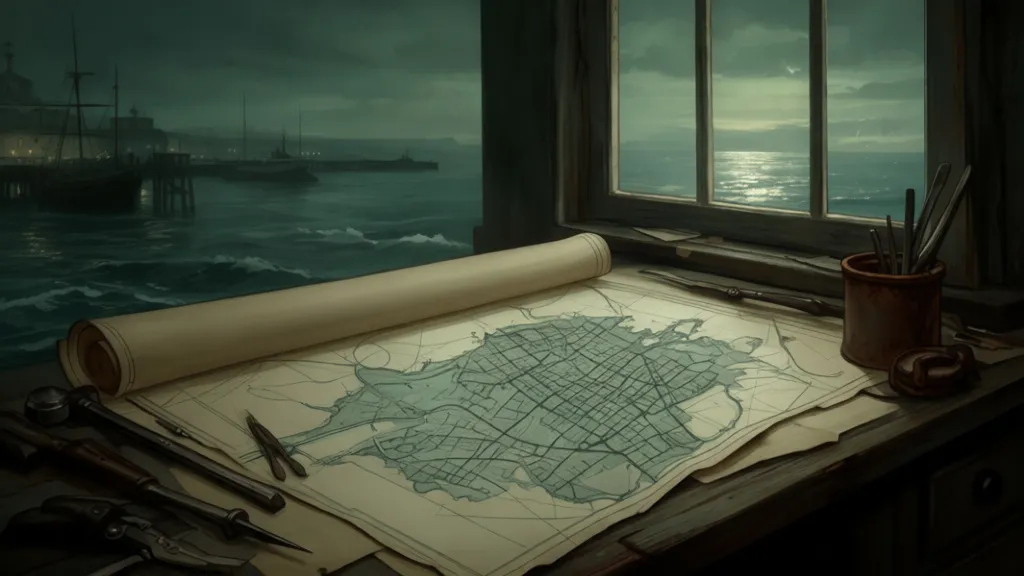
The tide had turned three times since the ink began moving, which meant the chart was either remembering or learning to lie.
Isla discovered it on the fourth morning, when she returned to her workbench to find Gull Street had shifted two degrees north and grown a cul-de-sac that terminated at the base of the harbor wall. She had drawn no such cul-de-sac. She had surveyed the waterfront herself, walked every cobbled inch of it during the spring surveys, and there had been nothing but the herring sheds and the tide gate's rusted housing where the new ink insisted a street now ended.
She pressed her palm flat against the vellum. The ink was dry. The lines were certain. They possessed the geographic confidence of coastline that had been wearing its shape for centuries.
But Gull Street did not do that. Gull Street ran parallel to the water, a simple connector between the chandlery and the sailmaker's loft, and it had done so since her grandmother's time, when the old charts were still drawn on scraped hide and sealed with beeswax against the salt.
Isla lit the lamp though dawn was already greying the workshop windows. She unrolled the previous survey—last autumn's work, before the commission—and laid it beside the new chart. In the older map, Gull Street was a straight line, unambiguous, ending precisely where it should: at the low wall that kept the spring tides from flooding the merchant quarter.
In the new chart, it hooked east and deepened into shadow.
She had used the same ink. Soot and oak gall, the proportions her mother had taught her, nothing that should wake in the night and decide to go walking.
"Maps don't revise themselves," she said aloud, because the silence in the workshop had begun to feel anticipatory.
The lamp flame bent toward the chart as though interested.
Isla rolled both maps carefully, tied them with undyed string, and walked down to the harbor while the fishing boats were still hauling in their night lines and the gulls were screaming their arguments over the jetty stones.
Gull Street looked exactly as it always had.
She walked its length twice: once toward the water, once away. The cobbles were slick with spray and the herring sheds smelled of yesterday's catch and the tide gate stood open, its iron jaws yawning at the retreating sea. At the street's end, there was the low wall, the harbor beyond it, and nothing else.
No cul-de-sac. No deepening. No shadow that shouldn't be there.
Isla returned to the workshop as the church bells rang seven, and the ink had moved again.
Now the cul-de-sac had sprouted a house.
It was a simple structure, the sort the old coast builders favored: clapboard, steep-roofed, shutters that would hold against a nor'easter. The map showed it in perfect detail, down to the salt crusting on the window frames and the lantern burning behind frosted glass on the ground floor.
Isla sat very still.
She had commissioned work before—parish surveys, cadastral plots for the county assessor—but this chart had been a private request. A man had come to her workshop six weeks ago, late in the evening, and asked for a map of the waterfront. He had been specific about the boundaries: from the north jetty to the tide gate, including all structures within two hundred yards of the high-tide line.
He had paid in silver, which was unusual. He had paid in advance, which was more unusual. And he had given no name, which was not unusual at all in a town where the sea brought strangers and took them away again and no one asked what they were running from.
She had drawn the map carefully, accurately, with all the precision her training afforded. She had delivered nothing but truth to the vellum.
And the vellum, it seemed, had decided to continue without her.
Isla traced the house's outline with her smallest brush, the one she used for depth soundings. The ink was cool beneath the bristles, inert now, but she could feel something in the vellum itself—a faint pull, as though the map were urging her toward a weight it had been holding all this time and was only now prepared to release.
"Where are you?" she asked the house that should not exist.
But of course it did exist. That was the trouble. The map had found it, or made it, or remembered it, and now it was waiting.
She closed the workshop before noon and walked back to Gull Street.
The cul-de-sac was there.
It opened between the herring sheds like a wound that had been stitched badly and had decided to reopen on its own terms. The cobbles were darker than the rest of the street, slick with something that was not quite water, and the air above them bent light in a way that made Isla's eyes ache if she looked too long.
She walked toward the cul-de-sac slowly, the way one approaches a tide pool when uncertain what might be sheltering in the rocks.
The house stood at the end of the street, exactly as the map had promised: clapboard, steep-roofed, salt-crusted. The lantern burned behind the ground-floor window, steady and golden, and the front door stood half-open.
On the steps, barefoot on the wet boards, sat the man who had commissioned the map.
He looked up as she approached, and his expression was neither surprised nor relieved, only patient, as though he had been sitting there for much longer than six weeks and was prepared to sit for much longer still.
"You found it," he said.
Isla stopped three paces away. "You knew it would appear."
"I knew the map would finish," he corrected. "Maps want to be complete. You gave it the bones. It grew the rest."
"Maps don't grow."
"Yours do." He gestured toward the house behind him, a small motion, economical. "You draw what's beneath the surface. Most mapmakers stop at the visible. You go deeper."
Isla's throat was dry. "I surveyed this street. There was nothing here."
"There wasn't," the man agreed. "But the coast remembers everything it's lost. The ink just gave it a way back."
Behind him, the house seemed to settle more deeply into its foundations. Isla could hear the tide gate grinding somewhere in the distance, a low metallic groan that spoke of strain.
"What are you?" she asked.
"Someone who lived here a long time ago," the man said. "Before the street forgot. Before the town built over the memory." He stood, slow, deliberate, and his bare feet left damp prints on the boards. "The map gave me a door. But it's your ink. You have to decide if it stays open."
Isla looked past him at the house. Through the frosted glass, she could see shapes moving—furniture arranging itself, walls remembering their plaster, a kettle beginning to sing on a stove that had been cold for decades.
"And if I seal the map?" she asked. "Burn the ink out? Redraw it clean?"
"Then the street forgets again," the man said simply. "And I go back under."
The tide gate groaned louder. Isla turned and saw, at the mouth of the cul-de-sac, that the cobbles were beginning to buckle. The street was spreading, slow but certain, its darker stones creeping toward the harbor wall.
"It won't stop," she said. "Will it? If I leave it."
The man tilted his head, considering. "The coast takes back what it wants. Streets, houses, tide gates. The map is just helping it remember faster."
"And the town?"
"The town," he said, "will have to decide what it values more: the waterfront it built, or the shore that was here first."
Isla thought of her workshop, her surveys, the careful accumulation of lines and soundings that made sense of the world. She thought of her grandmother's charts, sealed with beeswax, and the stories the old woman used to tell of streets that walked at night and houses that drowned themselves at high tide.
She had always thought they were only stories.
"How long do I have?" she asked.
The man glanced at the sky, where the light was already thickening toward dusk. "Until dawn," he said. "The map will finish itself by then, one way or another."
Isla looked at him for a long moment—this stranger who had paid in silver and given no name, who was barefoot on the wet boards of a street that had not existed yesterday and might swallow the tide gate by morning.
"Did you live here?" she asked. "Really? Or are you just something the map invented?"
The man smiled, faint, and it was the first human expression she had seen him make. "Does it matter?"
"Yes," Isla said, and was surprised to find she meant it.
He stepped aside, then, and gestured toward the open door. "Come inside," he said. "If you're going to decide, you should know what you're choosing."
The house was smaller than the map suggested, or perhaps it was still growing, one room at a time. The lantern cast long shadows that moved with the rhythm of the tide, and the walls were hung with charts—old ones, older than her grandmother's, drawn in ink that Isla did not recognize and annotated in scripts that had gone out of use when the coast was still wild.
"I was a mapmaker," the man said, as though answering a question she had not asked. "Before the harbor came. Before the town decided water was something to keep out rather than live alongside."
He moved to a table that was slowly solidifying in the center of the room, its wood grain darkening into certainty, and spread his hands across its surface.
"The coast was different then," he continued. "It moved. Streets came and went with the seasons. We drew maps that could change."
"That's not cartography," Isla said. "That's—"
"Listening," the man finished. "The land tells you what it wants to be. You just have to draw it faithfully enough that it believes you."
Isla looked at the charts on the walls. Now that her eyes were adjusting to the lamplight, she could see that they were moving—rivers shifting course, coastlines eroding and reforming, towns appearing and disappearing like thoughts the land was still deciding whether to keep.
"The map I drew," she said slowly, "it's not lying. It's just... early."
"Yes," the man said. "You drew the truth before it arrived. That's a rare gift."
"And if the street finishes?"
"Then the harbor has to accommodate it," he said. "The tide gate, the merchant quarter, the fishing boats—they'll have to make room, or they'll be made to leave."
Isla thought of the town she had surveyed her entire life, the streets she knew as well as her own pulse. She thought of the fishermen hauling their nets in the grey dawn, the chandler's daughter learning to splice rope, the sailmaker who sang while he worked.
"They'll fight it," she said.
"They will," the man agreed. "The coast doesn't mind. It's been here longer."
Outside, the tide gate groaned again, a deep iron wail that spoke of hinges beginning to fail.
Isla walked to the window and looked out at the cul-de-sac, which had grown longer in the brief time she'd been inside. It reached now almost to the harbor wall, its cobbles dark and certain, and along its length, other houses were beginning to appear—faint at first, sketched in possibility, but growing denser with each moment.
"You didn't commission a map," she said, not turning. "You commissioned a door."
"I commissioned," the man said quietly, "someone who could draw truthfully enough that the coast would listen."
Isla pressed her palm against the frosted glass. Outside, dawn was still hours away, but she could feel the map in her workshop pulling toward completion, each line settling into inevitability.
"If I seal it," she said, "do you vanish? Or just... sleep again?"
"I don't know," the man admitted, and it was the first uncertain thing he had said. "I've been under a long time. I'm not sure I remember the difference."
Isla turned to face him. "And if I let it finish?"
"Then the coast comes back," he said. "And I get to walk it. For a while. Until the town builds over it again, or the sea takes it, or mapmakers forget how to listen."
The lamp flame bent toward her, curious.
"That's not a choice," Isla said. "That's just... postponement."
The man nodded. "Yes. But sometimes postponement is all we get."
Isla walked back through the half-real street as the church bells struck midnight. The cul-de-sac watched her leave, patient, and the houses along its length flickered in and out of solidity like memories trying to decide whether they were worth keeping.
In her workshop, the map lay on the table, glowing faintly in the moonlight. The street had grown longer. The houses were clearer. The tide gate, at the map's edge, had begun to buckle.
Isla lit the lamp and sat down at her workbench.
She could seal the map—burn the ink with salt and vinegar, scrape the vellum clean, redraw Gull Street as it was supposed to be, straight and simple and true to the town's memory rather than the coast's.
Or she could let it finish.
She thought of the man with no name, barefoot on wet boards. She thought of the charts on his walls, the coast that moved, the maps that could change. She thought of her grandmother's stories, and how they had always ended the same way: The sea keeps what the sea wants, and the shore just borrows for a while.
Isla picked up her brush—the fine one, for details—and dipped it in ink.
She did not seal the map.
Instead, she drew.
She added the houses that were flickering into being, traced their foundations with the same precision she used for tide lines and depth soundings. She drew the lamplights burning in their windows, the salt crusting on their shutters, the way the street curved to meet the harbor wall.
And then, carefully, with the smallest brush she owned, she drew a second tide gate.
It was an old design, the kind her grandmother would have recognized—not iron but wood and rope and the kind of hinges that could bend without breaking. She placed it at the new street's end, where the cul-de-sac met the water, and she drew it standing open.
The ink settled into the vellum with a soft sigh, as though the map had been holding its breath.
Isla sat back and watched as the lines darkened, solidified, became true.
Outside, the tide gate stopped groaning.
She returned to the cul-de-sac at dawn, when the fishing boats were raising their sails and the gulls were making their first passes over the jetty.
The street was still there.
So was the house.
But now, at the street's end, where it met the harbor wall, a second gate stood open to the sea—smaller than the town's iron giant, but sturdy, balanced, the kind of threshold that could let the tide in and out without demanding it choose.
The man was standing beside it, still barefoot, looking out at the water.
Isla approached slowly. "I didn't seal it," she said.
"I saw," the man replied. "Thank you."
"I didn't do it for you," Isla said, and found she was telling the truth. "I did it because the map wanted to finish, and I couldn't bear to stop it halfway."
The man turned to look at her, and his expression was complicated—relief and sorrow and something that might have been gratitude or might simply have been recognition.
"That's still a gift," he said.
Isla looked at the street, at the houses that had remembered themselves, at the small wooden gate that would let the tide breathe without drowning the town.
"How long will it last?" she asked.
"I don't know," the man said. "Long enough, maybe. Until someone draws a better map."
The tide was coming in, salt-bright and steady, and the new gate creaked gently as the water began to test its hinges.
Isla thought of her workshop, her surveys, the charts still waiting to be drawn. She thought of the coast that moved, the streets that walked, the maps that could change if you listened carefully enough.
"I'll come back," she said. "To check on it. Make sure the gate's holding."
The man smiled, small and certain. "I'll be here," he said. "For a while, at least."
Isla nodded and turned back toward the town, toward the workshop where the map lay finished and true, toward the work that was still waiting.
Behind her, the new street settled into its cobbles, and the houses began to fill with the small sounds of habitation: shutters opening, kettles singing, the soft shuffle of feet on old floorboards.
The coast had taken back what it wanted.
The map had simply shown it how.