The Mirror That Kept Its River
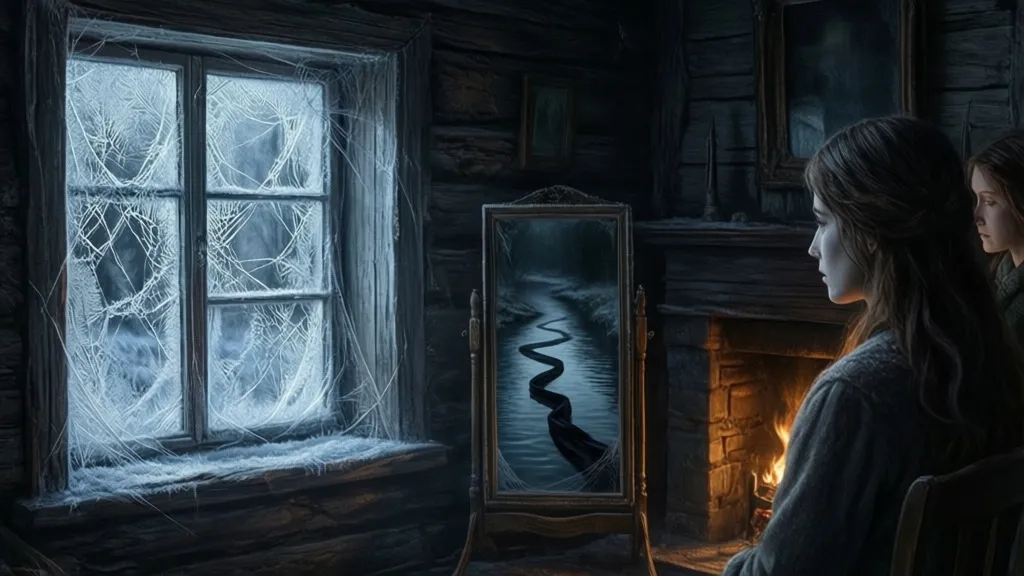
The frost began on the inside, which meant the house had stopped protecting them from what it remembered.
Celia noticed it first—fine white filaments threading across the kitchen window like the skeleton of something learning to see. She touched the glass and her fingertip came away wet, though the cold had been on the other side only moments before.
"Mother," she said, not turning from the window. "It's starting again."
In the chair by the hearth, Maren looked up from her mending with the expression of someone who has been expecting bad news for so long that its arrival feels almost like relief. "How many windows?"
"Just the one. But it's spreading."
"Then we have until morning."
Celia turned. Her mother's face was shadowed, halved by firelight, and for a moment she looked exactly like the woman in the tintype kept in the bottom drawer—Celia's grandmother, who had drowned in the river forty years ago on a night when the water ran backwards and the house groaned like a ship coming about.
"We should take it down," Celia said.
Maren's hands stilled on the fabric. "You know we can't."
"Then what are we waiting for?"
"Dawn. Always dawn."
Above the hearth, the mirror hung where it had hung for a hundred and thirty years, its frame blackened from smoke and age, its surface clouded with something that was not quite tarnish. It was nailed to the wall with iron, seven nails driven through the wood and into the beam beneath, and every generation of women in this house had been taught the same thing: never take it down, never cover it, and never, never speak to what might look back.
But tonight the mirror had begun to whisper.
Celia could hear it even from across the room—a sound like wind through dry reeds, or fingers trailing through standing water, or the way paper sounds when it crumbles from the outside in. It was not quite language, but it was close enough to language that her mind kept trying to shape it into words.
Maren set her mending aside and rose, moving to the window. She placed her palm flat against the frost. "It's inside the glass," she murmured. "That's new."
"What does it mean?"
"It means the house is listening harder than it used to."
They had lived in the riverhouse for as long as Celia could remember—a low, dark-beamed structure built on stilts above the bend where the current slowed and doubled back on itself. The river ran underneath them, always, a constant susurrus that had become the silence against which all other sounds were measured. Sometimes Celia woke in the night and thought she could feel the whole house rocking, gentle as a cradle, though the pilings had been sunk deep into clay and stone.
Her father had left when she was seven. Packed a bag one autumn morning and walked the plank bridge to the shore without looking back. Maren had watched from the doorway, her face expressionless, and when Celia asked why he was going, her mother had said only: "Some people can't live with what a house remembers."
Celia had not understood then. She thought she might be beginning to understand now.
The whispering grew louder.
She moved closer to the hearth, drawn despite herself, and tilted her head to listen. The words—if they were words—seemed to slide away whenever she tried to catch them, but their rhythm was insistent, repetitive, like a list being read aloud in a room she couldn't quite enter.
And then, clear as a stone dropped into still water, she heard a name.
Isobel.
Celia's breath caught.
"Mother."
Maren turned from the window. Her face had gone very still.
"It's saying names," Celia whispered. "The dead. I just heard Grandmother Isobel."
"Don't listen."
"But I can hear—"
"Don't listen."
The fire popped, sending sparks up the chimney. In the mirror's surface, something moved—not a reflection, exactly, but a deepening of the shadows, as though the glass had suddenly become much thicker, or much older, or both.
Celia took a step back. "What is it doing?"
Maren came to stand beside her, and for a long moment they both watched the mirror in silence. The whispering continued, patient and unhurried, and now Celia could hear other names threading through it: her great-uncle Thomas, who had died in the war; her cousin Margot, stillborn; names she didn't recognize but which felt familiar anyway, as though they had been spoken in this room so many times that the walls themselves remembered.
And then the mirror said a name that should not have been possible.
Lisbet.
Celia felt her mother stiffen beside her.
"That's impossible," Maren breathed. "She's not—"
But Celia already knew. Lisbet was her sister. Her older sister, the one who had left the riverhouse fifteen years ago and never written, never called, never sent word of where she'd gone or whether she was coming back. Maren had forbidden anyone to speak her name aloud, and over the years Celia had almost convinced herself that Lisbet had simply been a dream, a story she'd invented to explain the empty bedroom at the end of the hall.
"She's alive," Celia said. "Isn't she?"
Maren's jaw worked. "I don't know."
"The mirror wouldn't say her name unless—"
"The mirror says what the river tells it."
Celia looked at her mother, at the lines carved deep around her mouth, at the way her hands had curled into fists. "What happened to her?"
"She tried to take the mirror down."
The fire had burned low. In the kitchen, the frost had spread to the second window, and Celia could hear a sound like fingernails on glass—soft, insistent, patient.
Maren moved to the hearth and knelt, reaching for the key that sat in a saucer of salt on the mantelpiece. The salt had turned grey over the years, absorbing smoke and moisture, and the key itself was so old that its teeth had worn almost smooth.
"What does the key open?" Celia asked.
"The room downstairs."
"There is no room downstairs. The river—"
"There is a room," Maren said quietly, "that the river has not flooded yet. But it will, if we let it."
Celia stared at her. "What are you saying?"
"I'm saying that everything this house has been holding back is rising, Celia. It rises a finger-width every hour, and by dawn it will reach the floorboards, and then the choice will no longer be ours to make."
"What choice?"
Maren stood, the key gleaming dully in her palm. "Whether to let the house keep listening, or to stop it before it hears the one name it's been waiting for all this time."
"Whose name?"
Her mother looked at her for a long moment, and in her eyes Celia saw something she had never seen before: not fear, exactly, but something older and more complicated—recognition, perhaps, or resignation, or the particular grief of women who have lived in riverhouses long enough to understand what the water wants.
"Mine," Maren said.
The room beneath the house was smaller than Celia had imagined, and drier. The walls were lined with stone, and the floor was packed earth that had been swept smooth by generations of careful hands. A single lamp hung from an iron hook, its flame steady despite the draft that sighed up through gaps in the floorboards.
In the center of the room stood a wooden frame, empty.
"This is where the mirror lived," Maren said. "Before my great-grandmother brought it upstairs and nailed it above the hearth. She thought the house would be safer if the mirror could see the river through the windows. She was wrong."
Celia touched the frame. The wood was smooth, worn by handling, and when she pressed her palm against it she could feel something humming beneath the surface—not sound, exactly, but the memory of sound, or the place where sound might begin.
"What does it want?" she asked.
"To remember everything the river has taken. Every drowning, every leaving, every woman who chose silence over truth. It wants to say their names aloud, Celia, because the river has forgotten how to speak and the mirror is all it has left."
"And if we let it?"
Maren set the lamp down carefully. "Then the house will flood, and we will have to leave, and the next family who comes here will find only water and windows that frost from the inside."
"And if we stop it?"
"Then we take the mirror down, and we bring it here, and we lock the door behind us, and we never come back to this room. And the river will keep rising anyway, slower perhaps, but it will rise, because some things cannot be held back forever."
Above them, through the floor, Celia could hear the mirror whispering. The sound had changed—no longer a list, but a single word repeated over and over, patient and inexorable as water wearing stone.
Her mother's name.
Maren. Maren. Maren.
Celia looked at the empty frame, at the packed earth floor, at the walls that had been built to contain something that could not quite be contained. She thought of her sister, who had tried to take the mirror down and had disappeared into a silence so complete that even her name had been forbidden. She thought of her father, who had chosen to leave rather than live with what the house remembered.
She thought of her mother, who had stayed.
"I'll help you carry it," Celia said.
Maren looked at her, and something in her face softened—not quite relief, but its shadow, the acknowledgment that some burdens are lighter when they are shared.
"It will still rise," she said. "The water."
"I know."
"And one day, we'll have to leave."
"I know that too."
Maren nodded slowly. She picked up the lamp, and together they climbed the narrow stairs back to the main room, where the frost had spread to every window and the mirror hung above the hearth like a mouth that had finally learned to speak.
They would take it down before dawn. They would carry it to the room beneath the house and lock the door and walk away. And the river would keep rising, patient and inexorable, until the day came when the house could no longer hold it back.
But that day was not tonight.
Tonight, they would take the mirror down, and they would silence it, and they would choose—as every generation of women in this house had chosen—to live with what the river remembered, even if it meant one day they would have to let it go.
Celia pulled the first nail free, and the mirror exhaled like something that had been holding its breath for a very long time.
The whispering stopped.
In the silence that followed, Celia could hear only the river beneath the floorboards, running backwards in the dark, patient as ever, waiting for the house to remember what it had promised to forget.