The Orchid That Grew an Honest Hand
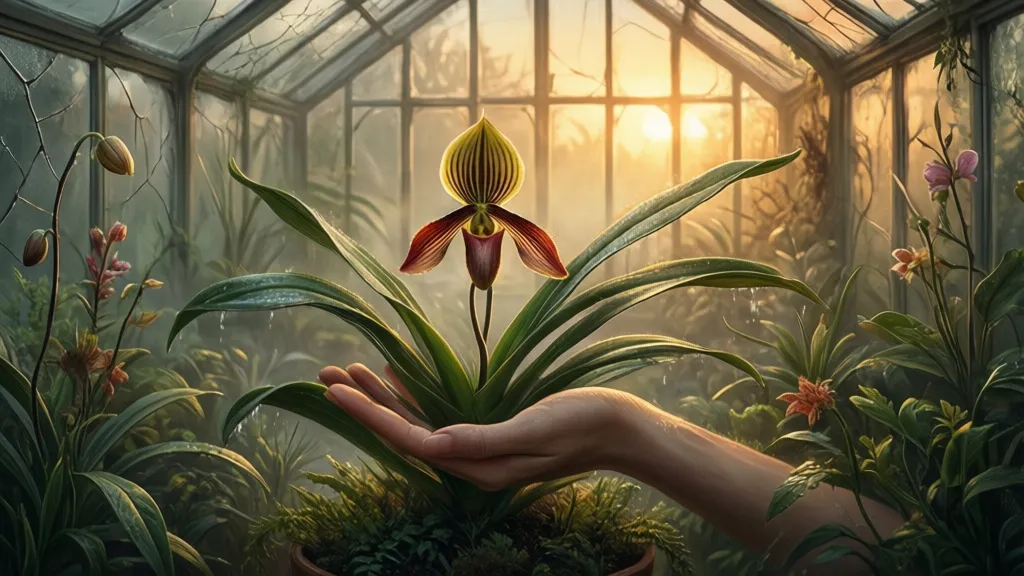
The glass cracked at first light, which meant the conservatory had become too warm for what it was trying to contain. Mara heard it from the office—a single hairline fracture threading across the upper pane like a held breath finally released. She had been awake since three, watching the temperature gauge climb past safe limits, watching the leaves press themselves flat against the glass as though trying to push through into cooler air.
The orchid had changed overnight.
She had checked it at midnight, as always, walking the perimeter with her flashlight, counting the buds on the Paphiopedilum collection, noting the slight phosphorescence that meant the night-blooming jasmine was considering whether to open. The Cypripedium in the corner—the ghost orchid, the one the donor had paid her specifically to watch—had been closed then, its pale green bud tight as a fist.
Now it was open, and the bloom wore the shape of a human hand.
Not metaphorically. Not approximately. The petals had arranged themselves into five distinct digits, each one curved slightly inward as though cupping water. The palm was formed from the labellum, that modified petal orchids use to trap their pollinators, and it was marked with lines—not veins, but the unmistakable whorls and creases of a lifeline, a heartline, the small tributary paths that palmists read for fortune.
Mara stood three feet away and did not touch it.
The conservatory had always been a place that remembered things. It had been built in 1889 by a shipping merchant who wanted somewhere to keep the plants his captains brought back from places the maps were still arguing about. The glass was original, slightly rippled, so that looking through it made the city outside seem older than it was, softened into the version of itself it had been before the roads were paved. The floor tiles were Victorian, laid in a pattern that suggested—if you looked long enough—a path leading somewhere the room itself had forgotten.
The orchid's hand was pale, almost translucent. In the growing light it seemed to glow faintly, the way certain deep-sea creatures do, luminous with their own loneliness.
Mara had been hired four months ago. The advertisement had been specific: Botanical guardian wanted. Night shifts. Must be comfortable with silence and unconcerned by minor impossibilities. She had arrived for the interview and found the conservatory empty except for Dr. Holt, the donor, who sat on the wrought-iron bench near the ferns and asked her only two questions.
"Can you keep a secret?"
"Can you let one go when it's time?"
Mara had said yes to both, which was either true or would become true, and Dr. Holt had nodded and given her the key.
The ghost orchid had been Dr. Holt's particular obsession. He visited it twice a week, always at dusk, always alone. He never touched it. He would stand where Mara was standing now, hands folded behind his back, and watch it for exactly seven minutes. Then he would leave. Once, Mara had asked what he was waiting for.
"For it to remember," he had said, and had not elaborated.
Now it had.
The hand was curled as though reaching for something, or as though it had just let something go. The gesture was so human, so unbearably familiar, that Mara felt her own hands tighten in response. There were no instructions for this. Dr. Holt had left her a manual for pests, for humidity control, for what to do if the night jasmine attracted moths that refused to leave. He had not left instructions for what to do when a flower remembered it had once been human.
Or—Mara corrected herself, watching the way the hand's shadow fell across the moss—when it remembered the shape of human longing so precisely that it could no longer hold any other form.
The conservatory's phone rang at six-thirty.
"I'm ten minutes away," Dr. Holt said without preamble. "Don't let anyone in."
"The school group—"
"Cancel them."
"They're already in the lobby. I can hear them."
A pause. Then: "Has it bloomed?"
Mara looked at the orchid. The hand had opened slightly, as though testing the air. "Yes."
"Is it—" Dr. Holt's voice was careful, the carefulness of someone who has been preparing for this moment and is now afraid they prepared for the wrong thing. "Is it intact?"
"It's perfect," Mara said, and heard him exhale.
"I'm bringing Clemence. The locksmith. And a container. We'll need to move it before anyone—" He stopped. "Mara. You understand what will happen if people see it."
She did. She understood that a flower shaped like a human hand would become a miracle or a hoax, a pilgrimage site or a laboratory specimen, something dissected under lights until it was no longer what it had been trying to say. She understood that the conservatory would fill with people who wanted explanations, and that explanations would require the orchid to be removed, catalogued, proven or disproven, and that in the process of proving or disproving it would certainly be destroyed.
"I understand," she said.
"Ten minutes," Dr. Holt said, and hung up.
The children were singing in the lobby. Some nursery rhyme about gardens and silver bells. Their teacher was explaining the rules: no running, no touching, stay together. Mara could hear their footsteps beginning to move toward the conservatory door.
She looked at the orchid.
The hand had opened further. The fingers were long, elegant, the proportions slightly wrong in a way that made them seem more honest than human hands usually were. There was dirt under one fingernail—not metaphorical dirt, actual dark soil, as though the hand had been digging, or planting, or reaching down into the earth to pull something up into the light.
Mara thought about the shipping merchant who had built this place, who had wanted to keep the impossible things his ships brought home. She thought about Dr. Holt, who had been visiting this orchid for long enough that it had learned the shape of what he wanted. She thought about the children in the lobby, who were six years old and would not yet have learned that some things needed to be kept secret in order to survive.
She thought about the conservatory itself, which had been holding its breath for a hundred and thirty-five years, waiting to see whether anyone would notice what it had been quietly growing toward.
The door to the lobby opened.
The teacher came through first, holding her clipboard, already smiling the bright anticipatory smile of someone about to bestow knowledge. Behind her, the children spilled in like water finding its level, spreading across the tile floor, their voices rising into the glass-trapped air.
Mara stepped in front of the orchid.
"I'm sorry," she said to the teacher. "We've had a minor—" She paused, hunting for the right word. "—incident. The conservatory needs to be closed for an hour. Maintenance."
The teacher's smile dimmed. "We've come all the way from—"
"I know. I'm very sorry. We'll reschedule. Free admission."
Behind her, Mara felt the air change. The hand was moving. Not dramatically. Just a slight curl of the fingers, the way a hand moves in sleep when it dreams of holding something it has lost.
One of the children—a girl with red ribbons in her hair—had wandered past the teacher and was staring at the orchid with the unwavering attention children reserve for things that are genuinely, cosmically strange.
"Why does it have fingers?" she asked.
The teacher turned. Her smile vanished entirely.
Mara looked at the child, who was maybe seven, and who would remember this moment for the rest of her life as either the time she saw something impossible or the time an adult lied to her about what was real.
Then she stepped aside.
The conservatory held its breath.
The orchid's hand opened fully, all five fingers spread wide, and for one clear moment it was the most honest thing in the room—more honest than the Victorian tiles pretending the world hadn't changed, more honest than the imported plants pretending they belonged in this climate, more honest than Mara pretending she could keep secrets that wanted to be seen.
The child walked forward slowly. She did not touch the flower. She simply stood beside it and lifted her own hand, matching its gesture, palm to palm with an inch of air between them.
"Hello," she said to it, very softly, the way you greet something that has been waiting a long time to be recognized.
The orchid's hand closed gently, as though accepting.
Dr. Holt arrived seven minutes later, breathless, the locksmith behind him carrying a velvet-lined box that would never be used. He stood in the doorway and saw the children gathered around the orchid, saw the teacher taking photographs on her phone, saw Mara standing to one side with her arms folded and her face very calm.
"It wanted to be seen," Mara said before he could speak. "I think it's been waiting for that for a very long time."
Dr. Holt looked at the orchid. The hand had begun, very slowly, to relax back into ordinary petals—not hiding, but settling, like someone who has finally said what they needed to say and can now rest.
"Yes," he said quietly. "I suppose it has."
The conservatory exhaled at last, and the crack in the upper pane stopped spreading, and outside the city continued its patient, unimpressed work of turning morning into noon, as it had done for longer than anyone could remember, as it would do long after the orchid forgot what it had briefly, perfectly recalled.