The River That Returns Names
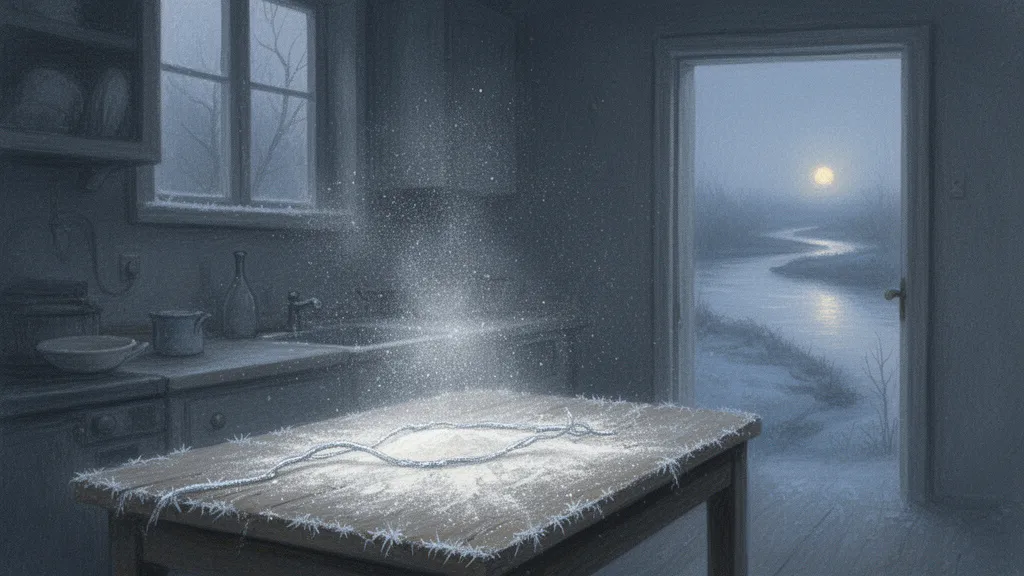
The frost should not have been there.
Castor woke in darkness to the familiar weight of flour dust in his throat and found the table marked with silver. A single thread of it, thin as spider-silk, ran across the wood grain where his hands had kneaded dough the night before. The room held summer's heat. The windows were latched. The fire in the corner still breathed embers into the predawn air.
He touched the frost with one finger and felt nothing — not cold, not wetness, just the faint resistance of something that wanted to remain untouched. When he lifted his hand, the silver thread continued unbroken to the doorframe, through the gap beneath the door, and out into the village.
Castor followed it.
The thread wound past the sleeping houses, between the church and the cooper's yard, down the earthen track where cart wheels had worn parallel grooves into the ground. It moved with the certainty of water returning to its source. At the riverbank, where willows grew dense and the current had cut deep channels into the clay, the thread divided into a hundred smaller filaments, each one leading to a reed basket half-submerged in the shallows.
The baskets had not been there yesterday.
Castor knelt at the water's edge and drew the nearest one toward him. Ice curled around its rim in delicate spirals, and in the spirals, written in a script he had never learned but could somehow read, was a name.
Maris Talfern.
His sister. Dead six years, drowned in spring flood, her body found three miles downstream wrapped in willow roots.
The basket held nothing but river water and a smooth white stone.
Castor's hands shook as he reached for the next basket. Jonah Mire. The blacksmith's son, taken by fever the winter before last. Another basket: Ellin Cort. The weaver who had taught his sister to card wool, gone peacefully in her sleep a decade past. Basket after basket, each name rising from the ice in letters that seemed to breathe with their own faint luminescence.
The dead. All of them. Every soul the village had lost within living memory.
Behind him, the silver thread had thickened into a rope of frost that wound back toward the mill. As he watched, a tendril split from the main thread and crept toward the nearest house, finding the gap beneath the door with the patience of something that had travelled a very long distance to arrive here.
"You've come to collect," Castor said to the river.
The water gave no answer, but the current shifted — just slightly, just enough to draw the baskets closer together, so that their edges touched and the names written in ice began to bleed into one another, forming longer sentences, half-remembered conversations, fragments of lives that the village had spoken aloud and then allowed to fade.
Do you remember when Maris wore bluebells in her hair.
Jonah could shoe a horse faster than his father ever managed.
Ellin sang while she worked and the songs were older than the church.
Castor's throat tightened. He had not thought of the bluebells in years. Had not remembered Jonah's quick hands or Ellin's threading voice. The village had moved forward as villages do, absorbing loss, filling the empty spaces with new children and new work and the steady accumulation of seasons. The dead became stories, and stories became brief mentions, and mentions became silence.
But the river had not forgotten.
The frost advanced. Another thread split from the rope and wound toward the church. Another toward the grain storehouse. The baskets multiplied in the shallows — twenty, thirty, forty — each one carrying a name that the water had preserved in its long memory. The dead were returning, not as ghosts but as the weight of what had been spoken about them, everything the village had allowed to slip away into convenient forgetting.
Castor understood, with the cold certainty of dawn light breaking across water, what the river wanted.
To be remembered. To have the village carry its dead as the river carried them — not buried and grieved and moved past, but present, acknowledged, woven into the ongoing life of the place. The river had held these names for years, decades, perhaps centuries, waiting for someone to notice that memory was not a private act but a shared ecology, something that required tending or it would grow wild and hungry.
If he burned the baskets, the frost would retreat. The village would wake to an ordinary morning. The dead would remain safely distant, their names growing dimmer with each passing year until they became only marks on stone in the churchyard, unvisited and eventually illegible.
If he did nothing, the frost would continue its advance. By midday it would reach every threshold. By evening, every hearth. The names would fill the houses like water rising, and the village would drown in remembering — unable to move forward, unable to forget, locked in an endless repetition of grief that had no useful shape.
Castor looked at his sister's name, written in ice that would not melt.
He thought of her laugh, which had been too loud for the church's liking. Her habit of stealing apples from the orchard and leaving the cores in perfect spirals on the mill steps. The way she had braided her hair with wildflowers every spring until the year she didn't.
He thought of how rarely he allowed himself to think of her now.
The river moved around the baskets with a sound like breathing.
Castor stood. The frost had reached the mill door and was beginning to climb the frame, silver threads spreading across the wood like roots seeking purchase. In another hour, it would be inside. In two, it would cover the grinding stones, the flour bins, the table where he kneaded dough each morning in the half-dark.
He could not burn all the baskets. There were too many, and more arriving with each shift of the current. He could not leave them to multiply until the village drowned. And he could not pretend the river was wrong — that forgetting was harmless, that the dead required nothing from the living except a brief season of grief before moving on.
So he did the only thing that seemed possible.
He carried his sister's basket up the bank and set it on the mill step, where it would catch the morning light. Then he returned for Jonah's basket, and Ellin's, and one by one brought them up from the water until a dozen baskets lined the path between the river and the mill door. Enough to remember. Not so many that remembering became all there was.
The remaining baskets he left in the shallows, anchored with stones so they would not drift but visible enough that anyone who came to the river would see them and read the names written in ice and decide, as he had decided, which memories to carry forward and which to leave in the water's keeping.
The frost stopped advancing.
The silver threads on the mill door held their position, neither retreating nor moving forward, as if the river were considering his offering and finding it, if not ideal, at least honest.
Castor sat on the mill step as dawn broke properly across the valley, turning the frost to brief gold before the heat began its slow work. The baskets on the path remained, their ice-written names intact. The baskets in the river stayed anchored. The dead neither returned nor vanished, but occupied the space between — present enough to be honoured, distant enough to allow the living to continue living.
By the time the first villagers emerged to draw water, Castor had decided what he would tell them. That the river was older than their forgetting. That it held more than they knew. That sometimes what returned from the water was not a body but an obligation, and the only way forward was to meet it halfway.
Whether they would listen, he could not say. But the baskets were there now, visible to anyone who came down to the bank. And the river, patient as rivers are, would wait to see what they chose to remember.