The Road That Smelled of Rain and Iron
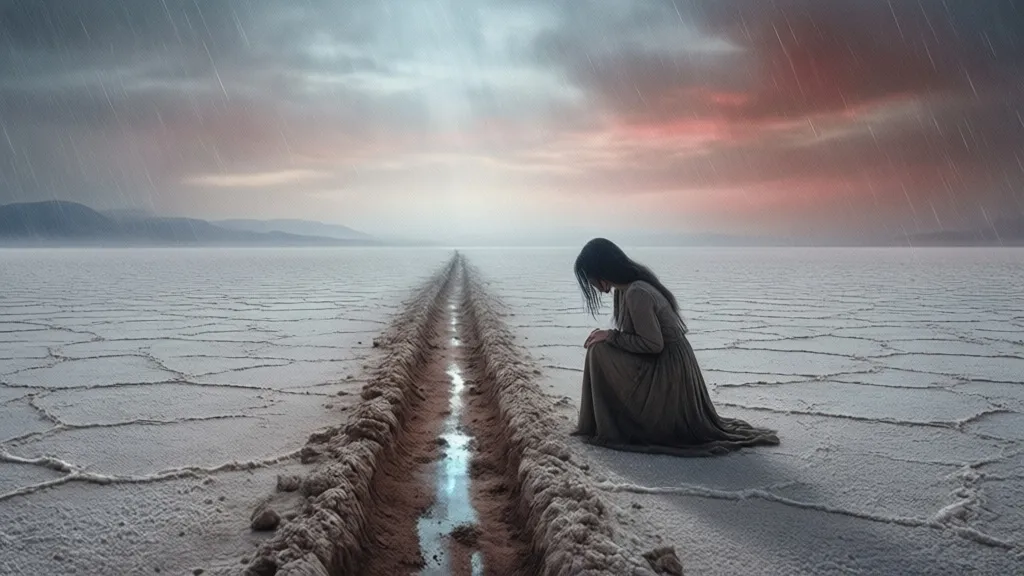
The roads had begun appearing three weeks after Catriona stopped drawing them, which meant the world was remembering something she had tried very hard to forget.
She found the first one at dawn, walking the salt flat's eastern edge where the crust gave way to scrub and stone. A narrow track, precisely three feet wide, cutting through ground that had been barren yesterday. The earth along its edges smelled of rain and iron, though it hadn't rained in four months and there was no metal for twenty miles in any direction.
Catriona knelt and pressed her palm to the road's surface. The compacted salt was still warm. She recognized the curve of it — a gentle arc she had sketched two years ago in the margins of a survey map, the night after they had found her brother's body in the shallows where the salt flat met the sea.
She had drawn it to hurt herself, she thought. To imagine a path that led nowhere useful, that would take someone walking confidently into emptiness and leave them stranded. She had wanted to make something as cruel as the world had been to Daniel.
Now the road existed. Not on paper. Here.
She walked its length. It ended after half a mile at a cairn of stacked stones she had never seen before. When she looked back, her footprints in the salt were already fading, erased by wind that had not been blowing moments earlier.
The second road appeared four days later. Then a third. Then seven more in the span of a week, each one corresponding to a sketch she had made in the fourteen months between Daniel's death and the fire that had consumed their childhood home.
Catriona had been a cartographer for the county council, then. Making official maps of roads that already existed, recording what was rather than imagining what might be. But grief had turned her methodical. She had started drawing phantom routes in the evenings — roads that went nowhere, roads that curved back on themselves, roads that led to places she wished existed: a harbour that was always calm, a forest where sound carried differently, a bridge across water that forgave.
She had burned all those sketches when the house burned. Watched them curl and blacken in the fireplace two days before the electrical fault that took the whole structure. She had thought that was the end of it.
The salt flat, it seemed, had been paying attention.
On the nineteenth day, she found the road she had been dreading.
It began at the flat's western edge, where the crystalline crust met the low hills that sheltered the town of Inverth from the sea. The road ran upward, into the hills, toward a place that should not exist: the house that had burned, reconstructed in salt and memory and something older than either.
The structure stood exactly where it had stood before, but wrong. The walls were too white, the windows too dark, the door precisely where she remembered but carved from something that looked like wood and felt like stone when she touched it.
The road smelled of rain and iron and something else now — smoke, or the memory of smoke, or the idea of smoke that the salt flat had absorbed when the house had burned and decided to hold onto.
Catriona stood at the threshold until the sun set behind her and the salt flat began to glow with the strange luminescence it took on after dark, as if moonlight were rising from below instead of falling from above.
Then she opened the door and went inside.
The interior was darker than it should have been. Not unlit — there was light, but it seemed to come from the walls themselves, a pale phosphorescence that made everything look underwater.
She recognized the hallway. The same floorboards, the same scuff marks near the kitchen where Daniel had dragged his bicycle through every summer. The same photographs on the walls, except they were blank — frames with glass but nothing behind them, as if the salt flat had remembered that photographs existed but not what they contained.
Daniel's room was at the end of the hall. The door was closed.
Catriona had drawn this road three nights before the fire. She had been drunk, which was rare, and crying, which was not. She had sketched it on the back of a shopping list: a simple line leading from the salt flat to the house, and from the house to Daniel's room, where the door had been locked since his death because she could not bear to open it and their father could not bear to be the one who did.
She had written a single word beside the sketch: Please.
She could not remember, now, what she had been pleading for.
The door opened when she touched it.
Daniel's room was exactly as he had left it, which meant it was chaotic in a way that only nineteen-year-old boys achieved — books stacked in precarious towers, clothes on every surface, a half-assembled model ship on the desk that he had been building since he was twelve and would never finish.
But there was something else. A new element. A map on the wall that had not been there before.
Catriona stepped closer.
It was a map of the salt flat. Not a sketch, but a finished piece — detailed, annotated, beautiful. Every road she had drawn in those fourteen months was marked in careful ink. Every phantom path, every imaginary route, every line she had made in grief and burned in shame.
And at the center of the map, where the salt flat was whitest and most empty, Daniel had written in his familiar handwriting: You thought these went nowhere. They all led here.
There was a second sheet of paper on the desk, weighted down by a stone from the beach.
Catriona picked it up.
Catri—
The flat has been holding these for you. Roads are never just about getting somewhere. Sometimes they're about having a direction at all.
I'm sorry I walked into the sea. I'm sorry I didn't tell you I was drowning long before the water came. But the roads you made — they weren't cruel. They were you trying to find a way back to believing there were places worth going.
There's one more road left. The one you started the night before the fire and never finished. It runs from here back to the town. If you complete it, everyone will be able to come here. They'll see what you built. They'll know what Inverth was really like for us — the weight of it, the watching, the way it crushed us into shapes that didn't fit.
You can burn the map. Let the roads fade. Keep this as yours.
Or you can finish the last line.
Either way, you're not lost anymore.
— D
Catriona read it twice. Then she folded the letter carefully and put it in her pocket.
She found the unfinished road at dawn. It began at the house and ran a quarter-mile toward Inverth before simply stopping, as if the cartographer had been interrupted mid-line.
Catriona knelt at its terminus. The salt was soft here, willing to be shaped. She could feel the road wanting to continue, the path already half-formed in the flat's strange memory.
Inverth was a town that smiled in public and kept its cruelties private. It had driven Daniel into the sea as surely as if it had pushed him, and it had done it with kind words and concerned looks and endless small moments of exclusion that accumulated like salt in a wound.
If she finished the road, people could walk it. Could reach the house. Could see the maps Daniel had made of what it felt like to live there. Could learn what they had done, collectively, in their thoughtless daily way.
Or she could leave the road unfinished. Let the house stand as her private place, her brother's letter her private grief.
She sat there as the sun rose and the salt flat began to shine like shattered glass.
In the end, she did not finish the road.
But she did not burn the map, either.
She built a cairn instead, at the place where the road ended. Stacked stones in the old way, the way that said: Something significant happened here. Pay attention.
And then she added a sign, carved from driftwood she carried up from the beach:
There is a house at the end of the salt roads. It holds maps of a drowned boy's geography. If you need to know how a town can kill someone slowly, walk the white roads until you find it. But know that once you've seen what's inside, you will have to decide what you're willing to change.
She did not think many people would make the walk. The salt flat was inhospitable, and the roads smelled strange, and Inverth was very good at not looking at things that made it uncomfortable.
But some would go. Some would see. Some would carry the knowledge back like iron in their teeth.
And that, Catriona thought, might be enough.
She walked back across the flat as the sun climbed higher. Behind her, the roads gleamed white and purposeful, leading from nowhere to everywhere, carrying their smell of rain and iron and the grief that had made them.
The salt flat, which had been holding these paths for her across two years and one fire and all the miles between drowning and shore, settled slightly under her weight. Satisfied, perhaps. Or simply patient, as geography always is, waiting for the next person who needed a road to somewhere they could not name but could, with enough sorrow and precision, draw.