The Shoe That Rang the Funeral Bell
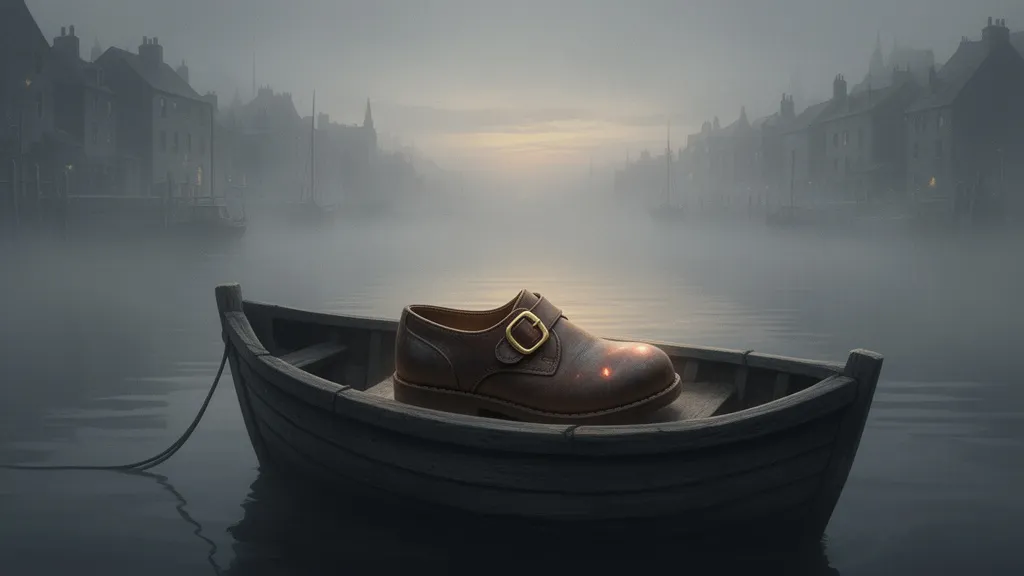
The shoe lay in the skiff's center like a question the dawn had brought and left unanswered. Gideon found it when the mist was still thick enough to mistake for sea, still cold enough to make the harbor seem older than the town that had grown up beside it. The leather was soft, child-sized, buckled with tarnished brass. He lifted it with both hands because something about it required care, and the warmth surprised him — not sun-warmed, but body-warmed, as though a foot had left it only moments before.
Inside the buckle, a beetle moved. Black as coal-dust, legs working against the metal loop that held it trapped. It did not fly when Gideon freed it. It crawled to the shoe's opening and stopped there, antennae testing the salt air, then crawled back inside.
The mist was lifting. Across the quay, the widow Marwen stood at her door with a bowl in her hands, waiting. She did this every morning — had done it for six years, since the drowning — and Gideon had learned not to watch too closely. Some griefs were meant to be private even when performed in public view. She would carry the bowl to the harbor's edge, pour the river water into the sea, and return without speaking to anyone. The river came from inland, past the mill and the burial ground, and the sea went everywhere and nowhere, and whatever Marwen was doing with the water between them was her own business.
But this morning she had not moved. She stood in her doorway, bowl cradled against her chest, staring at the bell tower.
The bell began to ring.
Slow, measured, the rhythm everyone in the harbor knew. Someone had died. Someone would be buried before the week turned. But no one had been sick, no one had been injured, and the bell was ringing at dawn when funerals were announced at noon, always noon, when the light was high and the day could absorb the grief without losing itself to it.
Gideon looked down at the shoe. The beetle had emerged again, circling the brass buckle, returning. Circling. Returning.
The bell rang seven times and stopped.
Seven was for a child.
The harbor woke slowly, uncertain. Doors opened, then hesitated. The baker came out with flour still on her hands and looked at the bell tower as though it had betrayed her. The harbormaster walked down to the water and stopped at the quay's edge, turning in a slow circle, counting boats, counting fishermen, counting children playing in the early light.
No one was missing.
"Did someone die?" The baker's voice carried across the water, too loud, as though volume could force an answer.
The harbormaster shook his head. "Bell rang itself, maybe. Wind gets in there sometimes."
"Seven times," the baker said. "Wind doesn't count."
Gideon wrapped the shoe in his coat and climbed onto the quay. The beetle stayed inside, circling. He thought about asking the harbormaster, thought about showing the baker, thought about carrying it to the tower and leaving it at the sexton's door where mysteries were supposed to go. But his feet carried him toward Marwen's house, and he did not stop them.
She was still standing in her doorway. The bowl had not moved.
"You know," Gideon said, which was not a question.
Marwen looked at him with eyes that had already finished weeping years ago and found the other side of grief, the part that was simply knowing. "The tide," she said. "You have until the tide turns."
"Until the tide turns to do what?"
"Decide." She looked at the bundle in his arms. "You found it in your skiff."
"How did you—"
"Because it was always going to be your skiff. That's how these things work." She lifted the bowl slightly, an offering or a warning. "River water. I carry it every morning, pour it into the sea. My daughter drowned in the river, you see. Inland, past the mill. But her body came here, to the harbor. The sea brought her back because it thought we'd want her, but we'd already buried what the river kept. So now there are two of her. One in the ground up past the town, and one down here in the water."
Gideon's throat closed. "Marwen—"
"The shoe is hers," Marwen continued, voice steady as stone. "The one she was wearing when she went under. I buried her in both shoes — I saw both shoes on her feet when we laid her down. But the river keeps one thing from every drowning. A shoe, a ring, a button. Something small enough to hold, large enough to remember. It keeps them until it's time."
"Time for what?"
"To ask if we're finished grieving yet." Marwen stepped forward, and Gideon saw that she had not aged in six years — her face was exactly as it had been the day they pulled her daughter from the water, neither younger nor older, suspended in that single moment of loss. "If you bring the shoe to my door, the river will know we're ready to let her go. Both of her. The one in the ground and the one in the water. She'll be gone entirely, and I'll be able to stop carrying this bowl, and the town will forget her name within a season."
The beetle crawled out onto Gideon's coat sleeve. It was warm against his skin.
"And if I return it to the sea?"
Marwen smiled, and it was the saddest thing Gideon had ever seen. "Then she stays. Both of her. The drowned one and the buried one. And I keep carrying river water to the sea every morning, and the town keeps pretending they don't see me, and she stays six years old forever in a grave that shouldn't exist and a current that won't let go."
The sun was higher now. The mist had burned away entirely. Across the harbor, the other boats were preparing to launch, and the children were gathering near the dock to watch the fishermen work, and the day was proceeding as though the bell had never rung, as though nothing had been announced, as though no question had been asked.
"I don't want to choose this," Gideon said.
"No one does. But the river doesn't ask the dead. It asks the living." Marwen looked down at her bowl. "I've been carrying this for six years. I'm tired, Gideon. But I don't know if I'm tired enough to let her go, or just tired enough to want someone else to make it stop."
The beetle climbed back into the shoe.
Gideon thought about his own daughter, alive and thirteen and learning to sail in the harbor where the water was calm. He thought about the way grief could split a person in two — one part buried, one part drowned — and how sometimes the only kindness was to let both parts go. He thought about Marwen standing in her doorway every morning for six years, pouring river water into the sea, trying to reconcile what had been lost with what remained.
The tide was turning. He could feel it in the pull of the water against the quay, the way the current shifted from incoming to outgoing, the moment when the sea decided what it would keep and what it would return.
He unwrapped the shoe and held it out to Marwen.
She took it with shaking hands. The beetle did not move.
"She was afraid of beetles," Marwen said softly. "When she was small. She'd scream if one landed on her dress." She looked at the creature trapped in the buckle, antennae still testing the air. "But this one stayed with her. All this time. Even the things she was afraid of didn't leave her alone down there."
She poured the river water over the shoe. It darkened the leather, pooled in the small hollow where a child's foot had once rested. The beetle floated for a moment, then crawled up the side and onto Marwen's hand. It sat there, legs still, as though it had been waiting six years for exactly this permission.
The widow closed her fingers gently around it.
"Thank you," she said, though Gideon did not know if she was speaking to him or the beetle or her daughter or the river that had kept one shoe and the sea that had returned it.
She walked into her house and closed the door.
The shoe lay on the threshold, still wet, empty now.
By the time the tide went fully out, the shoe was gone — whether taken by Marwen or the sea or something else that moved in the space between grief and forgetting, Gideon never knew. But Marwen did not come out the next morning with her bowl, and the children in the harbor learned to play a new game that involved sailing toy boats from the river to the sea, and somewhere inland past the mill, a grave began, very slowly, to grow grass again.
Gideon never found anything else in his skiff.
But sometimes, on mornings when the mist was thick and the harbor seemed older than the town, he thought he saw a small dark shape moving across the water — not drowning, not swimming, just crossing from one place to another — and he learned not to look too closely at what the tide brought in, or what it finally agreed to carry away.