The Stair the River Left Behind
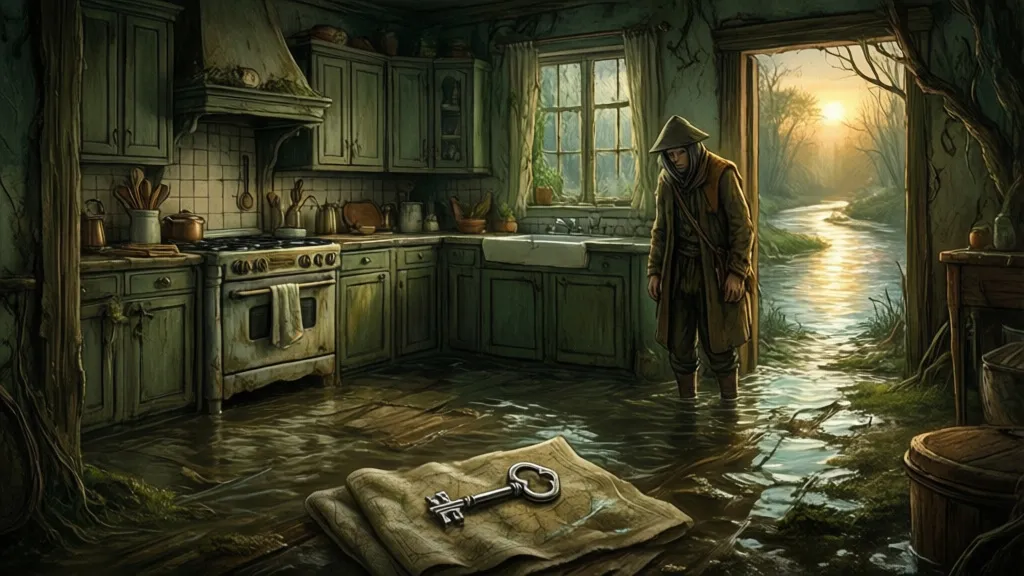
The mapmaker came home on the first warm Sunday after the river rose, which meant the house had been alone for three weeks with only the water's memory for company. Calla found the kitchen floor streaked with silt in patterns that looked deliberate, almost decorative, and a small silver key wrapped in a wet dish towel beside the bread knife where her mother had always kept the good scissors.
The river had crested six feet above the lane. The neighbors said it had come through the windows like an invitation, gentle and thorough, and left without breaking anything important. But rivers, Calla knew from her work tracing their courses across parchment, did not visit for no reason. They were old enough to have intentions.
She set her satchel on the table—the one piece of furniture that had somehow stayed dry—and unwrapped the key. It was small, delicate, the kind that might open a jewelry box or a diary. Silver, though not tarnished despite its time in the water. When she held it to the light coming through the eastern window, she saw symbols etched along the shaft: three parallel lines, a circle, something that might have been a fish or might have been an eye.
The house creaked around her. Not settling—listening.
Her mother had been dead four months. The funeral had been in January, when the ground was still hard enough to make the gravediggers swear. Calla had stayed three days after, just long enough to divide the jewelry and pack away the summer dresses, and then she had returned to her rooms above the cartographer's shop in the city, where rivers stayed on paper and houses did not collect secrets in their corners.
She should have sold the place already. Her brother Thom had said as much in his last letter, the one that arrived yesterday saying he would visit today, bringing Father Wellan to bless the rooms before they listed the house with the land agent. We can't keep paying to maintain an empty building, Thom had written, practical as always, and Calla had agreed because agreement was easier than explaining why she had not been able to bring herself to write the listing.
Now she understood. The house had been waiting.
The key fit the wardrobe in her old bedroom.
Calla had not expected this. She had tried the obvious locks first—the desk drawer where her mother kept letters, the cedar chest at the foot of the bed, the small cabinet in the parlor that held the good china. Nothing. The key had sat in her palm, patient and silver, while she worked through each possibility like a cartographer checking coordinates.
Then she had climbed the stairs to the room that had been hers until she turned sixteen and moved to the city to apprentice, and she had opened the wardrobe more from thoroughness than hope, and there it was: a new lock on the old door, bright brass against dark wood, waiting.
The wardrobe opened on a darkness that smelled of river water and green things growing in the absence of sun.
The back panel, which had always been solid oak, had been replaced. River reeds now filled the space where her mother's winter coats should have hung—dense, woven, still slightly damp. Calla reached through them, and her fingers found empty air, and then a railing made of something smooth and cold, and then the first step of a stair descending into a room that could not possibly exist beneath her childhood bedroom.
She fetched the oil lamp from the kitchen.
The stair was narrow, stone, older than the house. Older than the village, perhaps. Each step had been worn smooth in the center by the passage of many feet over what must have been a very long time. The walls were earth and root, but they held steady, and the air that rose from below was cool and tasted faintly of mint and copper.
At the bottom, perhaps twenty steps down, there was a room.
It was not large. Perhaps twice the size of the kitchen. The floor was packed earth, and the walls were the same woven reeds as the wardrobe's back, and in the center of the room stood a table made of river stone, and on the table sat a wooden box carved with the same symbols as the key, and beside the box lay a letter in her mother's handwriting.
Calla set the lamp on the table. Her hands, she noticed, were shaking.
The letter was not sealed. She unfolded it.
Calla,
If you are reading this, the river has made its choice. I am sorry I could not tell you while I was still able to speak plainly. Some things cannot be explained—they must be offered, and accepted, or left alone.
The room has been here since before the house. Your grandmother showed it to me on my wedding day and told me it would be mine to tend until I grew too tired, and then it would pass to one of my daughters if the river thought them suitable. You have no sisters, so the choice was easier than it might have been.
The box contains what the river has been collecting. Not treasure—you know I was never interested in that. Seeds, mostly. Cuttings. The small persistent things that want to grow in places that have forgotten how to let them. Once a year, at the spring flood, you take them to the places marked on the map inside and plant them where the water tells you. The river will show you. It has always been good at showing.
You may refuse. The stair will close, and the room will wait for another generation, or another century, or until the house finally falls and the river finds a different way. But I think you will not refuse. You have spent your life drawing the world as it is. This is a chance to draw it as it might become.
Your father never knew. Thom would not understand. This is work for someone who has learned to listen to things that do not speak with mouths.
The river rises every twenty years. You have time to decide.
With love,
M.
Calla read the letter twice, then set it down beside the box. Her mother's handwriting had always been precise, the letters small and even, the kind of hand that came from years of keeping household accounts and writing shopping lists. It looked strange here, in this room that smelled of earth and old water, discussing magic as though it were a recipe for bread.
She opened the box.
Inside: small cloth bags tied with twine, each one labeled in the same careful script. Willowbrook crossing. North bank, third stone from the bridge. Mercy Creek headwater. Where the old oak fell. The mill pond shallows. Among the cattails.
And beneath the bags, folded carefully, a map.
Not one of Calla's. This one was older, drawn on parchment that had been handled so many times it had gone soft as cloth. The river was marked in blue ink, its course winding across the page, and at intervals along its length were small red crosses with notes in faded handwriting. Some of the hands she recognized—her mother's, her grandmother's. Others were older, the ink brown and unfamiliar.
She was still holding the map when she heard the gate creak open and her brother's voice calling from the garden.
Thom had brought Father Wellan and his wife Margrit, who carried a basket of bread and early radishes. They came into the kitchen talking about the weather and the road, and Thom stopped mid-sentence when he saw Calla standing by the table with the silver key in her hand and silt still streaked across the floor.
"You should have cleaned first," he said, not unkindly. "Before we brought the Father."
"I was upstairs," Calla said. "Looking through Mother's things."
Father Wellan set his hat on the chair. He was old enough to have blessed Calla's mother's wedding and young enough to have climbed the church tower last autumn to repair the bell. He looked at the silt patterns on the floor for a long moment, then at Calla, then at the silver key.
"The river left you something," he said.
It was not a question.
"Yes," Calla said.
"Are you going to show them?" Father Wellan asked.
Thom looked between them, confused. Margrit had gone very still, the basket of bread forgotten in her hands.
Calla thought of the room below, of the bags of seeds and the map marked with generations of careful planting. Of her mother's letter and the choice it offered. Of the life she had built in the city, drawing borders and coastlines for merchants and nobles who wanted to know where their property ended and someone else's began.
Of the river, which had waited three weeks to make sure she came alone first, to give her time to understand before the house filled with footsteps and questions.
"No," she said. "Not yet."
Father Wellan nodded, unsurprised. "The house doesn't need blessing, then. It's already been attended to."
Thom started to protest, but Margrit touched his arm and shook her head, and something in her face made him stop. She had grown up in the marsh villages, Calla remembered. She would know about the things rivers did when they grew old enough to have intentions.
"I'll stay a few more days," Calla told her brother. "To finish sorting. You don't need to keep paying for the house. I'll take it."
"You'll live here?" Thom asked. "What about your position in the city?"
"I'll keep the position," Calla said. "But I'll come home in the spring. When the river rises."
She did not explain further, and after a moment Thom nodded, accepting what he did not understand because that was what family did. They ate Margrit's bread and divided the rest of the good china, and Father Wellan told stories about Calla's mother that made them laugh, and by the time they left the sun was setting and the house was full of the particular quiet that comes after people have been kind to each other.
Calla locked the door behind them, then climbed the stairs to her old bedroom. The wardrobe stood open, the reeds still damp, the stair descending into darkness that was no longer frightening but simply waiting, patient as rivers always were, for her to learn what her mother and grandmother had known:
That some work was measured in generations, not seasons. That maps could be made of possibility as well as property. That the world was old and ongoing and full of small persistent things that wanted to grow in places that had forgotten how to let them.
She closed the wardrobe but did not lock it. The key went into her pocket, where it would stay warm against her hip, ready for spring and the patient work of planting what the river had been collecting all these years.
Outside, the evening settled over the village like a benediction, and somewhere in the distance, the river continued its endless conversation with the stones and banks that had learned, over centuries, to listen.