The Street That Would Not Leave
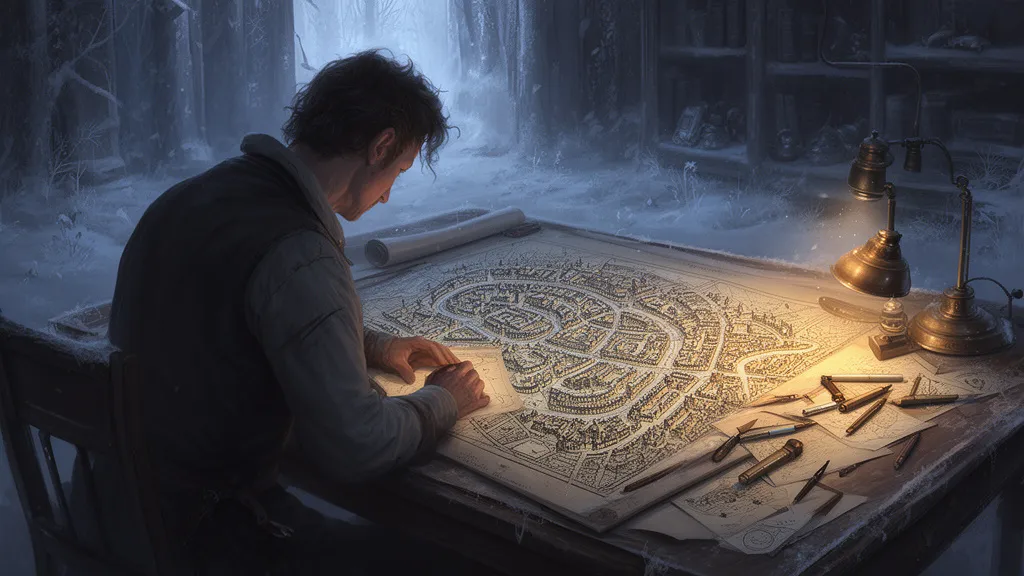
The frost came down like a decision the world had already made, and Calla pulled her sleeveless coat tighter though it did nothing against the cold. She had been drawing streets since before dawn, her fingers stiff around the pen, the cartographer's lamp burning low beside her drafting table. The capital spread across her paper in careful lines—Threadneedle Lane curving past the wool exchange, Copper Street descending toward the docks, the warren of alleys behind the guildhall mapped with the precision that had earned her the commission three years ago.
But every street she finished now led to the same place.
She had redrawn Threadneedle four times. Each time, the line curved away from the wool exchange and bent south, crossing streets that should not intersect, turning corners that did not exist on yesterday's draft, until it arrived at a house she had never drawn before: a narrow building at the river's bend, windows glowing amber in her ink, a black dog sitting patient on the stoop.
She had thrown away the first three attempts. The fourth lay before her now, still wet, and the dog was looking directly out of the paper.
Calla set down her pen. The lamp had burned through its oil. Outside, the frost made arabesques on the window glass, patterns that looked almost like streets themselves, almost like the city deciding which routes would remain open when winter came full and final.
She pulled on her walking coat—the wool one with sleeves, though it did nothing more against cold than the other—and went down into the capital at dusk.
The streets knew her. She had walked them for three years, measuring distances with paced steps, noting the way water pooled at certain corners after rain, recording which alleys the lamplighters forgot. A mapmaker learned a city by becoming its memory, and Calla had been meticulous.
But tonight the streets were leading.
She started on Threadneedle, intending to walk its proper course past the wool exchange and up toward the hill district. Instead her feet carried her south. At the corner where a coppersmith's sign usually hung, she found a turning she had never noticed—narrow, paved with stones that still held the day's faint warmth beneath the frost. The street curved like something breathing.
She followed it because she had drawn it four times and did not believe in coincidence.
The city changed as she walked. Not dramatically—no sudden walls or vanishing buildings—but in small ways that accumulated like water filling a lock. A doorway she knew painted blue was suddenly red. A baker's shop stood where she remembered a cordwainer's. The lampposts were older, their glass clouded with decades she had not lived through.
The river's smell reached her first: cold water and old stone, the particular scent of a waterway that had been flowing since before the city knew itself as a city. Then she saw the house.
It stood at the river's bend exactly as she had drawn it, narrow and three stories tall, its windows glowing amber from lamps or candles within. The black dog sat on the stoop, not moving, not watching her approach but somehow aware of it anyway, the way rivers are aware of rain coming long before it arrives.
The dog's eyes were the colour of turned earth.
Calla stopped at the garden gate—wrought iron, the frost making lace of its scrollwork. The house did not look abandoned. Smoke rose from its chimney. The windows were clean. But there was a quality to it, a sense of something held in suspension, like a breath taken and not yet released.
"I drew you," she said to the house, though she meant it for the dog.
The dog stood, shook itself once, and walked inside through a door that had opened without anyone touching it.
Calla followed because she had spent three years learning that when a city showed you something, you were meant to see it.
The kitchen was warm. A fire burned in the hearth, the kind of deep, settled fire that had been tended for hours. The table was laid with evidence of occupation: a cup with tea dregs dried in its bottom, a cracked blue saucer, a spoon resting at an angle that suggested someone had just set it down.
And a ledger, open, with her name written on the current page.
Calla Vess, in a hand she did not recognize—narrow letters, slightly backslanted, written with a pen that had been freshly inked. The ink still shone wetly beside the cup ring. Below her name, a date: tonight's date, written in the same careful script.
She sat down because her legs required it.
The ledger was old, its pages thick and soft with handling. She turned back one page, then another. Names filled them, dozens of names, each with a date beside it. Some of the dates were recent. Many were not. She found a date from forty years ago, then one from a century past, written in the same hand that had written hers.
The black dog lay down beside the hearth, settled its chin on its paws, and watched her with the patience of something that had done this before.
"How long," Calla asked, "have you been keeping this ledger?"
The dog did not answer, but the house did—a small sound, boards settling or wind through a gap she could not see, a sound that might have been a sigh or might have been the river outside remembering its own course.
She turned forward in the ledger. The pages after her name were blank, but they were not empty. She could feel them waiting, the way a street waits in early morning before the traffic begins, before the day has decided what it will become.
On the table beside the ledger sat a pen. Beside the pen, a small bottle of ink, stoppered, the glass clouded with age.
"I'm meant to write something," Calla said.
The dog's tail moved once. Not quite a wag. An acknowledgment.
She picked up the pen. It was warm, as though someone had been using it moments before she arrived. The nib was freshly cleaned. When she uncapped the ink, it smelled of oak gall and iron, the old smell, the smell of documents that lasted.
"What am I writing?"
The house did not answer. The dog watched. Outside, the frost was deepening, and Calla understood suddenly that when morning came, the streets she had drawn would seal. The city would forget the turnings that led here. She had seen it happen before—alleys that closed, bridges that vanished from collective memory, routes that simply stopped being walked until they stopped existing.
The capital was very old and knew how to let things go.
She thought of her drafting table, the lamp burned out, the maps half-finished. She thought of the commission, nearly complete, needing only the final annotations. She thought of her landlady, who would notice her absence by noon tomorrow and think nothing of it—mapmakers kept strange hours, walked odd routes, sometimes disappeared into the parts of cities they were charting.
She thought of the forty names in the ledger, the hundred names, the dates stretching back beyond the memory of anyone now living.
"This is not a choice," she said to the dog. "This has already happened."
The dog's eyes were steady. Not confirming. Not denying. Simply present, the way the river was present, the way the frost made its patterns on glass whether or not anyone watched.
Calla looked at her name in the ledger, the ink still wet, and understood that the map had not been recording an error. It had been recording an invitation. The city was very old, and it remembered every person who had helped it remember itself, and when their time came to be remembered in turn, it sent them here, to this house, to this kitchen, to this ledger where their names would wait in ink that lasted.
She set down the pen without writing.
She stood, her chair scraping softly against the floor, and walked to the window. Outside, the river bent around the house like an arm, dark water moving beneath the frost-white reeds. Across the water, the capital rose in tiers of lamplight, every street she had drawn now leading here, now leading home.
"I'm not finished," she told the dog.
The dog stood. Walked to the door. Sat.
Calla looked back at the ledger, her name waiting, the blank pages after. She thought of the streets that would seal by morning, the routes forgotten, the house vanishing from the city's memory until another mapmaker's pen found it, until another name was written and the invitation came again.
But tonight—tonight the streets were still open.
She pulled her sleeveless coat tight though it did nothing against cold, and walked out into the frost. The dog did not follow. The house remained, warm and amber-lit behind her, patient as rivers are patient, as old cities are patient, knowing that what is recorded once will eventually be recorded again.
The streets unfolded before her, leading away from the river's bend, leading back into the capital where her drafting table waited and the maps were not yet complete. She walked quickly, her breath clouding in the cold, following the turnings she had drawn, the routes her pen had made.
By morning they would seal. By morning the city would forget this path, and she would forget where she had walked, and the house would wait in the unmapped spaces where cities keep their oldest promises.
But tonight the frost was still deciding. Tonight the streets remembered. And Calla walked them, measuring their distances with paced steps, recording in the only way that mattered: by bearing witness, by choosing to return.
When she reached Threadneedle Lane, it curved exactly as she remembered, past the wool exchange, away from the river. Behind her, the turning she had followed was already fading, the stones cooling, the space between buildings closing like water behind a boat.
She did not look back. She went home to her drafting table, her lamp, her careful lines. The commission would be complete by spring. Her name would be written on the title page in ink that lasted.
And somewhere at the river's bend, a ledger lay open in a warm kitchen, her name still wet beside a cup ring and a cracked blue saucer, waiting for the night when she would follow those streets again, when she would sit at that table and lift the pen and write what she was always going to write, in her own time, in her own hand, when the maps were finished and the city had no more routes to show her.
The dog, patient on the stoop, would remember her.
The house, amber-lit and breathing, would wait.