The Thread That Knew the Tide
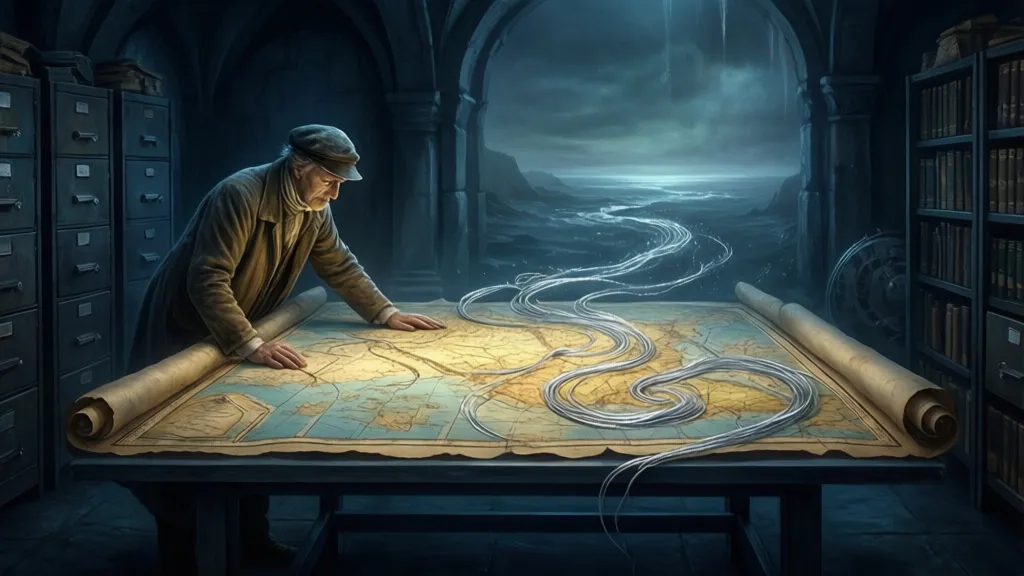
The silver thread had been still for four hundred years, which meant something had changed in the world beyond the archive's walls.
Maren noticed it first in the way the coastline of Berwick had shifted three millimetres north between Tuesday's cataloguing and Wednesday's dawn inspection. She might have attributed it to measurement error, but the thread itself lay coiled differently across the vellum, and when she leaned close enough to see the weave, she caught the scent of salt water in a room that had been dry since the roof was lead-sealed in 1603.
The illuminated map occupied the entire conservation table in Archive Room Seven, which faced no windows and permitted no moisture. Maren had been restoring it for eight months—gold leaf reapplied where candlewax had lifted it, pigments stabilised where damp had crept through the wooden frame during some long-ago flood. The map showed the eastern coast as it had been before the sea claimed six villages and a monastery, back when the land still remembered what it meant to hold fast.
But the thread had begun to remember something else.
She watched it through Thursday and Friday, documenting each shift. The coastline pulled incrementally seaward. The thread moved like something breathing, contracting and releasing in rhythm with the old clock in the hallway—the one that had belonged to the monastery before the waves took it, salvaged by a merchant's widow who'd donated it along with the map when her sons refused to keep either.
The clock struck eleven on Friday night, and Holy Island disconnected from the mainland.
Maren looked up from her notes. On the map, a gap had opened where the causeway should be. The silver thread lay across it like a suspended bridge, taut and trembling.
She should have called Dr. Hemsworth. Should have photographed the anomaly and locked the room and written a detailed incident report for Monday's review. Instead, she followed the thread.
It led off the edge of the vellum, across the conservation table, and over the lip into empty air where it should have ended. But the thread continued, visible as a faint gleam in the archive's security lighting, stretching toward the east wall where the sealed stairwell door stood behind two centuries of shelving.
The shelving had been moved.
Not recently. Dust lay undisturbed across the floor, but the angle was wrong—Maren had worked in this room long enough to know the precise placement of every fixture, and the gap that now existed between cabinet and wall should not have been there.
The silver thread disappeared into that gap.
Maren squeezed through, expecting cobwebs and the papery remains of silverfish. Instead she found the stairwell door standing open, and beyond it, stairs descending into blue-tinted darkness that smelled of low tide and old ink.
The thread ran down the centre of each step like a seam holding the stones together.
She descended twelve steps and found the child on the landing, curled on their side with muddy boots trailing dark prints across the flagstones. They might have been eight or ten or some age that didn't map cleanly onto human years. Their clothes were wrong—wool that looked handwoven, dyed the grey-green of rockpool shadows, and their hair was full of salt.
Their mouth, when they breathed, showed blue ink on their tongue.
Maren knelt. The child's pulse beat slow and steady beneath her fingertips, and their skin was cool but not cold—the temperature of something that had been underwater and was slowly remembering air.
"Hello," she said, because the silence seemed like something that should not be allowed to continue unchallenged.
The child's eyes opened. They were the colour of silver thread, and they held the same patient accumulation of purpose.
"The map," the child said, voice roughened by disuse or drowning, "is trying to go home."
"Maps don't have homes," Maren said, but even as she spoke she remembered the scent of salt on vellum that should have known nothing but dry air and careful hands.
"That one does." The child sat up, and blue ink dripped from the corner of their mouth onto the stones. Where it landed, the flagstones developed hairline cracks that glowed faintly, as if something beneath them was trying to be seen. "It was made from something the sea gave up. Now the sea wants it back, and I was sent to collect it."
"You're a child," Maren said, which was possibly the least relevant observation she could have made, but her mind was struggling to find purchase on what was happening.
"I'm what got through," the child said. "The thread knew you would follow it, and you wouldn't hurt something small."
The clock struck midnight, and the sound travelled down the stairwell like something with weight. The child flinched, and more ink spilled past their lips. Maren had the sudden, terrible sense that the ink was not coming from the child but through them—that they were a vessel for something much larger that was trying to speak in a language that required bodies to hold its meaning.
"What happens," Maren said carefully, "if I give you the map?"
"It goes back to the water," the child said. "The coastline stops moving. The villages the sea took stay taken, and the land stops trying to remember where they were."
"And if I don't?"
The child looked up at her, and their silver eyes were kind in a way that suggested they had been many things before they were a child, and would be many things after.
"The map keeps drawing," they said. "It will draw the coast as it wants to be, not as it is. By morning, the thread will have pulled Lindisfarne back from the sea. By evening, it will have raised the drowned monastery. By next week, the land will remember the villages so hard that they'll start appearing in the wrong places—foundations surfacing in fields, doorways opening in hillsides, the names of the drowned showing up in parish records dated yesterday."
Maren thought of the scholars arriving at nine a.m., of Dr. Hemsworth's careful scepticism, of the protocols and procedures and the fact that she had eight months of restoration work invested in a map that was apparently trying to rewrite four hundred years of coastal geography.
"The archive," she said, "will notice."
"Yes," said the child.
"People will come looking."
"For the map or for me?" The child smiled, and their teeth were dark with ink. "Both, probably. The map belongs to the sea but the sea can be patient. I am less essential—if you keep me, something else will come eventually. Something less small."
The clock struck the quarter hour. Fifteen minutes into Saturday. The archive opened at nine.
Maren had eight hours and forty-five minutes to decide whether four hundred years of settled coastline was worth more than one illuminated map and a child made of salt water and purpose.
She thought of the villages the sea had taken. She thought of the people who had mapped their grief onto vellum and bound it with silver thread, and whether they had meant it as memorial or as plea.
She thought of the map on the table upstairs, drawing a place that should not exist, and whether bringing back the dead was restoration or desecration.
"If I let you take it," she said, "will the people stay forgotten?"
The child considered this with the seriousness of something that had been asked to hold a grief it had not chosen.
"Yes," they said finally. "The sea is very good at keeping what it takes. The land is the one that struggles with letting go."
Maren stood. The blue cracks in the flagstones were spreading, branching like river deltas across the landing. When she looked back up the stairs, she could see the silver thread gleaming in the darkness, patient and inexorable as tide.
"Come on, then," she said.
She led the child up the stairs, through the gap in the shelving, back into Archive Room Seven where the map lay breathing under the conservation lights. The coastline had shifted further. Holy Island was nearly clear of the mainland now, and something that looked like monastery walls was rising from the vellum in layers of gold leaf and grief.
The child approached the table and placed both small hands flat on the map. The silver thread wound around their wrists like recognition.
"Thank you," they said, and Maren did not think they were speaking to her.
The map dissolved. Not burned or faded—simply stopped being ink and vellum and became instead salt water and light, and the child dissolved with it, and the silver thread, and when Maren blinked away the afterimage, the conservation table was empty except for a puddle of seawater that smelled of four hundred years and every coast that had ever learned to let go.
The clock struck one.
Maren stood in the empty archive and did not write an incident report. There was nothing left to report. The coastline would stay where the sea had put it, and the drowned would stay drowned, and she would have to tell Dr. Hemsworth that the map had been damaged beyond recovery by moisture infiltration from an unknown source.
Which was true, in every way that would fit inside the language they shared.
She locked Archive Room Seven at dawn and went home through streets that did not, as far as she could tell, contain any misplaced villages or impossible doorways.
The land, she thought, would learn.