The Threads That Knew Her Name
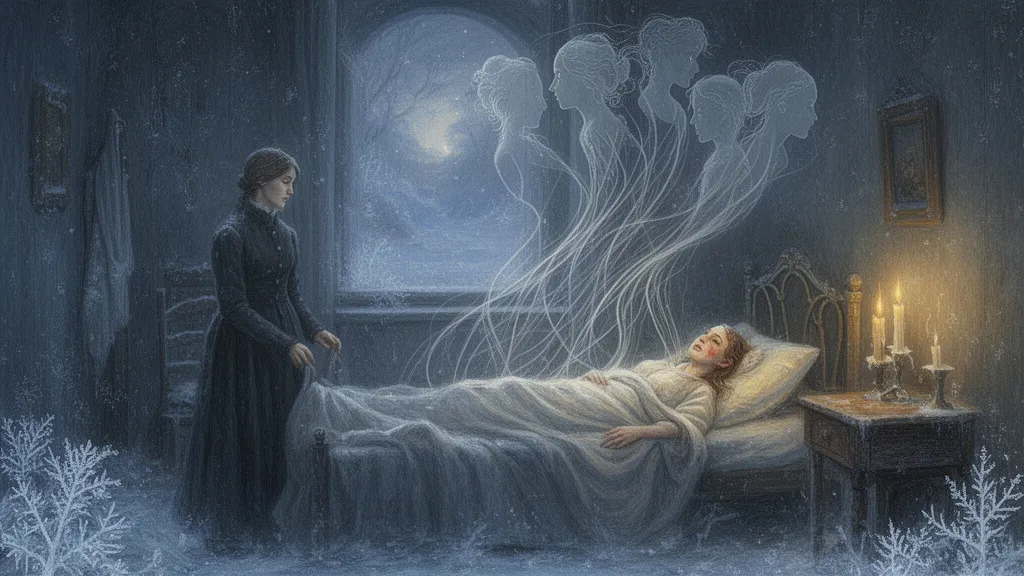
The mother was speaking in threes when Beatrice arrived, which meant the fever had climbed past reason into the country where the dead keep their addresses.
The household had sent for her just before dawn. Beatrice had walked through the frost with her bag of clean linens and yarrow tincture, her lantern swinging, expecting the usual aftermath: milk fever, torn stitching, the quiet hemorrhaging that took women in their sleep. She had not expected to find Margit propped against pillows, eyes half-closed, speaking in the voices of women Beatrice had buried.
The first voice was Margit's own grandmother, dead these twenty years. The second was a drowned girl from two villages over. The third was a woman Beatrice herself had midwifed fifteen years ago, who had bled out on sheets Beatrice still sometimes saw in dreams.
Margit's husband, Oswin, stood in the corner with his hands knotted together. "She won't stop," he said. "All night. Three voices, over and over."
Beatrice set down her bag. "Where is the child?"
"In the cradle. Breathing, but—" Oswin gestured helplessly. "Come see."
The river remembered its old name, which was older than the village and would outlast the bridge.
The baby was perfect. Ten fingers, ten toes, a shock of dark hair. But around each tiny wrist, someone had tied a silver thread—so fine it caught the lamplight like spider silk, so delicate Beatrice almost missed it in the dimness.
She knelt beside the cradle. The threads were knotted with a precision that spoke of intention, not accident. Each knot was identical, three loops pulled tight. The kind of knot you made when you wanted something to hold.
The baby was not crying. Its eyes were open, tracking the ceiling as if watching something move across the rafters. Beatrice touched one thread with the tip of her finger. It hummed, very faintly, the way a harp string hums after the note has already passed.
"Did you tie these?" she asked Oswin.
He shook his head. "They were there when the child came out. Margit saw them first—started screaming. Then she—then the voices started."
Beatrice followed the threads with her eyes. They did not end at the child's wrists. They extended across the room, impossibly fine, vanishing into the wall that separated this chamber from the next.
"Who's in the other room?" Beatrice asked.
"Margit's sister," Oswin said. "Helda. She's been here since the labor began. Helping."
Beatrice stood. The threads passed through the wall as if the wood were not there at all. She had seen many strange things in her forty years of midwifery—children born with cauls, afterbirths that moved on their own, women who spoke prophecies in the blood-loss haze. But she had never seen threads that ignored walls, that hummed like living things, that tied a newborn to someone unseen.
From the bed, Margit spoke again. The grandmother's voice first: She should have known better. Then the drowned girl's voice, high and waterlogged: We tried to warn her. Then the woman Beatrice had lost, whose voice was exactly as Beatrice remembered it, tired and already distant: It's too late to cut them now.
"No," Beatrice said quietly. "It's not."
She reached into her bag for the shears she used to cut cord.
The river remembered its old name, and the chapel bells remembered when they used to ring for different reasons entirely.
The first thread parted with a sound like a sigh. The baby did not move. Beatrice cut the second thread, and this time the humming stopped—not gradually, but all at once, as if something had been holding its breath and finally exhaled.
The baby opened its mouth and began to cry.
Across the river, in the stone chapel that had stood for three hundred years, the bells stopped ringing. They had been ringing for Lauds, as they did every dawn. Now they were silent. Beatrice could hear the absence through the walls, through the frost-thick air, a silence so sudden it felt like a held note.
Oswin stared at her. "The bells—"
"I know," Beatrice said.
She looked at the threads' cut ends. They were already unraveling, pulling back toward the wall, sliding through the plaster and timber like fish returning to water. In the cradle, the baby cried with the full-throated fury of something finally allowed to make sound.
Margit had stopped speaking. Beatrice turned to see her sitting upright in the bed, her face pale but her eyes clear. The fever was still there—Beatrice could see the flush on her cheeks—but the voices were gone.
"What did you do?" Margit whispered.
"Cut what shouldn't have been tied," Beatrice said. She picked up the baby, tested its weight, listened to its breathing. Strong. Angry. Alive in the way babies should be alive, undiluted by whatever had been holding it tethered.
She looked at Oswin. "Open the door to the other room."
He hesitated. "Helda is—"
"Open it."
He did. The door swung inward, and lamplight spilled into the dim corridor. Beyond, in the second chamber, Beatrice could see Helda sitting on the floor with her back against the bed, her hands resting palm-up on her knees. Around each of her wrists, the silver threads were unspooling, dissolving into air.
Helda looked up at Beatrice. Her face was wet with tears, but she was smiling. Not the smile of someone caught. The smile of someone who had been waiting.
"You cut them," Helda said softly. "I thought you might."
The river remembered its old name, and the chapel bells remembered when they used to ring for different reasons entirely, and the frost remembered the shape of every footprint it had ever held.
Beatrice set the baby back in the cradle and walked to the doorway. She did not enter the second chamber. She stood on the threshold, and Helda did not stand to meet her.
"How long have you been carrying this?" Beatrice asked.
Helda looked at her hands. The last threads were vanishing now, wisping into nothing like smoke. "Since I was born," she said. "My mother tried to give it to Margit's mother. The threads pass down through sisters. Someone has to hold them."
"Hold what?"
"The names," Helda said. "The ones the river takes. Someone has to remember them, or they drown forever. My mother held them. I held them. I thought I could pass them to the baby—let Margit's line carry them for a generation. But you cut them."
Beatrice looked at the space where the threads had been. The air was still vibrating faintly, like the aftermath of a bell. "The river doesn't need anyone to remember for it," she said. "It remembers itself."
"Does it?" Helda's voice was very quiet. "Or does it just keep taking, and taking, and no one counts anymore?"
Beatrice thought of the drowned girl's voice, high and waterlogged. She thought of the grandmother, dead twenty years, still speaking. She thought of the woman who had bled out on her sheets, whose name she still whispered on the nights she couldn't sleep.
"The dead don't need someone to tie them to the living," Beatrice said. "They need someone to let them go."
From the bed, Margit spoke—in her own voice now, hoarse but hers. "Helda. Is it true?"
Helda closed her eyes. "Yes."
"You tried to give it to my child."
"I thought—" Helda's voice cracked. "I thought if I could pass it on, I could finally stop hearing them. Every night, Margit. Every night for thirty years. The names. The voices. I just wanted it to stop."
Beatrice heard the ferry's horn across the river. The magistrate would be coming, as he did every week, to record births and deaths and marriages. By the time he arrived, Beatrice would have to have made her decision: name the woman who tried to tether a newborn to the dead, or let the household carry the secret themselves.
She looked at Helda, still sitting on the floor. She looked at Margit, pale and feverish in the bed. She looked at the baby, now sleeping peacefully in its cradle, freed from whatever weight it had been meant to carry.
"The bells stopped," Beatrice said finally. "That means the binding broke all the way through. The river won't take any more names tonight. Maybe not for a long time."
Helda looked up, her face full of desperate hope. "Does that mean—"
"It means," Beatrice said, "that you're free. But freedom comes with a price, same as binding. You'll have to learn to live without the voices. That's harder than it sounds."
She picked up her bag. The ferry's horn sounded again, closer now. The magistrate would arrive within the hour. Beatrice walked to the door, then paused.
"If you ever try to tie anything to a child again," she said, not looking back, "I'll name you myself. And I know how to make sure a name is remembered."
She left before anyone could answer. Outside, the frost was beginning to melt, and the river was running fast and bright in the early light, carrying away whatever it had been holding all these years, the names and the voices and the old burdens finally unraveling into the current, going wherever rivers take the things we cannot carry anymore.
The river remembered its old name, and then, after a while, it forgot it again, because that is what rivers do.