The Brass Handrail
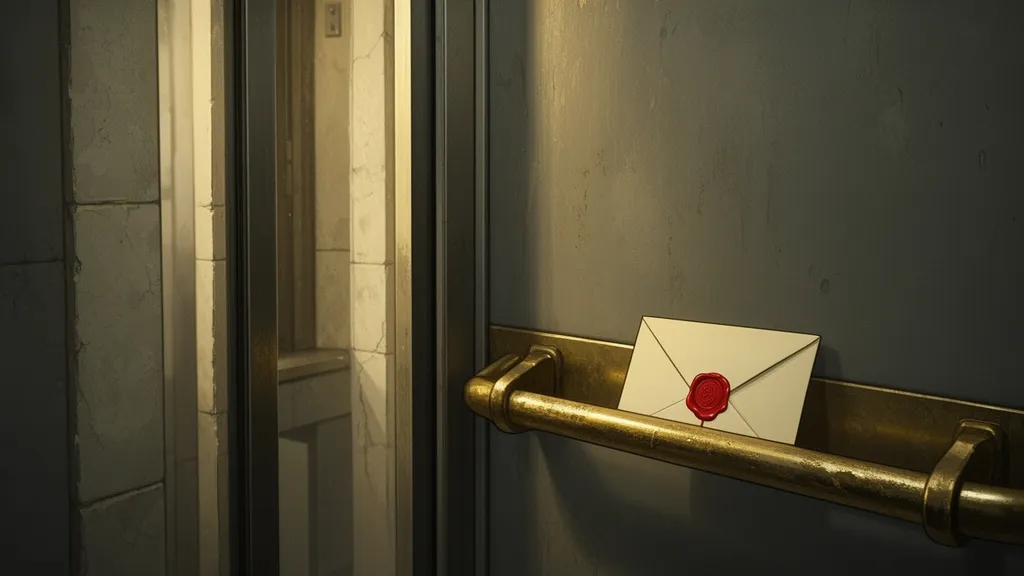
The elevator shudders to a stop at the fifth floor.
Not hers. The sixth is where Claire Vasseur lives, where she has lived for eleven years, where the hallway smells of old radiators and the neighbor’s garlic. She watches the doors slide open on the brass handrail, polished to a dull gleam, and the envelope resting there like a dropped coin.
No name. No stamp. Just a rectangle of cream paper, sealed with a smear of wax that hasn’t had time to cool.
Claire doesn’t touch it. She steps back, presses the button for her floor again. The doors close. The elevator ascends. She exhales through her nose, counts the seconds—twelve, thirteen, fourteen—until the sixth floor arrives and the doors open on her own hallway, empty and ordinary.
She locks her door behind her, sets her bag on the table, and pours a glass of wine she doesn’t want. The envelope sits on the counter, propped against the fruit bowl. She flips it over with a fingernail. The wax seal is still soft. Someone must have followed her up, placed it there while she was unlocking her door.
The first photograph is a man she remembers.
Not his name—Léon Morel—but the way his file felt in her hands: too light, like it had been emptied and refilled. She’d cataloged it in 2019, a routine transfer from the police archives to the municipal vault. A missing person, presumed dead. The case had been closed before she ever saw it. The photograph shows Morel at a café table, a cigarette burning between his fingers, his face half-turned toward the camera like he’s about to speak. The edges are clipped with scissors, not a machine. Someone’s hands did this.
The second photograph is a man she doesn’t recognize. Dark hair, sharp jaw, a scar above his eyebrow. He’s standing in front of a pharmacy on Rue de la République, the neon sign buzzing in the background. The timestamp on the photo is from last week.
The third is a man she almost remembers. A face from a file she processed last month—Alain Duvall, arrested for fraud, released on bail. The photograph shows him getting into a car, his back to the camera, his coat collar turned up against the rain.
No note. No explanation. Just the three photographs, clipped together with a paperclip that’s already leaving a rust stain on the top edge.
Claire slides them back into the envelope and puts it in the freezer, behind the frozen peas. She drinks the wine in three gulps and checks the locks twice.
The elevator stops at 2:13 the next night.
This time, she’s waiting. She steps in at 2:12, presses the button for the ground floor, and watches the numbers count down. The doors open at the fifth floor. The envelope is there, thicker than the last one. She picks it up before the doors close.
Inside: four more photographs. Two men she doesn’t know. One she does—Étienne Rousselle, a city councilman who’d been questioned in a bribery case last year. The fourth is a woman, her face obscured by a scarf, her hands clutching a shopping bag. The timestamp on the photo is from yesterday.
And a note, typed on the same cream paper:
You remember Léon Morel. You remember what you did. Tomorrow night, the last envelope. Be on the 22:47 tram to Saint-Just. Sit in the third car. Someone will find you.
Claire’s hands shake. She folds the note into her pocket and steps out of the elevator at the ground floor. The lobby is empty. The night guard is asleep at his desk, his chin on his chest, a half-eaten sandwich in front of him.
She walks to the tram stop. The 22:47 isn’t due for another twenty-four hours. She sits on the bench, her coat pulled tight, and watches the street. A man in a leather jacket leans against a lamppost, smoking. A woman walks a dog that sniffs at the curb. No one looks at her.
She goes back to her apartment. The envelope goes into the freezer, next to the first one.
The third night.
Claire doesn’t sleep. She sits at her kitchen table, a cup of cold coffee in front of her, and watches the clock. 2:00. 2:05. 2:10. At 2:12, she stands, walks to the elevator, and presses the call button. The doors open immediately. The envelope is already there, resting on the brass handrail like an offering.
She takes it. The elevator doesn’t move. She presses the button for the sixth floor. The doors close. The elevator ascends.
Inside the envelope: one photograph. A man she’s never seen before, standing in the doorway of a building she recognizes—the municipal archives. The timestamp is from today. And a single line, handwritten in blue ink:
You have until dawn.
Claire steps out of the elevator. Her door is still locked. She unlocks it, steps inside, and leans against the wood, her breath coming fast. The apartment is silent. The radiator ticks. The clock on the stove reads 2:17.
She pulls on her boots, her coat, her gloves. She takes the envelopes from the freezer and stuffs them into her bag. She checks the peephole. The hallway is empty.
The stairwell is colder than the apartment. She descends slowly, her hand on the railing, her steps quiet. At the fifth-floor landing, she stops. The door to apartment 5B is slightly ajar. A sliver of light spills into the hallway.
She doesn’t knock. She pushes the door open with her foot.
The apartment is empty. No furniture. No curtains. Just a single chair in the middle of the room, facing the door. On the chair, another envelope. On the floor, a pair of scissors, their blades open.
Claire picks up the envelope. Inside: a tram ticket, stamped for the 22:47 to Saint-Just. And a note:
You know what to do.
She pockets the ticket. She leaves the scissors on the floor.
The tram is half-empty.
Claire sits in the third car, her bag on her lap, her gloves still on. The tram lurches forward. The lights flicker. A man in a wool coat sits across from her, reading a newspaper. A woman with a stroller dozes in the corner. No one speaks.
At the Saint-Just stop, Claire steps off. The platform is deserted. The air smells of rain and wet concrete. She walks to the end of the platform, where a single streetlamp casts a pool of yellow light. A figure steps out of the shadows.
It’s the man from the first photograph. Léon Morel. Older than he was in the picture, his face lined, his hair gray. He’s wearing a dark coat, his hands in his pockets. He doesn’t smile.
"You came," he says.
Claire doesn’t answer. She takes the envelopes from her bag and holds them out. "I don’t know what you want."
Morel takes them. He flips through the photographs, his expression unreadable. "You buried my file. You made sure no one would ever find it."
"I cataloged it. That’s all."
"You lied on the transfer form. You said the case was closed. It wasn’t."
Claire’s throat is dry. "I didn’t know."
Morel steps closer. "You knew enough. You knew the police had given up. You knew I was still out there."
She doesn’t back away. "What do you want?"
"The truth." He pulls a key from his pocket. "This opens a locker at the Gare de Vaise. Inside, there’s a file. My file. The real one. The one you were supposed to archive."
Claire looks at the key. It’s cold in her palm. "And then?"
"And then you decide." He presses it into her hand. "You can walk away. Or you can give it to the right people."
"Why me?"
Morel smiles, but it’s not a kind smile. "Because you’re the only one who can fix it."
He turns and walks away, disappearing into the shadows. Claire stands there, the key in her hand, the envelopes in her bag. The tram rumbles behind her, ready to take her back across the river.
She doesn’t get on.
Instead, she walks to the station, her steps quick, her breath fogging in the cold air. The locker is where he said it would be. She inserts the key, turns it. The door swings open.
Inside: a single manila folder, thick with papers. She doesn’t open it. She takes it, closes the locker, and walks out into the night.
The first tram of the morning isn’t due for another hour. She sits on a bench, the folder on her lap, and waits for the sun to rise." }