The Warm Flap
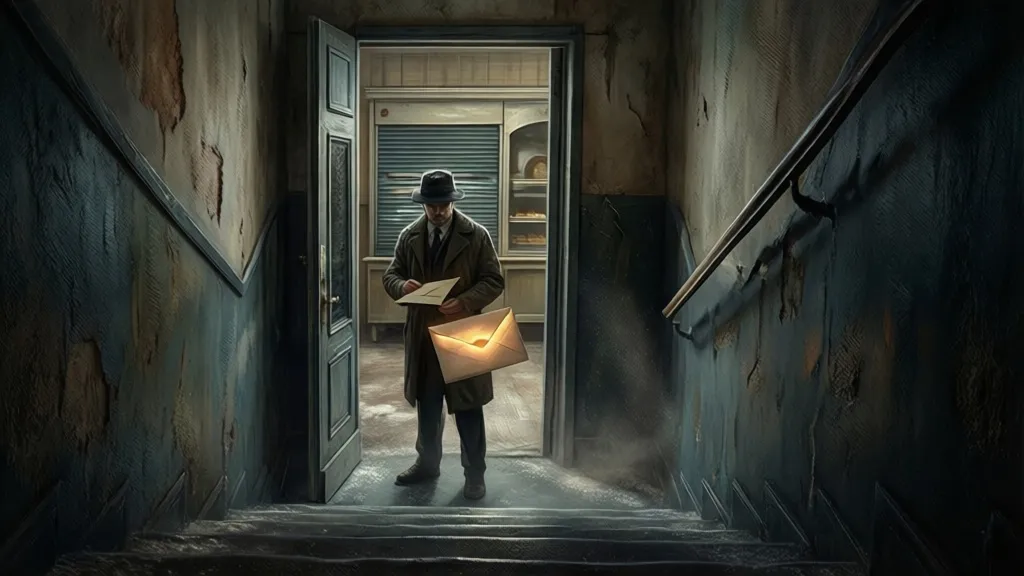
The envelope burns against my thigh. Not the paper—just the flap, still warm like it’s been ironed. I check the address again: 3e étage, 12 Rue des Catalans. No name. No buzzer. Only a bakery shuttered since spring, its awning sagging under the weight of last night’s rain.
I knock. Three times. The wood gives before the third hit—rotten, or just cheap. The door swings in on a hallway that smells of yeast and damp plaster. No lights. No sound except the hum of a fridge somewhere upstairs.
Then I see her.
Barefoot on the kitchen floor, knees pulled to her chest. Flour dusts her ankles like she’s been kneading dough in the dark. She doesn’t look up when I step in. Just holds out a hand, palm up, fingers trembling.
I place the envelope there. She turns it over once, twice. The clear tape catches the light from the streetlamp outside—someone’s already been here. Someone who didn’t want to leave prints.
She peels the flap back. No cash. No documents. Just a key, brass and heavy, tagged with a room number: Hôtel des Vagues, 412.
I know that hotel. Know it’s been a parking lot since ’09.
Her laugh is a dry thing, like she’s swallowed a coin. "Of course," she says. "They always send the key after the door’s gone."
I should leave. But the flour on her feet is fresh. And the envelope’s still warm.
The stairs creak behind me. Not mine. Someone’s coming up slow, like they’re counting steps. I press against the wall, but the hallway’s too narrow—no hiding. The woman doesn’t move. Just watches the door like she’s waiting for a train.
Then the knock. Three sharp raps. The same rhythm I used.
A voice, muffled through the wood: "Police municipale. Open up."
Not a cop. Not really. The municipale handle the parking tickets and the drunk tourists. But they carry batons. And they ask questions.
The woman finally looks at me. Her eyes are the color of old pennies. "You brought it this far," she says. "Might as well see it through."
I don’t have a choice. The key’s in my pocket, cutting into my palm. The envelope’s on the floor, empty. And the man outside is humming—some tune I recognize but can’t place.
I take the stairs two at a time. The key burns in my fist. Behind me, the door opens. A pause. Then footsteps, quick and heavy, like someone’s late for a bus.
The bakery’s back door leads to an alley. No lights. No cameras. Just a cat eating something that might be a rat. It doesn’t run when I pass.
I hit the street at a jog. The municipale’s car is parked crooked by the curb, engine running. No one inside. Which means he’s already upstairs. Which means he’s not here for a parking ticket.
I duck into the first bar I see—Le Comptoir des Oubliés, a place that smells like spilled beer and regret. The bartender doesn’t look up from his phone. I order a pastis, neat. The key goes into the ashtray. The envelope’s still in my pocket, but the warmth is gone.
The TV above the bar shows a news ticker: "Fire at Hôtel des Vagues construction site. No injuries reported."
I laugh. The bartender finally glances at me. "Bad day?" he asks.
"Worse for someone else," I say.
The woman’s name is Lila. Or at least that’s what she tells me when she slides into the booth an hour later. She’s wearing shoes now. The flour’s gone from her feet. She orders a coffee. Black. No sugar.
"You didn’t run," she says.
"I did. Just not far enough."
She smiles. It’s not a nice smile. "The key opens a locker at Gare Saint-Charles. Number 412. The one that’s always broken."
"And the envelope?"
"A receipt. For services rendered."
"Whose services?"
She stirs her coffee. The spoon clinks against the cup like a metronome. "Does it matter? You’re already in it."
I think about the municipale’s humming. The way the envelope was warm. The way the key fits too perfectly in my palm.
"What’s in the locker?" I ask.
"Something you’ll want to sell," she says. "Or something you’ll want to burn. Either way, it’s yours now."
The locker is where she said it would be. Behind a row of broken ones, like it’s hiding. The key turns smooth. No resistance. Inside, a duffel bag. Not heavy. Not light. Just awkward.
I don’t open it in the station. Too many cameras. Too many eyes.
I take it to the men’s room. Lock the door. Unzip the bag.
Inside, a stack of passports. All different names. All the same photo: a man with a scar through his eyebrow. The municipale from earlier. The one who hummed.
And beneath the passports, a gun. Not new. Not clean. Just a tool, like the key. Like the envelope.
I zip the bag back up. Flush the toilet for show. Wash my hands twice.
Lila’s waiting outside the station. Leaning against a scooter that’s too nice for this neighborhood. She tosses me a helmet. "We’re going to the docks," she says. "Someone’s waiting."
"For what?"
"For you to decide if you’re a courier or a collector."
I get on the scooter. The duffel bag sits between us like a third passenger. The engine starts. The night air smells like salt and diesel.
"What if I don’t want either?" I ask.
She revs the throttle. "Then you should’ve run faster."
We pull into traffic. The key’s in my pocket. The envelope’s in the trash. And the municipale’s passports are burning a hole in the bag.
Somewhere behind us, a siren starts. Or maybe it’s just the wind.
The docks are quiet. Too quiet. No ships. No workers. Just a single warehouse with a flickering light. Lila kills the engine. "Last chance," she says.
I get off the scooter. The duffel bag feels heavier now. Or maybe that’s just the weight of the key.
The warehouse door is open. Inside, a man in a suit. No tie. No smile. He’s holding a briefcase. Not the kind for documents. The kind for money.
"You’re late," he says.
"Traffic," I say.
He nods at the duffel bag. "That it?"
I hand it over. He doesn’t open it. Just sets it on a table next to the briefcase. "You know what this is about?" he asks.
"No," I say. "And I don’t want to."
He laughs. It’s a dry sound. Like Lila’s. Like the envelope’s flap.
"Smart man," he says. "Here’s how it works. You take the briefcase. You walk away. You never see us again."
"And if I don’t?"
He taps the duffel bag. "Then you’re not a courier. You’re a problem."
I look at Lila. She’s watching the door. Not me. Not the man. Just the door.
I take the briefcase. It’s lighter than I expected. Or maybe that’s just relief.
The scooter’s gone when I get outside. So is Lila. The briefcase is in my hand. The key’s still in my pocket.
I walk. No destination. Just away.
The first drops of rain hit my neck. Then the rest. A downpour. Marseille at 3 a.m., washing away the flour and the lies.
I don’t look back.
The briefcase is waterproof. The money inside is dry. The key’s still warm.
Or maybe that’s just my hand." " }