The Wrong Key
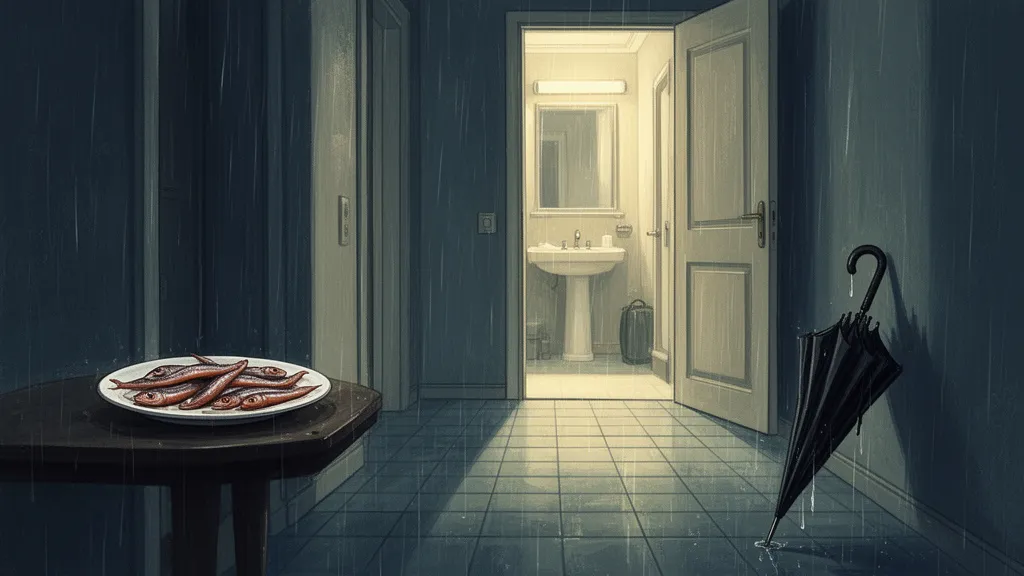
The lock clicks. Not mine—the tenant’s. I turn the knob, push. The door swings open before I touch it.
Merde.
I step inside. The hallway smells of salt and wet wool. A dinner plate sits on the table: six anchovies curled like commas, oil pooled in the porcelain. Beside it, a black umbrella drips onto the tiles. The fabric’s soaked through, but the handle’s dry. Someone left it open to dry, then forgot.
I call out. No answer.
The bathroom light’s on. I walk past the kitchenette—sink full of unwashed glasses, one lipstick-stained. The bathroom door’s ajar. Inside, the sink’s been scraped. A razor blade lies on the edge, dull with old paint. Not shaving. Not cleaning. Someone took a strip off the enamel, top to bottom, like they were looking for something underneath.
I pick up the blade. Cold. No blood.
Back in the hallway, I notice the key rack. Three hooks, two empty. The third holds a single brass key, no tag. The kind that fits a deadbolt. The kind you don’t leave lying around.
Footsteps on the stairs. Not mine.
I pocket the key.
The tenant’s name is Moreau. He opens the door before I knock, like he’s been waiting. His knuckles are raw, the skin split over the middle finger. He sees me looking, shoves his hands in his pockets.
"You’re late," he says.
"Door was open."
He exhales through his nose. "I know."
I hold up the brass key. "This yours?"
Moreau stares at it. "Where’d you find that?"
"Key rack."
"That’s not—" He stops. Swallows. "That’s hers."
"The woman who left the umbrella?"
A pause. "Yes."
"You want it back?"
"No." He steps aside. "Come in."
The apartment’s too warm. The radiator hisses. Moreau’s shirt’s untucked, the collar damp. He moves like a man who’s been running, but his shoes are by the door, polished. No mud, no rain.
I point at the plate. "You eat anchovies at two a.m.?"
"She did."
"Your wife?"
A pause. "No."
I nod at the umbrella. "She leave that?"
"She forgot it."
"And the paint in the sink?"
Moreau’s jaw tightens. "That was me."
"You strip enamel for fun?"
"I was looking for something."
"Under the paint?"
He doesn’t answer. Instead, he walks to the window, pulls the curtain back an inch. The streetlamp throws his shadow long across the floor. "You still have the key?"
I take it out. The brass catches the light. "This one?"
"That’s hers. I want you to give it to her."
"Why not do it yourself?"
"Because she’s not my wife."
Outside, the stairwell’s cold. The bruised-knuckle man’s waiting on the third-floor landing. He’s smoking, but the air doesn’t smell like tobacco. More like burnt sugar. His coat’s too heavy for Marseille in September. The collar’s turned up, hiding his throat.
He flicks the cigarette. It arcs into the dark. "You the locksmith?"
I keep walking. "Depends."
"On what?"
"On whether you’re here for the key."
He falls into step beside me. "Which key?"
"The one Moreau wants me to give to the woman who isn’t his wife."
The man laughs. It’s a wet sound, like he’s got something caught in his chest. "You always this chatty?"
"Only when I’m being followed."
"Who says I’m following you?"
"The way you’re breathing. Like you’ve been running."
He touches his side. "Asthma."
"Sure."
We reach the ground floor. The front door’s propped open with a brick. Outside, the street’s empty except for a parked van, engine running. No plates. The side door’s slid back just enough to fit a person.
The man stops. "You got the key?"
I hold it up. "You got a name?"
"Call me le fantôme."
"Ghosts don’t bruise their knuckles."
He smiles. His teeth are too white. "Ghosts don’t need keys either."
I toss the key in the air, catch it. "What’s it open?"
"A locker. Gare Saint-Charles. Number 17."
"And what’s in it?"
"Something she forgot."
"The woman who left her umbrella?"
"The woman who left her umbrella."
I look at the van. The driver’s watching us. No face, just a silhouette behind the windshield.
"You want me to give her the key," I say. "Or you want me to open the locker?"
"Does it matter?"
"It does if you’re planning to put me in that van."
He shrugs. "I could’ve done that already."
"But you didn’t."
"Because I don’t need to." He pulls a phone from his pocket, taps the screen. A photo: the woman from the apartment. Younger, smiling. Not the kind of smile you give a man who isn’t your husband. Behind her, a suitcase. A train ticket stub in her hand. Marseille to Barcelona, one way.
"She’s already gone," he says. "But she left something behind."
"In the locker."
"In the locker."
I weigh the key in my palm. "And if I open it?"
"Then you decide what to do with what’s inside."
"And if I don’t?"
He pockets the phone. "Then Moreau’s wife finds out about the anchovies."
The locker’s small. A gym bag inside, zipped shut. I don’t open it in the station. Too many cameras, too many eyes. I take it to a café near the Vieux Port, the kind with sticky tables and espresso cups that haven’t been washed since the last World Cup.
The bag’s light. Too light for a body. Too heavy for nothing.
I unzip it.
Inside: a passport. A stack of euros, bound with a rubber band. A burner phone, screen cracked. And a single Polaroid. A man, mid-40s, asleep in a chair. His shirt’s unbuttoned, his chest marked with numbers—bank codes, maybe, or locker combinations. His face is relaxed. Too relaxed. The kind of sleep you don’t wake up from.
The phone buzzes. Unknown number. I answer.
"You find it?" The ghost’s voice.
"I found it."
"Good. Now bring it to the van."
"Or?"
"Or I tell Moreau’s wife about the woman who left her umbrella."
"She already knows."
A pause. "What?"
"The lipstick on the glass. The way he didn’t look me in the eye when he said she wasn’t his wife. She’s not the other woman. He’s the other man."
Silence. Then, a laugh. "You’re smarter than you look."
"Not smart enough to walk into that van."
"Then what’s your play?"
I look at the Polaroid. The man in the chair. The numbers on his chest. "I’m going to find out who he is."
"And then?"
"Then I’m going to decide if he deserves what he got."
Dawn breaks over the port. The first ferries are loading. I walk to the address on the passport. A fifth-floor apartment, no elevator. The door’s locked. I pick it in thirty seconds.
Inside, the air’s stale. The bed’s unmade. A suitcase sits by the door, half-packed. On the nightstand, a framed photo: the man from the Polaroid, arm around a woman. The same woman from the ghost’s phone. The one who left her umbrella.
I check the bathroom. The sink’s been scraped. Not paint—plaster. Someone took a chunk out of the wall behind the mirror. Like they were looking for something.
I find it in the kitchen. A safe, hidden under the floorboards. Not locked. Inside: a ledger. Names, dates, amounts. All in the same handwriting. The ghost’s, maybe. Or Moreau’s. Or the man in the Polaroid.
The last entry’s from yesterday. A name I recognize: le fantôme. A number with too many zeros. And a single word: terminé.
I hear footsteps in the hall. Not heavy. Not rushed. The kind of steps you take when you know the door’s already open.
I close the safe. Slide it back under the floor.
The ghost steps into the kitchen. He’s not holding a gun. He doesn’t need to.
"You were supposed to bring the bag to the van," he says.
"I changed my mind."
"Why?"
"Because I don’t like being told what to do."
He nods. "Fair."
"What’s in the ledger?"
"Proof."
"Of what?"
"That some debts don’t get paid with money."
I look at the photo on the nightstand. The happy couple. "She was his wife."
"Was."
"And Moreau?"
"Her lover."
"And you?"
"The man who collects what’s owed."
I tap the Polaroid in my pocket. "You kill him?"
"No." He smiles. "But I made sure he wouldn’t wake up."
I pull out the locker key—the one the ghost gave me. "This opened the locker. Not the brass one."
"Smart boy."
"The brass key opens this apartment."
"It does."
I toss the brass key to him. He catches it. "What now?"
"Now," he says, "you decide."
"About what?"
"About whether you walk out of here, or whether you end up in that van after all."
I look at the ledger. The names. The numbers. The word terminé.
"I already decided," I say.
"Oh?"
I pull the Polaroid from my pocket, tear it in half. "I’m not your delivery boy."
He doesn’t move. Doesn’t blink. Just watches as I drop the pieces on the floor.
"You’re making a mistake," he says.
"Maybe." I step over the torn photo. "But it’s mine."
Outside, the city’s waking up. The first tram rumbles past. I light a cigarette, inhale. The smoke tastes like salt and bad decisions.
My phone buzzes. A text from Moreau: You still have the key?
I don’t answer. Instead, I walk to the port, toss the burner phone into the water. It sinks without a sound.
The ledger’s in my bag. The money too. The ghost can come for me if he wants. But he won’t. Not yet.
Because some debts aren’t about money. And some keys don’t open doors.
They open mouths.