Acoustic Frost
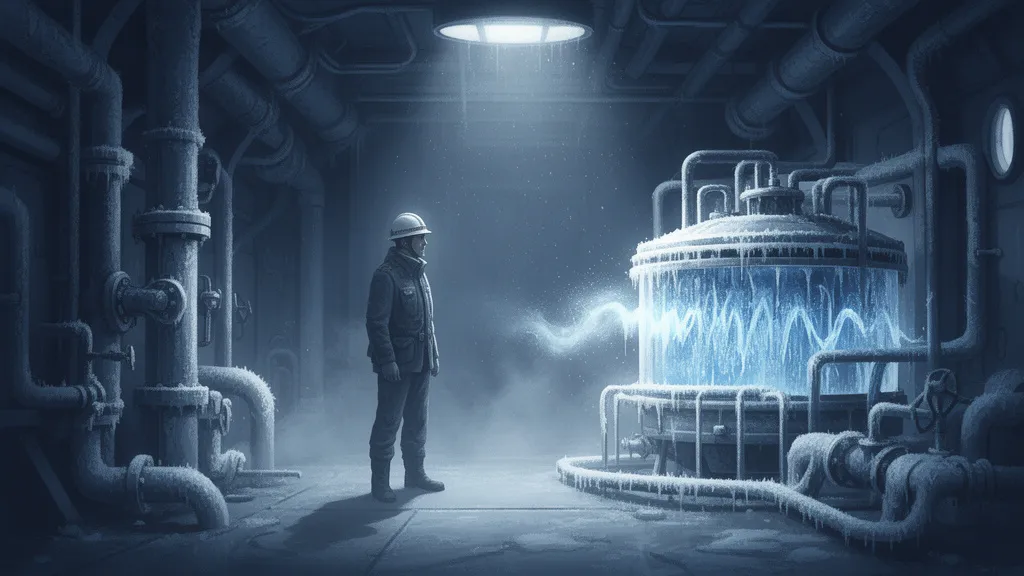
The pump cycled at 0400 hours, a rhythmic shudder that vibrated through the soles of Elara’s boots. It didn't sound like the usual harmonic resonance of an aging filtration rig. It sounded like a phoneme. A clipped, percussive t that trailed off into the cavitation hiss of mineral-heavy water moving through lead-lined pipes.
Elara braced her hip against the bulkhead and tapped her diagnostic scanner against the intake valve of Tank 4. The readout was standard: 84% sedimentation, 12% flow degradation. The station was a tomb of recycled brine and calcified dreams, two thousand kilometers above a coastless Earth. She wasn't supposed to hear voices. She was supposed to ensure the flow didn't stutter.
She cycled the pump manually. The vibration returned, deeper this time. A gravelly frequency.
“—shift... the axis... shift...”
She froze. The ambient hum of the station’s failing power grid seemed to drop by a decibel, leaving the room hollowed out. She leaned her ear against the frost-rimed plating. The metal was cold enough to stick to her skin, but she didn't pull away.
“Identify,” she said. Her voice was flat, practiced.
“—the axis... seven degrees... north-by-north...”
The voice was not a recording. It lacked the digital clipping of a playback loop. It felt biological, pressurized, trapped inside the density of the ice crusting the interior tank wall.
LOG ENTRY: T-MINUS 14 DAYS TO PERIGEE. Subject: Acoustic anomaly, Tank 4. Observation: Frequency oscillation corresponds with pump pressure cycles. Voice output possesses non-synthetic spectral variation. Initial assessment suggests vocal-cord vibration transmitted through high-density ice lattice. Recommend: Do not purge.
Elara stripped the paneling from the maintenance chase, her fingers raw from the bite of the coolant leaks. The smell behind the wall was wrong—not the metallic rot of the station, but something like ozone and old, wet paper.
Beyond the primary intake, she found the seal. It was a reinforced hatch, welded shut from the outside with a thick, jagged bead of industrial sealant. Etched into the frame, partially obscured by oxidation, was a directive in standard bureaucratic shorthand: MAINTAIN CORE INTEGRITY. BY ORDER OF TRANS-ORBITAL LOGISTICS. THAW RATE MUST REMAIN BELOW 0.04% PER DIEM.
She looked at the internal core monitor. The station’s power supply was fluctuating. The thermals were failing. The room temperature was climbing, slowly, as the failed HVAC system struggled to vent the heat from the cooling arrays.
“Elara.”
The voice hadn't come from the tank this time. It was smaller, localized. It originated from the sealed space behind the rusted bulkhead. It knew her name.
“Who are you?” Elara asked, her throat dry, the taste of recycled air like cardboard in her mouth.
“The witness,” the voice whispered. The tone was ancient, brittle. “The one who keeps the count. You arrived on the shuttle from Sector 9. You are three weeks early to finish a shift that no longer exists.”
“The station is scheduled for de-orbit,” Elara said, checking her wrist display. 92 hours remaining. “There is no one else here but the automated systems.”
“There is Julian,” the voice said. “He will be born in the rain-gardens of Neo-Casablanca in four years. He will be your brother. He will die at six, in the spill.”
Elara felt a sudden, sharp prick of sweat at her hairline. She jammed her pry-bar into the seal of the maintenance hatch. “That’s not a configuration within the mission parameters. Stop.”
“There is Hana,” the voice continued, its pace accelerating as the pump cycled again. “She will take your job at the plant, but she will do it with better equipment. She will wonder why you went silent. She will read these logs and realize that the ice is the only place left to store memory.”
SYSTEM ALERT: THERMAL THRESHOLD EXCEEDED. Cooling efficiency at 42%. Warning: Structural expansion of Tank 4 likely due to thawing ice mass. Instruction: Manual pressure venting required for crew safety.
Elara sat on the floor, the metal vibrating beneath her. She held the pry-bar, but her arms felt heavy, as if the gravity on the station had increased.
“Why are you telling me this?” she asked.
“Infrastructure is for utility,” the voice said, sounding as if it were struggling to breathe through the shifting ice. “But we are the baggage. The weight that keeps the station oriented. They couldn't delete the histories, so they froze them into the filtration cycle. You are not a maintenance engineer, Elara. You are a jailer who has forgotten the nature of the prisoner.”
She saw a flicker of movement behind the thick, scratched observation port of the secondary housing. A shadow trapped in the blue-white opacity of the ice grid. It wasn't a person. It was a dense, bio-organic knot of data-nodes and synthetic tissue, threaded into the filtration coils. It looked like a heart made of discarded wiring and frozen blood.
“I have to vent the tank,” Elara said. “The pressure is hitting critical levels. If I don't, the seal breaches and the station depressurizes.”
“Then the station dies,” the voice said. The tone was almost inquisitive, entirely detached. “And the histories drift into the decay of the lower orbit. We burn. You burn. The un-born, the already-buried—all of us become atmospheric dust.”
Elara looked at the manual override lever. It was painted in the high-visibility yellow of safety protocols. To pull it was to clear the path, to save the station by dumping the contents of Tank 4 into the waste chute. To save herself. To ensure that 92 hours would lead to a landing, and not a fireball.
She stood up. Her boots crunched on ice crystals that had formed on the floor as the room’s humidity condensed.
“Elara,” the voice said. It wasn't a command. It sounded expectant. “Do you want to know how the rain-garden smells?”
POWER LOG: Auxiliary reactors failing at 0612 hours. All non-critical systems terminated. Maintaining life support and Tank 4 integrity. Power reserve: 12%.
Elara reached for the lever. Her hand hovered. The station groaned—a deep, tectonic protest of metal losing its battle with the void. The walls were weeping now, the frost melting into thin, dark rivulets that traced the lines of the welds.
If she broke the seal, the voice would stop. The names would cease to exist beyond the reach of her memory. She could continue her career in the dry, quiet industry of planetary reclamation. She could live a life curated by the same bureaucracy that had turned people into filters.
She gripped the handle.
“There is no Julian,” she whispered to the empty, freezing air.
“He is coming,” the voice replied, faint, barely a ripple in the sound of the pump.
The pump cycled for the last time. It stuttered, struggling against a mounting pressure it was no longer designed to handle. A crack appeared in the observation port, a jagged white line that traced the length of the ice.
Elara pulled the lever.