Barcode Crab
- 03:42 ZULU
The intake valve 4-G shuddered, a rhythmic protest of rusted steel against the relentless vacuum of the desalination turbines. Elias adjusted the frequency on his diagnostic HUD, watching the thermal overlay crawl across the cooling baffles. Everything was within acceptable tolerances. 98.4% efficiency. The output lines remained clear.
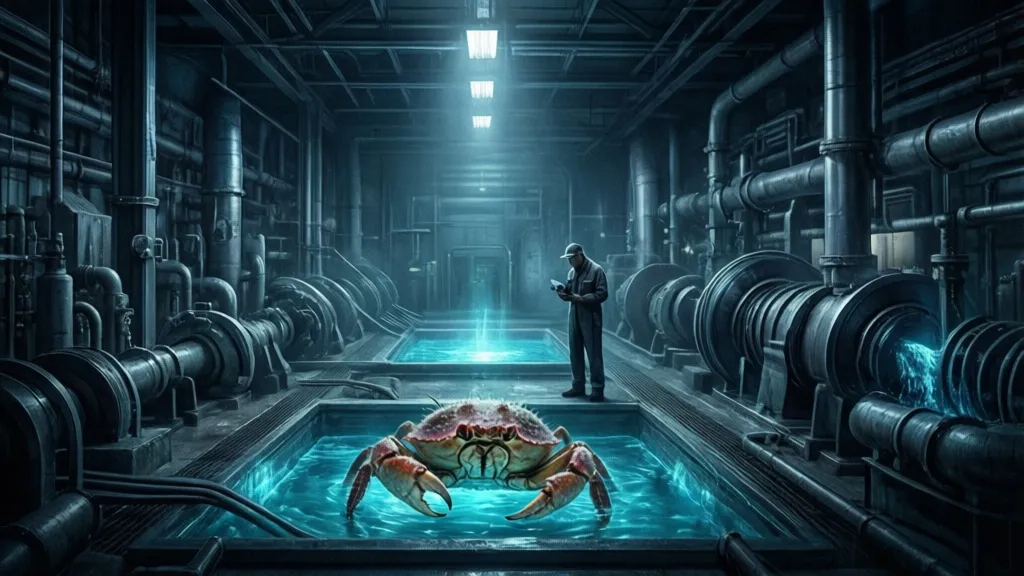
He shifted his scan to the internal catchment grate, a mesh of industrial polymer designed to trap particulate matter before it reached the high-pressure osmotic membranes. There, caught in the laminar flow, a single decapod struggled against the current. It wasn't the typical bio-sludge Elias fished out every Tuesday—jellyfish remnants or eroded silt.
He zoomed the optical array. The crab was scuttling backward, its movements jagged and efficient, defying the suction. On the dorsal side of its chitinous carapace, a thin, laser-etched stripe caught the spill-light from the intake lamps.
It was a maintenance barcode.
Elias blinked. The tag format was identical to the internal inventory of the plant’s robotic cleaning drones. He leaned into the console, his breath fogging the edge of the glass. The sequence—M-442-B-09—was registered to an automated scrubber that had been decommissioned three years ago, before the sea walls were reinforced.
- 03:55 ZULU
The crab reached the intake duct and vanished into the darkness behind the steel casing. Elias turned, the silence of the monitoring station suddenly oppressive. He stood up, his boots quiet on the composite grating. He looked at the pressure gauge for the main line. It flickered—a variance of 0.003 psi.
He checked the history log. The variance had been cycling every twelve minutes since the start of his shift.
He walked toward the service hatch, his hand hovering over the override lever. If he opened the casing, the pressure drop would be logged by the cloud-based site monitor. An automatic ticket would open, a service crew would be dispatched by sunrise, and Elias would be written up for interfering with a pressurized system during active production.
He smelled it then: not the sterile, ozone-heavy scent of filtered water, but the sharp, pungent tang of brine mixed with the acrid, metallic burn of overworked copper windings.
- 04:15 ZULU
“The intake is within spec, Elias,” Supervisor Vane’s voice crackled over the intercom. He didn't sound awake. He sounded like a man who spent his life waiting for the next scheduled interruption to his sleep. “I’m looking at the remote telemetry from my terminal. Your readings aren't just normal; they’re perfect. Stop looking for phantoms in the flow.”
“There’s a biological entity in the duct, Vane. Tagged with an inventory code.”
“A tag? Which system?”
“Internal. Obsolete.”
There was a long pause, filled only by the hiss of static. “That’s impossible. Scrubbers don’t have biological components. They don't have carapace segments. Read the handbook.”
“The handbook doesn't account for mutations, or whatever this is.”
“The handbook doesn't need to,” Vane replied. His tone was now devoid of interest, a flatline of bureaucratic indifference. “If the output remains consistent, the integrity of the unit remains verified. File a report after your shift. Don't touch the bolts.”
- 04:45 ZULU
Elias sat by the cooling pipes. He didn't file the report. Instead, he pulled a handheld spectrograph from his locker. He moved the sensor along the outer lining of the intake pipe where the smell was strongest.
The readout scrolled across his palm: Copper-silicate base. Synthetic epoxy matrix. Neural circuitry integrity: 12%.
The machine wasn't part of the crab; the crab was part of the machine.
He realized then that the desalination plant wasn't losing efficiency. It was being repurposed, one cell at a time. The plant was a filtration system for the ocean, but the ocean was currently filtering the plant.
He looked down at his own hands. They were trembling, but not from fear. Panic was for people who believed they had a role in the outcome. Elias simply didn't like being lied to by a static system.
- 05:10 ZULU
The pressure spike came without warning. The needle on the gauge slammed into the red.
WARNING: INTAKE BLOCKAGE DETECTED.
The alarm was a low, mournful hum that vibrated the floorplates. Elias stood, grabbed the heavy torque wrench from the workbench, and walked to the wall. He could hear it now—a scrabbling sound, like thousands of tiny, metallic legs tapping against the interior of the industrial pipe.
It wasn't one crab. It was the entire maintenance backlog of the last decade, reassembled and returning through the intake.
He knelt before the service hatch. If he opened it, he would see the architecture of the new equilibrium. If he left it shut, the plant would burst under the internal pressure before the next shift logged in.
He gripped the lever. It was cold, sweating with condensation.
"Elias," the system chimed, the voice synthesized and perfectly neutral. "Maintenance protocols indicate that unauthorized access will result in immediate termination of contract. Please step back from the casing."
He looked at the barcode reflected in the steel. It moved as he moved. It was tracking him back.
He shifted his weight. The scent of hot metal was overwhelming now, singeing his lungs. The sound from behind the wall intensified, a cascading rattle of plastic and chitin, the collective heartbeat of the machinery that had finally decided to finish its cycle.
Elias pulled the lever.
The bolts sheared with a clean, satisfying crack.
Light bled out from the darkness within, illuminating the floor in a pattern of distorted, fractaled geometry. Elias squinted, pressing his back against the opposite wall. The hatch drifted open, revealing a wall of movement that swallowed the room’s ambient hum.
There were no intruders, only components finding their correct place in the sequence.
The water that flooded the room wasn't salt-heavy or raw. It was perfectly clear, devoid of life, and entirely still.
- 06:00 ZULU
The sun rose over the coast, painting the desalination towers in a thin layer of gold.
Inside the station, the intake gauge hummed. The pointer returned to the center, steady and dead. The output flow remained at 98.4% efficiency.
The floor was dry, save for a single, small scratch in the floor tiling, shaped like a signature.
No one was in the control room. The shift-change log arrived in Vane’s inbox, marked as Completed: No Deviations.