Extended Cycle
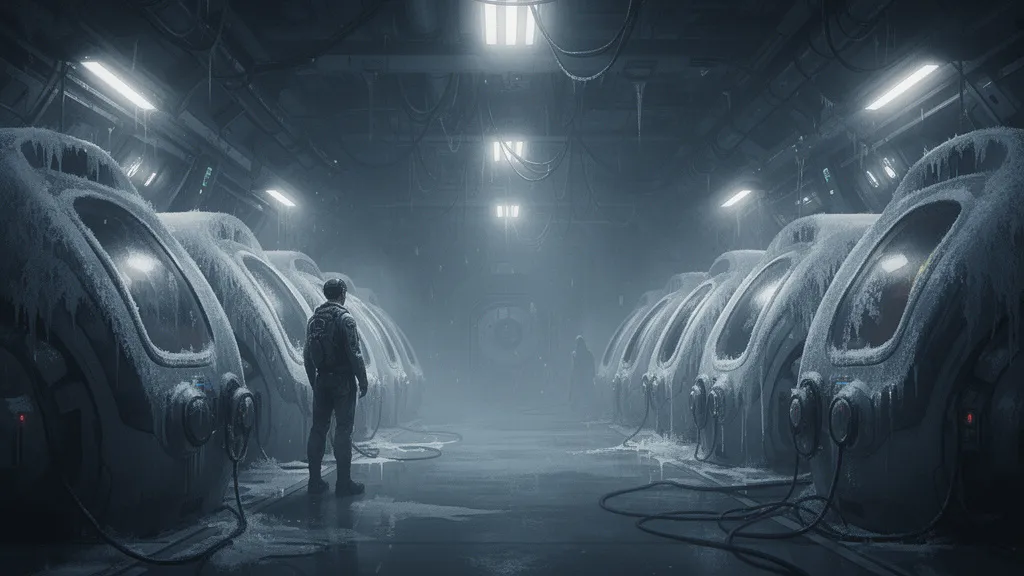
- 03:12. Kael pulled the magnetic seal from row 42, the hum of the cooling fans dying in a series of sharp, mechanical clicks. The decommissioning bay was a tomb of high-density polymers and dead circuitry. She adjusted her respirator. The air smelled of ozone, copper, and the lingering, synthetic sweetness of recycled oxygen.
She worked with the practiced rhythm of a technician who had spent five thousand hours in the dark. Six thousand, counting the commute. She scanned the manifest: 412 pods, all dormant. Total power draw: 0.04 kilowatts, attributed to base-level thermal maintenance.
She stopped at 42-G.
It wasn't a standard sleep capsule. The exterior plate was frosted, a milky sheen that obscured the inhabitant. A thin, crystalline trail of condensation tracked from the lower seal to the floor, where it pooled in a perfectly circular depression in the deck plating.
Kael tapped her console. The status read OFFLINE.
She looked at the floor. The pool of water had a diameter of eighteen centimeters. Water didn't behave like that in zero-G, but the bay’s gravity plating was pegged at 0.9g. She reached out, her glove brushing the frosted surface. It was warm.
- The diagnostic interface under the faceplate was encrypted with a high-level administrative key. Kael pushed her override node into the socket. The machine protested, a whining frequency that rattled the fillings in her teeth. After three cycles, the screen unlocked.
Occupant: Unassigned. Duration: 6 months, 12 days, 04 hours, 18 minutes over nominal cycle.
Kael felt a dull ache in her temples. The station’s records were digital, immutable, and backed up in three distinct sectors of the orbital cloud. A pod didn't just stay awake for half a year without triggering a thermal alarm.
She toggled the message buffer. They were text-only, filtered through a basic linguistic processor.
Day 42: Tell Miller the transfer at Sector 7 is compromised. Day 98: Aris says the radiation shielding is porous in the ventilation shafts. Day 142: I can hear them breathing in the conduits. It sounds like paper tearing. Day 180: Miller hasn't arrived. I checked the roster again. The roster is blank.
Kael tapped the screen. Miller was a senior surveyor scheduled for transport two cycles from now. Aris was a lead technician listed for the next orbital rotation.
She stared at the list of names. She knew Aris from the canteen. She was currently in the hydroponics bay, three levels up, eating a bowl of rehydrated algae.
- The bay door was set to seal at 06:00. The decommissioning, an automated flush of the atmosphere and a vacuum-cycle purge, would turn the room into a sterile tomb.
Kael checked her internal clock. 03:45.
She looked at the pod again. She could trigger a purge. The system would recognize it as a software glitch, dump the waste, and reset the internal thermal registers to zero. The anomaly would disappear, and the maintenance logs would be purged in the morning sweep. It was the procedure. The bureaucracy of the station was built on the assumption that if a problem was erased locally, it was solved globally.
She reached for the emergency manual release. It was a heavy, industrial red handled-bar, protected by a wire-seal.
She thought of the last inspection team—three men, two women—sent to investigate a similar report in Block 9. They had been listed as 'reassigned to Earth' three days later. No one saw them board a shuttle. No one saw their names on any manifest. They simply ceased to be part of the station’s immediate reality.
She knelt by the pool of condensation. The water was clear. She dipped a finger into it, then touched it to her tongue. It tasted like mineral-heavy desalinated water, laced with a faint, metallic trace of iron.
- "Who is Miller?" she whispered.
The pod hummed. The faint sound of a heartbeat, amplified by the vibration of the plates, pulsed against her hand. It was too regular. Too slow. Fifty-two beats per minute.
"The roster is blank," she corrected herself.
If she reported it, the AI would interpret the anomaly as a security threat. The station’s protocols for threat mitigation were surgical. A room-wide vacuum dump was the most efficient solution. It would kill the occupant, the evidence, and Kael, if she was inside when the sensors triggered the lockdown.
She walked to the console at the end of the hall, her feet echoing on the metal floor. She pulled up the sensor logs. The camera had been dead for six months. A localized static loop had been spliced in—an elegant, professional bit of code. Someone had been watching the station from inside the pod for months, manipulating the logs, keeping the ghosts of un-hired personnel in the system.
Or the station had decided it needed them, even if they hadn't been born yet.
- 04:30. She sat on a crate of spare filters. The silence of the station was a physical weight, pressing against the hull. She realized then that the pod wasn't a prison. It was a factory. A way to stockpile consciousness until the station had enough mass to support a new configuration.
She looked at her own hands. They were trembling, just slightly.
If she released the lock, she didn't know what would happen. If she stayed, the 06:00 flush would reduce the contents of the bay to dust.
She tapped a final command into the terminal, overriding the door’s seal mechanism three minutes early. She wasn't reporting the anomaly. She was acknowledging it. She created a new user profile: Kael-002, and linked it to the pod's life support.
She stood up, walked to pod 42-G, and pulled the manual release.
The seal hissed, a long, agonizing sound of air equalizing. The fog on the faceplate cleared in an instant. The capsule was empty, save for a pile of discarded, damp synthetic skin and a terminal tethered to the interior, burning with light.
The screen flickered: Miller ready. Aris ready. The roster is full.
- 05:45. Kael sat in the chair she had dragged from the storage closet, facing the open, empty pod. She watched the countdown on the main bay screen. 15 minutes to vacuum.
She felt a strange sense of composure. The absurdity of the situation—that she was sitting in a room about to be purged because a machine had started generating people who weren't there—seemed almost trivial. It was statistically insignificant.
She pulled a pen from her pocket and wrote Kael was here on the bulkhead, just above the pod’s registration code.
The lights in the bay strobed, turning a deep, warning amber. The ventilation overhead shut down. The air turned heavy, the pressure differential between the bay and the exterior vacuum growing as the seals clicked into place.
At 05:59, the internal speakers cycled on. A flat, synthesized voice echoed in the room.
"Decommissioning sequence initiated. Personnel, please vacate the area to avoid structural trauma."
Kael didn't move. She looked at the empty, dripping pod, then at the sealed bay doors. She folded her hands in her lap, feeling the vibration of the pumps deep in the foundation of the station begin to draw the atmosphere out.
The air began to thin, chilling instantly. Her ears popped. She didn't press the override. She didn't try to leave. She simply watched the small, circular reflection of the overhead warning light in the puddle of water on the floor, its soft red pulse slowing as the pressure dropped.