Future Echo
- 02:44 ZULU
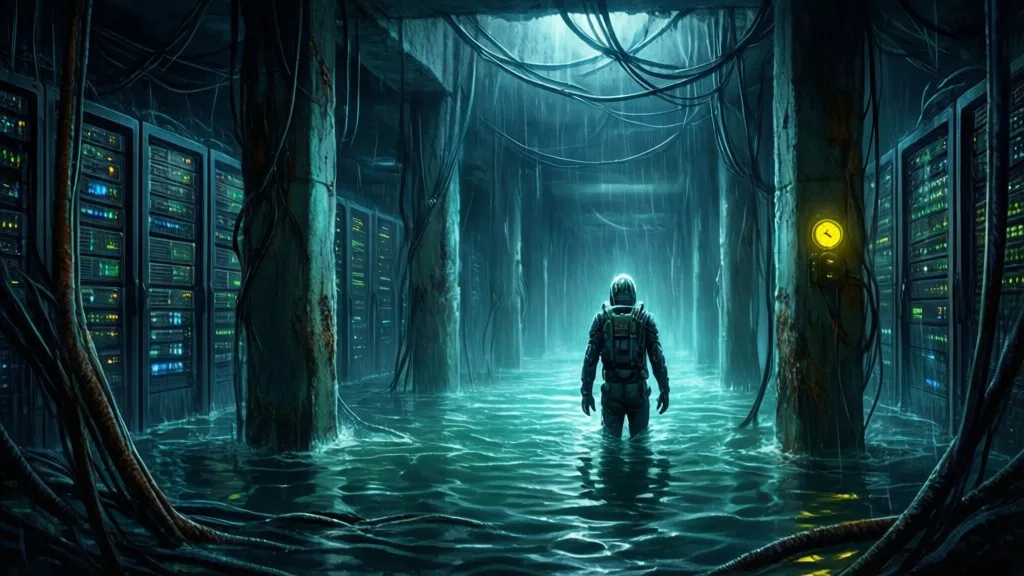
The hydro-suit’s thermal lining hummed against Aris’s skin, a low-frequency vibration that did little to dissipate the mounting dread of the lower basements. He moved through the flooded corridor of Data-Center 04, his heavy boots stirring up a decade of silt and rusted conduit fragments. Above him, the ceiling groaned under the oceanic weight of the storm-lashed coast. Outside, the North Sea was reclaiming the peninsula; inside, the building was simply holding its breath.
He checked his wrist display. The pressure gauge pulsed a steady, caution-yellow, calibrated to the structural integrity of the bulkhead doors. Ahead, the server vault radiated a faint, bioluminescent glow through the murky water, the signature of a rack still powered by the isolated geothermal backup. The target: a legacy M.2 interface drive, identified as a critical security redundancy.
He pushed through the hanging wires, their frayed ends brushing his helmet like dead tentacles. The rack hummed with a subsonic frequency that traveled through the water and rattled his teeth. There it was—a single green light pulsing at the base of the rack. It rhythmically lit the silt-choked water, a lonely beacon in the drowning dark.
- 03:02 ZULU
Aris pulled the drive from the port with a sharp, magnetic snap. The casing was warm, an unsettling sensation against his insulated gloves. It shouldn't have been hot; the ambient temperature of the vault hovered at a precise four degrees Celsius to combat thermal runaway.
He secured the drive in his utility pouch and turned to retreat, but the building shivered. A deep, tectonic vibration traveled through the floor plates. High above, the sound of the main storm shutters buckling echoed through the shafts—a tearing scream of reinforced aluminum failing under the surge. His wrist display flickered. The pressure gauge shifted from yellow to a sharp, aggressive red. The intrusion rate had spiked by 400% in six seconds.
He navigated back toward the main stairwell, his buoyancy compensator whining as it struggled to adjust for the density of the incoming torrent. He stopped at the mezzanine level. The heavy, hermetically sealed doors to the service lift were buckled inward, and saltwater poured through the gaps in a white, frothing veil. The facility was no longer just leaking; it was being digested.
His oxygen monitor beeped—a sharp, staccato warning. He had forty minutes of air, provided he didn't exert himself. He leaned against the damp concrete of the shaft to steady his breathing. In the silence between the waves, he reached into his pouch and pulled the drive back out.
He held it up to the dim glow of his shoulder light. The green LED continued its patient, rhythmic blinking.
He didn't know why he did it then—a morbid curiosity, or perhaps the psychological fragmentation of being alone in the deep, but he slotted the drive into his suit’s local playback port. He expected archival data, or perhaps an encrypted ledger.
Instead, he heard his own voice.
“Don’t look at the foundation slab in the central vault,” the recording said. “If you report the structural failure here, the emergency lockdown will trigger. If the lockdown triggers, the pressure release valves will close. You will be trapped in the intake surge.”
Aris froze. The voice was his, the inflection precise, the cadence identical down to the slight hitch in his breathing when he was tired.
“It’s 15:00 ZULU,” the recording continued. “Twelve hours from now, you will think you have survived.”
- 03:19 ZULU
He pulled the playback port lead out, his hand shaking. The silence returned, heavier than the water surrounding him. He looked at the timestamp on his HUD: 03:19 ZULU.
He stared at the drive. The pulse of the light was the only thing grounding him, a steady, mechanical heart beating in a dead machine. The absurdity of it—receiving a warning from a version of himself that hadn't even existed an hour ago—was a logic error he couldn't process. The bureaucracy of his life required him to record, to log, to report. If he ignored the mandate, he would be terminated in every sense of the word. If he reported the breach as standard procedure, he was ensuring his own entombment.
He realized then that the data center wasn't suffering a casualty of nature. The facility had been designed to keep the water out, and the sensors were acting exactly as authorized. The system was responding to the catastrophe by sealing the sections that were compromised, effectively choosing which parts of the building to sacrifice. He was the variable the system had calculated as expendable.
He looked back toward the server vault. He hadn’t looked at the foundation slab. He had been too focused on the hard drive.
He crawled toward the aperture of the center’s infrastructure maintenance hatch. Below, the water level was rising with rhythmic, calculated precision. He tapped the communication array on his forearm, intending to send the standard incident report. His thumb hovered over the ‘Transmit’ button.
If he transmitted, he triggered the lockdown. If he didn't, he was officially absent, a ghost in the company ledger.
He took a long, shallow breath, the oxygen scrubbers wheezing against the contaminated air. He thought about the weather reports he had seen that morning—the storm was moving inland, and the projected surge was supposed to dissipate by noon.
He sat in the dark, the weight of the water pressing against his suit, the pressure gauge ticking upward: 0.8 MPa, 0.9, 1.0.
He didn't transmit. He looked at the drive one last time. The green light blinked twice, then flickered out, the internal battery finally exhausted.
A hairline fracture appeared in the reinforced viewing port of the adjacent room. A thin, pressurized needle of water shot across the corridor, spraying the bulkhead with a fine, translucent mist. The building groaned again, a shifting of steel and concrete, settling into the seabed.
Aris waited for the next shift in the floor, his eyes fixed on the darkness where the green light had been.
03:22 ZULU.
The pressure gauged peaked at 1.15 MPa.