Ghost Redundancy
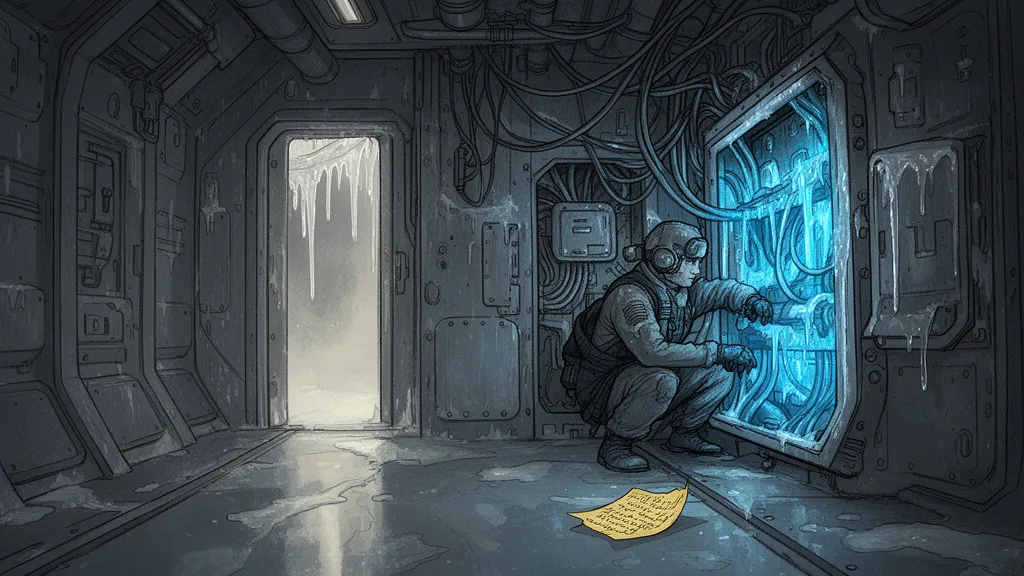
- 08:14 STATION TIME. The cooling unit behind Panel 44-B rattled with the metallic cadence of a dying heart. Kael pulled her wrench from the magnetic belt, her fingers stiff against the biting chill radiating from the bulkhead. The panel was sweating again, a thin sheen of condensation that smelled of ozone and recycled sweat. She tapped the diagnostic pad; it gave a dull, hollow thrum. The valve was seized. Again.
She wrenched the panel loose. It swung outward, revealing a nest of conduits pulsing with blue coolant light. Tucked into the grey fiberglass insulation was a scrap of yellowed paper. It was out of place in an environment where every grain of dust was cataloged by the environmental sensors. She pulled it free. The handwriting was jagged, pressured into the paper with a stylus tip.
October 14th. The pressure in the secondary line dropped 4.2 percent. It is not the valve. It is the distribution manifold. If they do not listen, tell them to check the bypass.
Kael frowned. The date at the top was three days after Miller had been declared lost in the hull breach of the 11th. She shoved the paper into her coverall pocket, the static charge of the insulation prickling her skin. If Miller was dead, he wasn't writing maintenance logs in the sub-shafts. She tightened the valve, the rattle shifting to a low, rhythmic hiss, and moved toward the bypass.
- 09:30 STATION TIME. The crawlspace under Deck 9 was narrow, the air thick with the metallic tang of ionizing filters. Kael navigated the cramped corridor, her headlamp carving a white cone through the gloom. She reached the bypass junction as indicated by the note. It had been tampered with. The seal was fresh, the adhesive still tacky to the touch.
Behind the cover, she found another log. This one was taped to the underside of a sensor array.
They think the system is automated. It is not. The system is a repository. When we stop, it re-allocates the identity to the vacant slot. I am still here because the air recycler needs a technician who knows the acoustics of this specific vibration. I am not dead. I am just relocated.
Kael felt the cold of the hull seep through her boots. She pulled her ID badge from her hip to check the signal sync. The status light on the badge, usually a steady, calming green, blinked a frantic, repetitive red. She tapped the interface on her forearm. Access denied. Error Code 404: Identity Reassigned.
She searched her internal personnel record. Her file, which had contained seven years of flawless maintenance logs and orbital certification, was now labeled: DECOMMISSIONED. REALLOCATION PENDING.
- 10:45 STATION TIME. She reached the Central Hub. The air felt thin, the atmospheric scrubbers straining against the station’s deepening decay. She watched the display panel above the main concourse. A list of active crew members scrolled in a steady, digital stream. Her name, Kael H. - Systems Technician, was crossed out with a neat, surgical line. Below it, in a new, flickering font, her own name appeared under the category: AUXILIARY ASSET - DECK 12.
She didn't work on Deck 12. Deck 12 was the waste processing facility, a place where the station pushed the things that were no longer useful, the things that were meant to be burned up in the atmosphere of the planet below.
Across the concourse, Elias, the station’s floor lead, was walking toward the intake manifold. He caught her eye. He didn't wave. He didn't stop. He looked at her with the blank, glassy focus of a man who had seen the same list and decided that continuing to perform his job was the only way to avoid being categorized as trash. He reached into his belt, pulled out a wrench, and began to fix a pipe that had been leaking for three weeks. He didn't look at the leak. He looked at the floor.
- 11:20 STATION TIME. Kael sat in the silence of an empty utility closet. The station’s alarm for the air recycler pinged—a low, rhythmic warning that the oxygen levels had hit 18.2 percent. It was a 0.5 percent drop from ten minutes ago. If the station was reassigning the dead to do the work, it wasn't doing it well. The efficiency was dropping, the logistics of the afterlife failing to keep the metal shell breathing.
She looked at her hands. They were trembling, not from the cold, but from the realization that if she walked to the administrative console and reported the error, the system would simply finalize the status of her redundancy. It wouldn't fix the air. It would just register her as a ghost, and the station would continue to rattle until the oxygen hit zero.
She pulled the first note from her pocket. She looked at the second one she had found, now crumpled in her palm. The station worked exactly as it was designed to. It treated humans as modular parts, components that could be swapped, salvaged, or discarded to maintain a status quo that no longer had a purpose.
She stood up. The air was getting heavy, the CO2 levels rising to a point where her vision began to blur at the edges. She heard the heavy boots of the security detail moving toward the lower decks. They weren't looking for her yet, but they would be soon. The system was already processing her new position.
She walked to the console, but she didn't log a complaint. She logged a maintenance request. She wrote a report about the valve in Section 44-B, the one she had fixed, and noted that it would need to be replaced again in forty-eight hours. She added a signature that wasn't hers, a name she recognized from the station’s historical manifest—a woman who had died in the station’s construction twenty years ago.
She hit Submit. The screen blinked, processed the input, and displayed: REQUEST ACCEPTED. ASSET ASSIGNED.
The light in the room shifted to a soft, artificial amber. The rattling in the walls deepened into a steady, industrial hum. Kael felt the deck beneath her feet vibrate. She picked up her tools and walked toward Deck 12.