Orbital Drift
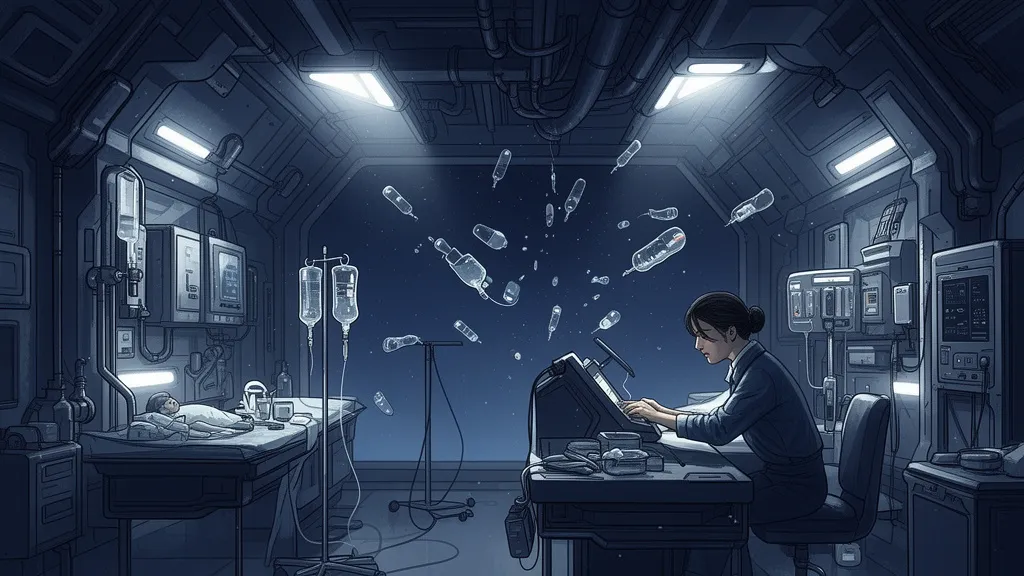
- 03:42 ZULU. The gravity centrifuge stuttered, a metallic hiccup that traveled up the spine of the station. In the surgical ward, the liquid in the IV bags rose in slow-motion crescents, drifting toward the bulkhead lights like jellyfish in a stagnant tide. Elena gripped the console. Her coffee, held in a weighted thermal cup, swayed four inches to the left of the internal magnetic seal.
“Stabilization sequence initiated,” the onboard system announced. The voice was flat, synthetic, devoid of the panic currently rising in the throat of the night supervisor, Miller. Miller did not look up from his screen. He tapped a sequence into the glass, smoothing out the telemetry reports for the morning handover.
“The thrusters are out of sync,” Elena said. She did not raise her voice. To shout would be to acknowledge that they were currently tumbling at an altitude of four hundred kilometers over the Pacific.
“They are recalibrating,” Miller replied. He swiped a list of patient vitals into the archive. “The inertia dampeners are compensating. Keep your eyes on the vitals, Elena. We have three patients in critical post-op. They don’t need a technician watching the ceiling.”
- 03:51 ZULU. The station tilted. The horizon, visible through the reinforced viewport, swung from a steady black velvet to a blurred streak of ionized neon as the satellite skirted the auroral fringe. Inside the ward, a saline bag collided with a bulkhead, the plastic stretching until it popped. The liquid didn’t splash; it formed a translucent globe, wobbling as it caught the light, and drifted toward the air circulation intake.
Elena moved to Bed 4. Patient 77-B, a routine lung replacement. She checked the monitor. The ECG trace was a flat, jagged rhythm—not the slow, rhythmic thump of a sedative-induced heart, but a frantic, rapid-fire vibration. It occurred at exactly 440 beats per minute.
She looked at the sensor pad. It was glued to the patient’s chest, the adhesive failing as the skin beneath it seemed to shift. There was no pulse in the neck. There was only the sound of a dry, scraping friction, like sandpaper dragged across silk.
- 03:59 ZULU. The observation drawer at the foot of Bed 4 was sealed with a lead-lined magnetic latch. It was designed to contain bio-hazardous waste until the morning pickup. Elena hesitated. The station’s automated triage logic dictated that any anomaly in a patient’s neurological or cardiovascular baseline that exceeded a 30 percent threshold required an immediate reporting sequence.
Reporting triggered the Emergency Containment Protocol.
If she hit the red input, the module would seal. The air would vent. The fire suppression system would trigger a flash-freeze of the internal cabin. By 04:00, the station would be a sterilized coffin, and she would be dead, along with Miller and the three patients.
“The drift is at 4.2 degrees,” Miller said. He sounded bored. “The orientation thrusters are unresponsive. I’ve submitted a ticket to Ground Control. They’ll respond after the sunrise window.”
Elena looked at the drawer. She reached out, her fingers hovering over the manual release.
“Miller, check the rhythm on 77-B.”
“I’ve seen it. It’s an electrical artifact. The centrifuge shift is feeding noise into the lead wires.”
“The rhythm is 440, Miller. That’s not noise.”
Miller turned. His face was gray, illuminated by the cold blue light of the monitors. He had been on this shift for twelve years. He had seen the station lose power, lose air, and lose its grip on the orbital decay curve. He had never seen someone question the triage log.
- 04:07 ZULU. Elena pulled the latch. The lock clicked, a sharp, violent sound in the near-silent cabin. She slid the drawer open.
The compartment was empty of the expected medical waste. There was no bandage, no discarded catheter, no used needle. Instead, the interior of the metal box was clouded with a thick, iridescent frost—condensate from the patient’s own biological cooling system.
In the center of the frosted metal, pressed into the surface from the underside, was a handprint.
It was not a human hand. The fingers were too long, possessing too many joints, pressing against the metal with enough force to warp the high-tensile steel. The impression wasn't made by a hand inside the drawer, but by something that had been pressed against the exterior of the station’s hull, its heat signature blooming into the metal, reaching through the layers of shielding as if the ship were made of paper.
Elena watched the handprint begin to shift. The fingers curled. A slight, screeching sound echoed through the ward—the sound of metal groaning under extreme, localized thermal stress.
The triage protocol dictates: Any biological entity displaying non-standard thermotropic properties shall be purged to maintain the integrity of the atmospheric envelope.
- 04:11 ZULU. The station rotated again, a sharp, jarring movement that sent chairs sliding across the floor. Miller was watching the screen now. He wasn't looking at the vital signs. He was looking at the external hull temperature sensor.
“The exterior is reading 4,000 degrees Celsius,” Miller whispered. “That’s impossible. We’re in the shadow of the Earth. There is no radiation source.”
“It’s not outside,” Elena said. She pushed the drawer shut, the metal latch resisting her as if something were holding it from the other side.
She reached for the emergency console. Her hand hovered over the button labeled VENT. It was a simple command. It would stop the drift. It would end the heat. It would satisfy the requirement for silence.
Outside the viewport, the stars were no longer points of light. They were streaks, distorted by the curvature of the atmosphere, or perhaps by something passing between the station and the void.
“If you vent it,” Miller said, his voice cracking, “the telemetry will prove we were responsible. Ground Control will find the biological anomalies in the logs. They’ll revoke our licenses. They’ll charge us with bio-contamination.”
“If I don't,” Elena said, “there won't be anyone left to charge.”
She looked at the handprint she had just trapped inside the box. It was vibrating. The metal was turning cherry-red, the paint peeling away in thin, blackened scales.
She looked at the monitors. The other two patients were starting to show the same rhythm. 440 beats per minute. A perfect, synchronized symphony of non-human hearts, all of them beating in time with the thruster failure.
Elena took her hand away from the VENT button. She looked at Miller. He had stopped moving. He was staring at his own hands, which were now pulsing with a faint, iridescent glow, the same color as the frost in the drawer.
She sat down in her chair and buckled the harness. She reached out and turned the monitor brightness to its minimum setting. The room went dark, save for the flickering of the interior lights and the steady, rhythmic hum of the station’s structural integrity failing.
Outside, the Pacific Ocean lay deep and dark, unaware that the hospital above it was no longer a hospital, and no longer a station.
- 04:15 ZULU. The silence returned. It was heavy, pressurized, and absolute. Elena watched the clock. The seconds ticked by, each one a measured, clinical failure. The handprint on the drawer was no longer visible; it had burned through the metal entirely, leaving a perfectly shaped hole that bled a thin, freezing mist into the cabin.
The station stopped spinning. It drifted, silent and empty, into the shadow of the world.