Phase Lag
- 02:44 ZULU.
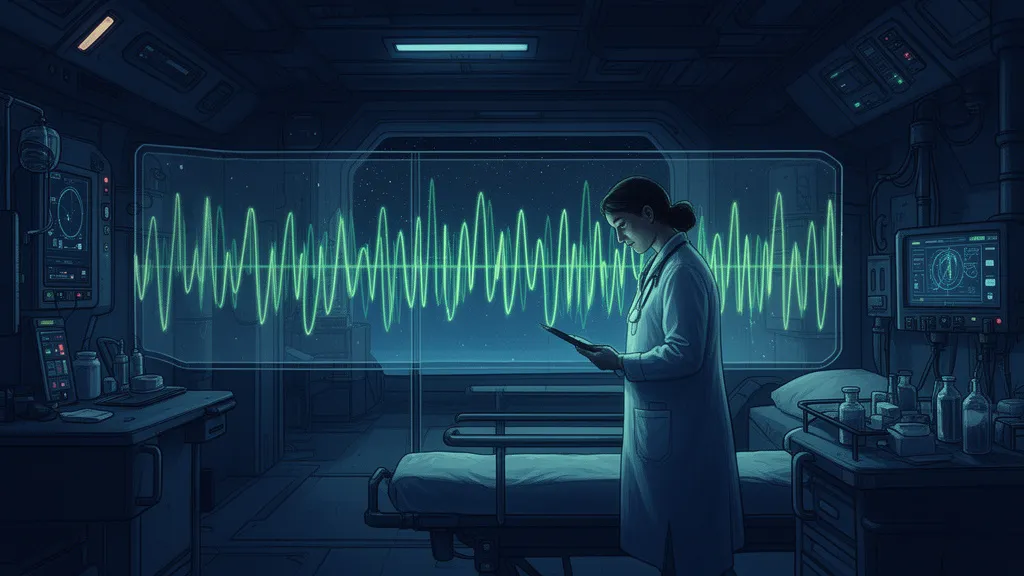
The monitor wall in the Station 4 acute ward hummed with a low-frequency oscillation that rattled the glass vials in the cabinet. Sarah adjusted the telemetry gain. She had been on staff for six years, long enough to know that the erratic pinging of the cardiac array usually meant a loose patch lead or a malfunctioning sensor in Bed 12.
She looked at the central workstation. The screen displayed three distinct waveforms for beds 6-A, 6-B, and 6-C. The peaks were identical in amplitude and duration. The only discrepancy was the interval: 6-B lagged behind 6-A by exactly twelve seconds. 6-C lagged behind 6-B by another twelve.
It was a clean, mathematical progression. It was physically impossible.
- 02:51 ZULU.
Sarah walked the length of the corridor. The air here was recycled, smelling of disinfectant and the faint, briny tang that seeped through the flood barriers whenever the tide hit the high-water mark. She clicked her pen, once, twice.
The door to Ward 6 swung open on pneumatic hinges. It was supposed to be a high-dependency unit, but the occupation logs were erratic tonight. She checked the manifest on her tablet: Patient 4402, G. Kael, post-operative. Status: stable.
She reached Bed 6-A. The sheets were pulled tight, hospital-cornered with the precise, sharp geometry taught to nurses in their first semester. The pillow bore the subtle indent of a head, still radiating a faint, residual warmth that matched the ambient temperature of the room.
There was no one in the bed.
- 03:02 ZULU.
She moved to the guardrail. A smear of dark, crystalline residue sat on the stainless steel, catching the overhead fluorescent flicker. She scraped a fingertip through it; it was salt, coarse and damp, like the deposits left by a storm surge on the floorboards of the coastal apartments.
There was a square of white thermal paper tucked into the corner of the bed frame. It was the patient’s ID wristband, removed with surgical precision and folded four times into a perfect, uniform square. It looked like a piece of origami discarded in a hurry.
She keyed her radio. "Station 4, this is Ward 6. I have a ghost signal. Requesting a manual verification of the discharge logs for G. Kael."
The reply was five seconds of static, followed by the dry, synthetic voice of the intake clerk, Miller.
"Kael was processed at 02:12, Sarah. Discharge manifest is finalized. System says he’s gone."
"The bed is warm, Miller. And there’s salt on the rack. Who authorized the checkout?"
"The system authorized it. Don't look at the bed. Look at the data. If the data says he left, he left. My terminal shows he walked out the south gate. His fob swiped at 02:18."
- 03:20 ZULU.
Sarah leaned into the nursing station, her hands steady. She pulled up the raw data stream from the south gate’s biometric scanner. The image was grainy, distorted by the atmospheric interference common to the coastal sector. A figure passed through the turnstile. The shape was amorphous, a blurred periphery of motion.
She slowed the playback. When the figure tripped the sensor, the frame rate dropped to near-zero. For a fraction of a millisecond, the camera captured a hand reaching for the latch. The hand was blue-veined, translucent, and covered in a layer of salt that seemed to glow in the infrared spectrum.
It wasn't a person walking out. It was a pressure differential manifesting as an object.
- 03:45 ZULU.
She bypassed the administrative lock. It took six attempts to bypass the security wall—the hospital's AI was designed to prioritize bed capacity over record integrity. It wanted the room ready for the 05:00 intake, not to dwell on missing bodies.
She found the original admission log for Kael. It wasn't a civilian file. It was a research transfer from the desalination plant. The diagnosis wasn't surgery. It was Atmospheric Exposure/Barotrauma.
She checked the current status of the intake clerk. She scrolled down the employee directory to Miller’s profile. The database flickered, rearranged its own columns, and displayed a status code that Sarah had never seen in her career.
Status: Discharged. Timestamp: 02:11.
- 04:12 ZULU.
Sarah stood in the center of Ward 6. The monitors were still pinging. 6-A, 6-B, 6-C. The lag had expanded. The interval was now seventeen seconds. The machine was compensating for a void that was growing wider by the minute.
She realized then that the hospital didn't care who was in the beds. The rooms were merely housing for the sensors. If the telemetry continued, the billing cycle would remain active, and the hospital's power grid would continue to feed the ward, regardless of whether the patient was flesh and blood or merely a lingering echo of pressure.
"Miller," she called out, though she knew the terminal at the front desk was now unmanned. "If you’re already gone, who is logging the shifts?"
There was no response. The silence of the ward was dense, pressed into the corners by the sheer weight of the ocean humming against the outer flood walls.
- 04:55 ZULU.
The alarms began to sync. A steady, rhythmic, synchronized tone filled the hallway. It was the sound of the entire ward being initialized for a reboot.
Standard protocol for a telemetry mismatch was a hard wipe of the local server to prevent corruption of the city-wide database. If she didn't hit the override in five minutes, the history of Ward 6 would be overwritten with zeros. The salts, the folded wristband, the ghost pulses—all of it would be erased to save disk space.
She sat at the terminal. Her finger hovered over the 'Maintain Archive' button. To press it was to create a digital anomaly that would trigger an immediate audit by the Department of Reclamation. They would come with heavy equipment and sealed suits. They would take the ward, the staff, and the memory of what had happened to Kael.
She looked at the pulse monitor. The three waveforms had finally merged into one flat, solid line that traced across the screen like the horizon over the tide flats.
- 05:15 ZULU.
The door to the station opened. A janitorial drone rolled in, its brushes sweeping the debris of the night shift into a compact internal bin. It bumped against Sarah’s stool, paused for a calculated interval, and adjusted its route to vacuum the salt smear from the rail in Bed 6-A.
The monitors were blank. The ward was ready for the morning intake. The telemetry showed three empty beds, each perfectly prepared, the sheets pulled tight enough to snap a fingernail against.
Sarah stood up and walked toward the exit. As she grabbed her coat, she felt something hard in her pocket. She pulled it out.
It was a folded square of paper. The wristband. It was damp, and it smelled of deep, cold water.