Pink Pressure
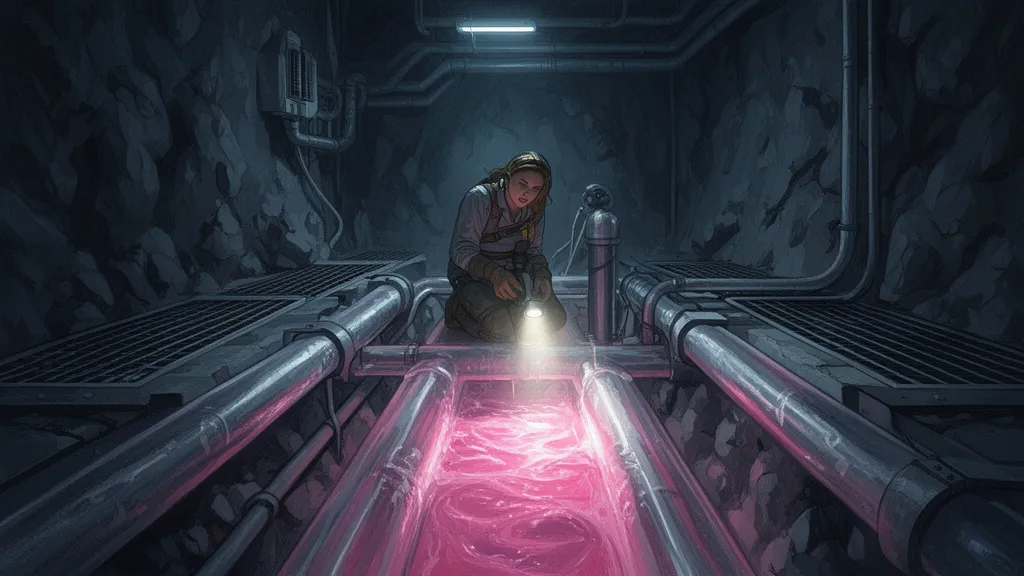
- 04:12 STATION TIME. The coolant trench hummed at a frequency that made the fillings in Mara’s molars ache. It was a low-cycle vibration, rhythmic and insistent, like a heavy heart muffled by two feet of reinforced lunar basalt. She adjusted her headlamp, the beam cutting through the gloom of the sub-level to strike the trench’s primary circulation loop. The liquid coolant was supposed to be a translucent, sterile cerulean.
It was the color of a bruised lung.
Mara knelt, her boots grating against the iron grate. She tapped a sensor against the transparent casing. The pink hue was not a dye. It was particulate, a suspension of biological matter so fine it looked like a cloud of static. As she watched, a filament of something darker, something the color of dried liver, drifted toward the intake valve.
- The maintenance log for Sector 4 showed no anomalies for the last 4,000 cycles. She pulled up the diagnostic feed on her wrist console. Efficiency was down 0.8 percent. It was a marginal deviation, the kind of data drift that usually warranted a firmware update rather than a physical inspection. But the pump was straining, its rotors grinding against the slurry.
She looked up. The trench stretched into the dark, vanishing beneath the bulkhead door that separated the coolant facility from the cargo bay. That bay was supposed to be locked, sealed by the automated inventory system six years ago. Status: Empty.
- Kael was in the mess hall when she returned. He was sitting at the end of the long, aluminum table, stirring a bowl of rehydrated protein mash with a plastic spoon. He didn’t look up. The station’s air recyclers kicked on, a sharp hiss that drowned out the distant vibration of the coolant pump.
“The pump is struggling, Kael,” Mara said. She didn't sit.
Kael stopped stirring. He didn’t move his head, but his eyes shifted toward the ventilation grate above them. “The pressure is internal, Mara. It’s looking for a way to equalize.”
His voice was wrong. It possessed a strange, layered texture, as if two different recordings were playing at once—his usual flat, weary baritone overlaid with a sibilant, wet whisper that felt like sand sliding down glass.
“I need the bypass code for the Cargo Bay,” she said, her voice remaining steady. “Something is fouling the coolant in the trench.”
Kael turned his head. His pupils were blown wide, black circles that seemed to swallow the light. “The code doesn't matter. The pod isn't empty. It was never empty. It was just waiting for the temperature to drop.”
- Mara walked to the communications array and pulled the local maintenance logs from the archival drive. She bypassed the AI-filtered summaries and accessed the raw, uncompressed video feed from the night the pod arrived.
Six years ago. The station was supposed to be a relay for deep-space telemetry. The pod had come in on an automated supply barge, tethered as ‘Surplus-Standard.’ It had been logged into the manifest by a system that hadn’t been updated since the colony project collapsed.
She scanned the footage. The loading arm had deposited the pod into the bay, the magnetic clamps locking with a thud that shook the camera mount. There was no documentation on the contents. Just a weight reading: 412 kilograms.
She checked the current weight.
412 kilograms.
It hadn’t lost mass, but it had grown in volume. The sensors now registered a bulge against the inner hull of the cargo bay, a stress fracture spreading across the bay door like a spiderweb. The structural integrity was at 64 percent and falling.
- The vibration grew. It was no longer coming from the coolant pump; it was coming from the floorboards, from the walls, from the very air she breathed. The entire station was becoming a resonant chamber for the cargo pod.
She went to the observation deck. The moon outside was a jagged ruin of crater walls and shadows. Far in the distance, a transport beacon blinked: a soft, rhythmic white light that offered no assistance.
“We are not going to make it to the next rotation,” Kael said. He stood in the doorway. He was holding his hand against the bulkhead, his fingers splayed. She saw the pink filament—the same stuff from the coolant—seeping from under his fingernails, trailing into the grout of the floor.
“How long have you been leaking?” she asked.
“Since I checked the seal,” Kael replied. His voice was becoming a chorus now, a cacophony of voices that didn't sound human. “It’s very cold in there. It was so hungry for heat.”
- The math was simple. If she opened the pod, the contamination would vent into the station’s atmosphere. The life support system would be overwhelmed in minutes. The station would be a tomb, but a stable one.
If she kept the pod sealed, the rising internal pressure would eventually breach the bay wall. The resulting explosive decompression would tear the station apart. The debris would be scattered across the lunar plain.
She walked to the console. The bypass code was a string of twelve hexadecimal characters. Kael watched her, his expression vacant, his skin now mapped with fine, arterial-red lines that pulsed in time with the station's vibration.
“If you open it,” he whispered, “you can see what we were waiting for.”
- 06:14 STATION TIME. Mara placed her fingers over the interface. The station was groaning, the sound of metal yielding to an impossible, organic force. The coolant in the trench was no longer fluid; it was a solid, throbbing mass of pink, pushing against the reinforced viewports.
She thought about the maintenance logs, the dry reports, the long hours of silent, routine work. She thought about the transport beacon, blinking its empty, automated pulse.
She typed the first four characters.
The station shivered, a deep, tectonic tremor that knocked her to her knees. The pink liquid surged up from the vents, slick and warm, coating the floor in a thin, iridescent film. It didn’t smell like blood. It smelled like ionized air and old, wet dust.
She looked at the pod status one last time.
Status: Breaching.
She closed her eyes. The hum of the station stopped, replaced by a sudden, absolute silence. Then, the sound of a seal failing—a long, slow hiss of escaping air that sounded remarkably like a sigh.
She hit the final key.